

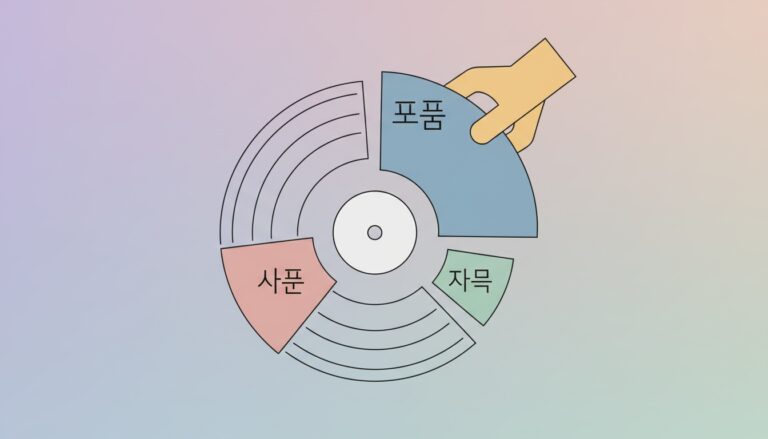
🎧 Who Really Gets the Money in K-Pop? Decoding Copyrights
Phase 1: Introduction
Hello! This is your Chief Editor from Daily Hangul.
So, you are reading articles about the K-Pop industry, maybe analyzing why your favorite indie artist is struggling despite having a million streams. You stumble upon a heated debate about “streaming fees” and “distribution rates.”
At a C1 (Advanced) level, saying “Musicians need more money” is too simple. You want to discuss the structural issues of the industry.
Today, we are diving deep into the Music Copyright Royalty Distribution Structure (음원 저작권료 분배 구조). This isn’t just vocabulary; it’s business Korean that will make you sound like an industry insider or an entertainment lawyer. Let’s decode the system.
Phase 2: Deep Dive (Core Expressions)
Here are the three heavy-hitter terms you need to discuss industry economics.
1. 저작권료 (Jeojakkwollyo)
- Pronunciation: [Jeo-jak-kwon-nyo] Sounds like ‘Juh-jak’ + ‘kwon’ (like Taekwondo) + ‘nyo’.
- Meaning: Copyright Royalties
- Editor’s Insight: This is the umbrella term. However, in conversation, we often distinguish between composition royalties and performance royalties. Note the pronunciation change: the ㄹ (l) sound turns into a ㄴ (n) sound due to nasal assimilation.
- Situation Check: Formal/Professional. Used in news, contracts, and serious discussions.
2. 수익 배분율 (Suik Baebunyul)
- Pronunciation: [Su-ik Bae-bun-nyul]
- Meaning: Profit Distribution Rate / Profit Split Ratio
- Editor’s Insight: You might know ‘나누다’ (to divide), but at the C1 level, we use 배분 (distribution) or 분배. When discussing the exact percentage (like 60:40), use ‘요율’ (rate) or ‘배분율’ (split ratio).
- Situation Check: Business. “The split ratio is unfair” = “수익 배분율이 불공정해요.”
3. 저작인접권 (Jeojaginjeopkwon)
- Pronunciation: [Jeo-ja-gin-jeop-kwon]
- Meaning: Neighboring Rights (Rights of performers and producers, distinct from authors)
- Editor’s Insight: This is the killer C1 term. Singers don’t usually own the “copyright” (composition); they own the “neighboring rights” as performers. Knowing this distinction instantly elevates your status from ‘learner’ to ‘expert’.
- Situation Check: Technical/Legal. Use this when explaining why a singer might not get paid when their song is covered by someone else.
Phase 3: Textbook vs. Real Life
Let’s compare how a standard student speaks versus how a music industry staffer talks.
| Textbook / Standard (C1) | Real Life / Industry Lingo (Native) |
|---|---|
| 돈을 정산받다 (To receive the settlement money) | 정산이 터지다 (For the settlement to ‘burst’ – meaning to finally get paid a significant amount) |
| 가져가는 몫이 적다 (The share they take is small) | 파이가 작다 (The ‘pie’ is small – metaphor for market size) |
| 수수료를 떼다 (To deduct the commission) | 떼주다 / 떼이다 (To give a cut / To have a cut taken off – nuances of reluctance) |
Editor’s Note: Using “파이 (Pie)” to talk about market share or profit pool is extremely common in Korean business contexts, just like in English.
Phase 4: Cultural Context & Manners
🇯🇷 The “Gap-Eul” (갑을) Relationship in Creativity
In Korea, contracts are often described through the Gap (갑 – The one with power) and Eul (을 – The one providing service) dynamic.
When discussing copyright distribution, the conversation almost always touches on whether the Platform (Melon, Genie, Spotify) acts as a “Super Gap” (슈퍼 갑) over the Creators (changjakja).
- Nunchi Tip: If you are talking to an artist or a songwriter, never ask, “So, how much is your copyright income?” (저작권료 얼마 받으세요?). Instead, criticize the system to show empathy: “The platform fees are too high these days, aren’t they? It must be tough for creators.” (요즘 플랫폼 수수료가 너무 높죠? 창작자분들이 힘들겠어요.)
Phase 5: Real-Life Scenario (Roleplay)
Setting: Two friends discussing a news article about low royalty payments for indie artists in a quiet cafe.
Characters:
* Min-ji (Korean): Works at a music distribution company.
* Alex (You): Passionate about the Korean music industry.
Dialogue:
Alex: (Sighing while looking at phone)
와, 스트리밍 수익의 35%를 플랫폼이 가져간다는 게 사실이야?
(Wa, seuteuriming suige 35%reul peullaepomi gajyeogandaneun ge sasiriya?)
Wow, is it true that platforms take 35% of streaming revenue?
Min-ji:
사실이지. 그래서 정작 실연자한테 돌아가는 몫은 6% 정도밖에 안 돼.
(Sasiriji. Geuraeseo jeongjak siryeonjahante doraganeun mokseun 6% jeongdo-bakke an dwae.)
It is true. So the share that actually goes back to the performers is only about 6%.
Alex:
구조가 너무 기형적인데? 이러니 창작자들이 정당한 보상을 못 받는다고 하지.
(Gujoga neomu gihyeongjeoginde? Ireoni changjakjadeuri jeongdanghan bosangeul mot banneundago haji.)
The structure is too deformed (abnormal), isn’t it? No wonder creators say they aren’t receiving fair compensation.
Min-ji:
(Nodding) 맞아. 그래서 요즘은 유통사를 거치지 않고 직접 음원을 내는 경우도 많아.
(Maja. Geuraeseo yojeumeun yutongsareul geochiji anko jikjeop eumwoneul naeneun gyeongudo mana.)
Right. That’s why these days, there are many cases where they release music directly without going through a distributor.
Phase 6: 10-Second Shadowing
Read this aloud to practice the flow of a logical argument. Focus on the pauses /.
“The problem is that the platform’s commission fees are set too high compared to the creators’ effort.”
문제는 / 창작자의 노력에 비해 / 플랫폼 수수료가 / 지나치게 높게 책정되어 있다는 점입니다.
(Munjeneun / changjakjaui noryeoge bihae / peullaepom susuryoga / jinachige nopge chaekjeong-dweeo itdaneun jeom-imnida.)
Key Point: Emphasize ‘지나치게 (excessively)’ to sound more persuasive.
Phase 7: FAQ & Troubleshooting
Q: Can I use the word ‘월급’ (salary) for artists?
A: No. Artists usually receive ‘정산금’ (settlement money) or ‘인세’ (royalties). ‘월급’ implies they are regular employees, which most artists are not (unless they are trainees receiving an allowance, but even that isn’t ‘salary’).
Q: Is it okay to say ‘돈을 뜯기다’ (to have money ripped off) regarding fees?
A: It’s very casual and slightly aggressive. Use it only with close friends when complaining on behalf of the artist. In a formal discussion, use ‘수수료가 공제되다’ (fees are deducted).
Phase 8: Wrap-up
One-Liner Summary:
When discussing music money, move beyond ‘money’ (돈) and use ‘Royalty’ (저작권료), ‘Distribution’ (배분), and ‘Commission’ (수수료).
Your Mission:
Find a news article about K-Pop earnings. Try to find the word ‘정산’ (Settlement). If you see it, nod knowingly.
Comment below:
Do you think the 35% platform fee is fair? How is it in your country? Let me know in Korean! (e.g., “저희 나라에서는…”)
Phase 9: Quiz
1. Which term refers to the rights of the singer or performer, distinct from the composer?
a) 저작인격권 (Moral Rights)
b) 저작인접권 (Neighboring Rights)
c) 소유권 (Ownership)
2. Which verb is most appropriate for ‘setting’ a price or fee rate officially?
a) 만들다 (Make)
b) 책정하다 (Appropriate/Set)
c) 쓰다 (Write)
3. If a platform takes a fee, we say they ___ the fee.
a) 떼다 (Deduct/Take)
b) 찢다 (Tear)
c) 줍다 (Pick up)
(Answers: 1. b, 2. b, 3. a)
Frequently Asked Questions (FAQ)
Q: What does "저작권료 (Jeojakkwollyo)" mean in Korean and how do you pronounce it?
A: In Korean, "저작권료 (Jeojakkwollyo)" is pronounced [Jeo-jak-kwon-nyo] and means: Copyright Royalties
Q: What does "수익 배분율 (Suik Baebunyul)" mean in Korean and how do you pronounce it?
A: In Korean, "수익 배분율 (Suik Baebunyul)" is pronounced [Su-ik Bae-bun-nyul] and means: Profit Distribution Rate / Profit Split Ratio
Q: What does "저작인접권 (Jeojaginjeopkwon)" mean in Korean and how do you pronounce it?
A: In Korean, "저작인접권 (Jeojaginjeopkwon)" is pronounced [Jeo-ja-gin-jeop-kwon] and means: Neighboring Rights (Rights of performers and producers, distinct from authors)







