

Phase 1: Introduction
Hello! This is your Lead Editor at Daily Hangul.
Have you ever watched a K-Drama scene where the main character is sighing deeply at a Pojangmacha (street food stall), staring at a shot of Soju? In that moment, you want to reach through the screen and say something more meaningful than just “Fighting!” (Hwaiting).
Giving comfort in Korea is an art form. It’s less about giving advice and more about acknowledging the struggle. If you use the wrong phrase, you might sound like a distant textbook robot. But if you get this right? You become the friend they want to call first when life gets tough.
Today, I’ll share the secrets I’ve taught my students over the years—how to truly “pat someone on the shoulder” with your words.
Phase 2: Deep Dive (Core Expressions)
Here are the top 3 expressions chosen by our tutoring team for B1 level learners. These go beyond the basics.
1. 고생했어요 (Gosaeng-haesseoyo)
- Pronunciation: [Go-saeng-hae-sseo-yo]
- Sound Tip: ‘Go’ as in Go, ‘Saeng’ sounds like Sang (past of sing), ‘Hae’ like Hay.
- Meaning: You went through hardship / You worked hard.
- Editor’s Insight: This is the MVP of Korean empathy. In English, saying “You suffered” sounds dramatic. In Korean, it is the warmest way to validate someone’s effort. It says, “I saw how hard you tried.”
- Situation Check: Safe for colleagues and friends. For elders/bosses, upgrade to “고생하셨습니다” (Go-saeng-ha-shyeot-seum-ni-da).
2. 다 잘 될 거예요 (Da jal doel geo-ye-yo)
- Pronunciation: [Da jal doel geo-ye-yo]
- Sound Tip: ‘Doel’ is tricky; try combining Duh + L quickly.
- Meaning: Everything will turn out well.
- Editor’s Insight: This is the classic optimistic reassurance. Use this when someone is anxious about a future result (like a test or interview).
- Situation Check: Politeness level is high (honorific), so it’s good for most general relationships.
3. 기운 내요 (Gi-un nae-yo)
- Pronunciation: [Gi-un nae-yo]
- Meaning: Cheer up / Energize yourself.
- Editor’s Insight: This is softer and more affectionate than the energetic “Hwaiting!” It’s like offering a warm cup of tea verbally.
- Situation Check: Good for friends or close colleagues.
Phase 3: Textbook vs. Real Life
Textbooks teach you to describe emotions. Real Koreans fix emotions with food and empathy.
| Textbook (Correct but Stiff) | Real Life (What we actually say) |
|---|---|
| 슬퍼하지 마세요. (Don’t be sad.) | 맛있는 거 먹으러 가자! (Let’s go eat something delicious!) |
| 걱정하지 마세요. (Don’t worry.) | 무슨 일 있어? (Did something happen? / Is something wrong?) |
| 힘내세요. (Cheer up.) | 오늘 내가 살게. (My treat today. / I’ll buy today.) |
Editor’s Note: At the B1 level, suggesting an action (eating, drinking, hanging out) is often the most powerful form of consolation!
Phase 4: Cultural Context & Manners
The Art of “Todak Todak” (토닥토닥)
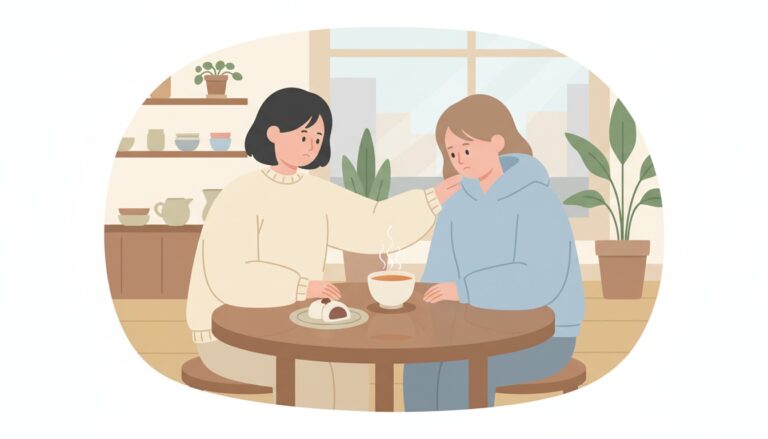
In Korea, there is an onomatopoeia for gently patting someone on the back or shoulder: 토닥토닥 (To-dak To-dak).
- The Gesture: If you are close friends (same gender usually, or very close), a light pat on the shoulder while saying “Go-saeng-haesseoyo” is very powerful.
- Nunchi (Eye-measure): If someone is crying or really angry, don’t ask “Why?” immediately. Just offering a tissue or a drink shows better Nunchi than interrogating them about the details.
Phase 5: Real-Life Scenario (Roleplay)
Setting: A cafe. Minji looks depressed because she made a mistake at work. Alex (You) tries to comfort her.
Alex: (Noticing Minji’s sigh)
민지 씨, 무슨 일 있어요? 표정이 안 좋아요.
(Minji-ssi, museun il isseoyo? Pyo-jeong-i an jo-a-yo.)
Minji, is something wrong? You don’t look good.
Minji: 아, 오늘 발표를 망쳤어요… 팀장님한테 혼났어요.
(Ah, I ruined the presentation today… I got scolded by the team leader.)
Alex: (Gently nodding)
저런… 준비 많이 했잖아요. 진짜 고생했어요.
(Jeo-reon… jun-bi ma-ni haet-ja-na-yo. Jin-jja gosaeng-haesseoyo.)
Oh no… You prepared so much. You really worked hard/suffered.
Minji: 속상해 죽겠어요.
(I’m so upset I could die.)
Alex: 너무 걱정하지 마세요. 다음엔 다 잘 될 거예요. 나가서 매운 거 먹을까요?
(Neo-mu geok-jeong-ha-ji ma-se-yo. Da-eum-en da jal doel geo-ye-yo. Na-ga-seo mae-un geo meo-geul-kka-yo?)
Don’t worry too much. Next time it will all go well. Shall we go eat something spicy?
Phase 6: 10-Second Shadowing
Read this aloud to practice your intonation. Pause where the / marks are.
“지난 일은 / 잊어버려요. / 제가 / 항상 응원할게요!”
(Ji-nan i-reun / i-jeo-beo-ryeo-yo. / Je-ga / hang-sang eung-won-hal-ke-yo!)
Forget about / the past things. / I will / always root for you!
Phase 7: FAQ & Troubleshooting
- Q: Can I say “Fighting!” (Hwaiting) to my boss who is having a hard time?
- A: It’s a bit risky. “Hwaiting” is casual energy. To a superior, it’s better to say “힘내십시오” (Him-nae-sip-si-o) or simply “고생 많으셨습니다” (You suffered a lot) when they finish a task.
- Q: Is it rude to offer to buy food?
- A: Never! In Korea, “bab” (food) is love. Offering to buy a meal is the ultimate sign of caring.
Phase 8: Wrap-up
One-Liner Summary: comfort in Korea is 50% saying “You suffered” (Gosaeng-haesseoyo) and 50% offering delicious food.
Action Mission: Next time you see a friend or coworker finish a long task, don’t just say “Good job.” Try saying, “Gosaeng-haesseoyo!” with a warm smile.
Tell me in the comments: What is your “Soul Food” when you are feeling down? I’ll recommend the Korean equivalent!
Phase 9: Quiz
1. Your friend failed a test. Which phrase is the BEST specifically for acknowledging their effort?
A) 축하해요 (Congratulations)
B) 고생했어요 (You suffered/worked hard)
C) 빨리 하세요 (Do it quickly)
2. Which is the most natural “Real Life” way to comfort a sad friend?
A) Suggesting to eat something good.
B) Reciting a poem.
C) Ignoring them.
3. What is the sound effect for patting someone gently?
A) Kung-Kung
B) Bang-Bang
C) Todak-Todak
(Answers: 1. B, 2. A, 3. C)
Frequently Asked Questions (FAQ)
Q: What does "고생했어요 (Gosaeng-haesseoyo)" mean in Korean and how do you pronounce it?
A: In Korean, "고생했어요 (Gosaeng-haesseoyo)" is pronounced [Go-saeng-hae-sseo-yo] and means: a key conversational Korean expression covered in this lesson.
Q: What does "다 잘 될 거예요 (Da jal doel geo-ye-yo)" mean in Korean and how do you pronounce it?
A: In Korean, "다 잘 될 거예요 (Da jal doel geo-ye-yo)" is pronounced [Da jal doel geo-ye-yo] and means: a key conversational Korean expression covered in this lesson.
Q: What does "기운 내요 (Gi-un nae-yo)" mean in Korean and how do you pronounce it?
A: In Korean, "기운 내요 (Gi-un nae-yo)" is pronounced [Gi-un nae-yo] and means: Cheer up / Energize yourself.







