

Phase 1: Introduction
Hello! This is your Chief Editor from Daily Hangul.
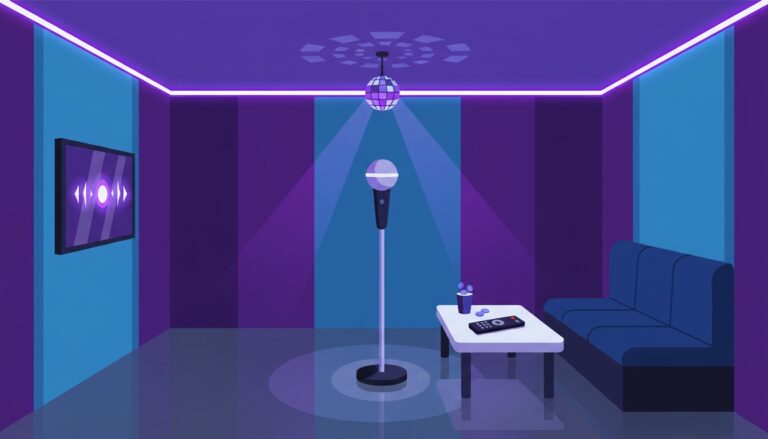
Have you ever had one of those days? Your boss gave you vague feedback, the subway was packed, and you just want to scream. In many cultures, you might go to a pub or hit the gym. But in Korea, we have a magical, neon-lit cure called “Coin Norebang” (Coin Karaoke).
I’ve seen many of my students stand in front of these tiny booths, clutching a 1,000 won bill, too afraid to go in because they don’t know how to operate the remote or what to say to their friends.
Today, we are going to learn how to relieve stress the Korean way. By the end of this lesson, you’ll be able to invite a friend to a “Coin Norebang” and sing your heart out like a true local. This guide is based on real questions from students who wanted to know: “Is it okay to go alone?” and “What does the remote control say?”
Phase 2: Deep Dive (Key Phrases)
Here are the three most important phrases you need to survive (and enjoy) a karaoke session.
1. 스트레스 풀다 [seuteureseu pulda]
- Pronunciation: Su-teu-re-su pool-da (The ‘pool’ sounds like a swimming pool.)
- Meaning: To relieve stress (Literal: To untie/unravel stress)
- Editor’s Insight: In English, we “manage” or “relieve” stress. In Korean, we imagine stress as a tangled knot that needs to be untied (풀다). It feels very satisfying to say!
- Situation Check: ✅ Casual (Friends) | ✅ Formal (Colleagues – if you add ‘요’ at the end)
2. 지르다 [jireuda]
- Pronunciation: Jee-reu-da (‘Jee’ like G-whiz, ‘reu’ is tricky—smile wide and make a disgusted sound like ugh!)
- Meaning: To shout / To scream / To sing loudly
- Editor’s Insight: You don’t just “sing” at a karaoke; you scream (지르다) high notes. If you say “소리 질러!” (Sori jilleo!) at a concert, it means “Make some noise!”
- Situation Check: ✅ Casual (Very common when encouraging friends)
3. 예약하다 [yeyakhada]
- Pronunciation: Ye-yak-ha-da (‘Ye’ like Yes)
- Meaning: To reserve / To book
- Editor’s Insight: You know this word for hotels, but in a Karaoke room, this is the most critical button on the remote. It queues your song so it plays next. Don’t press ‘Start’ (시작) immediately, or you’ll cut off your friend’s song!
- Situation Check: ✅ Universal
Phase 3: Textbook vs. Real Life
How to sound less like a robot and more like a Seoulite.
| Textbook Korean (Standard) | Real Life Korean (Spoken/Slang) |
|---|---|
| 노래방에 갈래요? (Shall we go to the singing room?) |
코노 갈래? (Wanna hit the ‘Kono’?) |
| 고음이 잘 안 나와요. (The high notes aren’t coming out well.) |
오늘 목이 좀 잠겼어. (My throat is a bit locked/hoarse today.) |
| 1,000원에 몇 곡이에요? (How many songs for 1,000 won?) |
여기 천 원에 몇 곡? (How many for 1k here?) |
💡 Bottom Note: ‘코노’ (Kono) is the abbreviation for 코인 노래방 (Coin Norebang). If you use this word, Koreans will assume your level is much higher than B1!
Phase 4: Cultural Context & Manners
1. The “Hon-Kono” (혼코노) Trend
Unlike Western karaoke which is often in a public bar, Korean Coin Karaoke is private. It is perfectly normal—and trendy—to go alone. This is called Hon-Kono (Alone + Coin Karaoke). It’s the ultimate B1 level cultural experience.
2. The Remote Control Etiquette (Nunchi)
* Never press ‘취소’ (Cancel) while someone else is singing, even if they are terrible.
* Never press ‘우선예약’ (Priority Reserve) to jump the queue unless everyone agrees. It’s considered very rude!
3. Hygiene
Most places have disposable microphone covers (마이크 커버) at the entrance. Grab a pack (usually 2 pieces) before you enter the booth. It shows you are clean and considerate.
Phase 5: Roleplay Script
Setting: Friday night. Two friends, Minji (Korean) and Sam (Foreigner), are walking past a Coin Karaoke.
Minji: 아, 이번 주 일 너무 많았어. 머리 아파.
(Ah, too much work this week. My head hurts.)
Sam: 나도 그래. 우리 스트레스 좀 풀까?
(Me too. Shall we relieve some stress?)
Minji: 오, 좋아! 저기 코노 보이는데 들어갈래?
(Oh, good! I see a Kono over there, wanna go in?)
Sam: 좋아! 나 오늘 고음 제대로 지를 거야. (enters booth)
(Great! I’m going to properly scream the high notes today.)
Minji: (Handing the remote) 자, 너 먼저 예약해.
(Here, you reserve first.)
Sam: (Looks at remote) 어? ‘시작’ 버튼 누르면 안 되지?
(Uh? I shouldn’t press ‘Start’, right?)
Minji: 응! 번호 누르고 꼭 ‘예약’ 눌러!
(Yep! Press the number and make sure to press ‘Reserve’!)
Phase 6: 10-Second Shadowing
Read this aloud to practice your intonation. The / indicates a short pause for breath.
“오늘 스트레스 쌓였는데, / 코노 가서 / 딱 30분만 / 놀다 갈까?”
(I’m stressed out today, / shall we go to Kono / and play for just 30 mins / then go?)
Phase 7: FAQ & Troubleshooting
- Q: Can I bring alcohol inside a Coin Karaoke?
- Answer: NO. Most Coin Karaokes are youth-friendly zones. Alcohol is strictly prohibited. You can bring water or non-alcoholic beverages (often sold in vending machines inside).
- Q: What if I don’t have cash?
- Answer: While the name is “Coin” Karaoke, most modern machines accept credit cards (look for the card reader attached to the machine) or have a bill exchanger (지폐 교환기) for 5,000/10,000 won notes.
Phase 8: Wrap-up & Mission
Today’s Summary:
Stress isn’t managed; it is untied (풀다)! And the best place to do it is at a Kono (코노) by screaming (지르다) your favorite song.
Your Mission:
Next time you pass a Coin Karaoke, go inside! Even if you don’t sing, just look at the remote control and find the ‘예약’ (Reserve) button. If you’re brave, put in 1,000 won (usually 2-3 songs) and sing one song alone!
Tell me in the comments: What is your “go-to” karaoke song that helps you relieve stress?
Phase 9: Pop Quiz
- What is the slang word for “Coin Karaoke”?
- a) Nok-bang
- b) Kono
- c) Coin-bang
- If you want to queue a song without interrupting the current one, which button do you press?
- a) 시작 (Start)
- b) 취소 (Cancel)
- c) 예약 (Reserve)
- How do Koreans say “relieve stress”?
- a) 스트레스를 먹다 (Eat stress)
- b) 스트레스를 풀다 (Untie stress)
- c) 스트레스를 자다 (Sleep stress)
Click to see answers
1. b) Kono
2. c) 예약 (Reserve)
3. b) 스트레스를 풀다
Frequently Asked Questions (FAQ)
Q: What does "스트레스 풀다 [seuteureseu pulda]" mean in Korean and how do you pronounce it?
A: In Korean, "스트레스 풀다 [seuteureseu pulda]" is pronounced [Su-teu-re-su pool-da (The 'pool' sounds like a swimming pool.] and means: To relieve stress (Literal: To untie/unravel stress)
Q: What does "지르다 [jireuda]" mean in Korean and how do you pronounce it?
A: In Korean, "지르다 [jireuda]" is pronounced [Jee-reu-da ('Jee' like G-whiz, 'reu' is tricky—smile wide and make a disgusted sound like ugh!] and means: To shout / To scream / To sing loudly
Q: What does "예약하다 [yeyakhada]" mean in Korean and how do you pronounce it?
A: In Korean, "예약하다 [yeyakhada]" is pronounced [Ye-yak-ha-da ('Ye' like Yes] and means: To reserve / To book







