

Phase 1: Introduction
Hello! It’s your Daily Hangul Editor. 👋
Imagine this: You’ve been invited to a Korean friend’s house for Seollal (Lunar New Year). You sit down, the table is full of delicious food, and suddenly an elder looks at you and asks:
“Did you eat your age yet?”
Wait, what? Eat my age? Is that a side dish?
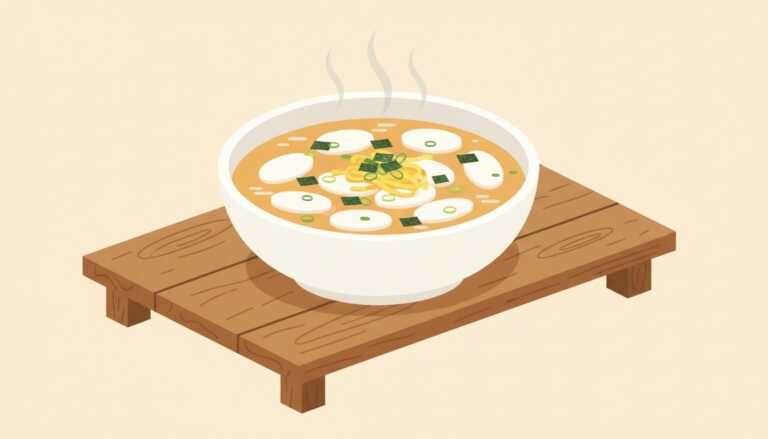
Don’t panic! They are talking about Tteokguk (떡국), the sliced rice cake soup. In Korea, there is an old saying that you don’t truly turn a year older until you finish a bowl of this soup on New Year’s Day.
Today, I’ll teach you how to survive this “soup interview” and impress the locals with your manners. Trust me, knowing this will make you the favorite guest instantly!
Phase 2: Deep Dive into Key Expressions
Here are the top 3 expressions you need for a Tteokguk situation.
1. 떡국 드셨어요?
- Pronunciation: [Tteok-guk deu-syeo-sseo-yo?]
- Sound-alike: Think of “Duck” (the bird) + “Cook” (cooking) + “Deu-syeo-sseo-yo?”
- Meaning: Did you eat Tteokguk (Rice Cake Soup)?
- Editor’s Insight: This isn’t just asking about your lunch menu. On New Year’s morning, this is basically saying, “Did you celebrate the New Year properly?”
- Situation Check: ✅ Formal/Polite (Use with elders or people you don’t know well).
2. 한 살 더 먹었어요.
- Pronunciation: [Han sal deo meo-geo-sseo-yo.]
- Meaning: (Literal) I ate one more year. / (Real) I turned one year older.
- Editor’s Insight: In Korean, we use the verb 먹다 (to eat) for both food and age! It’s a cute way to say you’ve aged. Even though the legal age system in Korea has changed to the international standard recently, culturally, we still joke about “eating age” with soup.
- Situation Check: ✅ Casual/Polite (Standard polite form).
3. 국물이 시원해요!
- Pronunciation: [Gung-muri si-won-hae-yo!]
- Meaning: The broth is refreshing!
- Editor’s Insight: Wait, ‘Siwonhada’ usually means ‘cool’ (temperature), right? But when eating hot soup, it means the flavor is deep, savory, and relieves stress. If you say this while eating hot Tteokguk, Koreans will look at you with amazed eyes and say, “You are truly Korean now!”
- Situation Check: ✅ Common (Use it as a reaction while eating).
Phase 3: Textbook vs. Real Life
Let’s make you sound natural, not like a robot.
| Textbook (Stiff 🤖) | Real Life (Natural ✨) |
|---|---|
| 떡국을 좋아합니까? (Do you like Tteokguk?) |
떡국 좋아해요? (Do you like Tteokguk? – Particles dropped) |
| 맛있습니다. (It is delicious.) |
와, 이거 진짜 맛있어요. (Wow, this is really tasty.) |
| 나이를 한 살 더 먹었습니다. (I ate one more year of age.) |
이제 진짜 어른이네요. (Now I’m really an adult/grown-up.) |
💡 Editor’s Note: At A2 level, dropping particles like ‘을/를’ in speech makes you sound much more comfortable with the language!
Phase 4: Cultural Context & Manners (Nunchi Time)
👀 The “Bowl” Rule
In many Western cultures, it’s okay to lift a soup bowl to drink the last drop. In Korea? Keep that bowl on the table!
- Why? Historically, holding a bowl was considered low-class (like a beggar). Use your spoon (숟가락) to scoop the broth. Tilt the bowl slightly away from you only at the very end.
👀 The “Garnish” Respect
Tteokguk usually has beautiful garnish (eggs, seaweed, beef) on top called Gomyung (고명). Don’t stir it into a mess immediately. Take a moment to admire it and say, “너무 예뻐요” (It’s so pretty) before eating. That’s good Nunchi (sense)!
Phase 5: Real-Life Scenario
📍 Setting: You are visiting your Korean friend Minji’s house for New Year’s lunch.
👥 Characters: You (Guest), Minji’s Mom (Korean Elder)
(Minji’s Mom puts a hot bowl of soup in front of you)
Minji’s Mom: 자, 많이 먹어요. 떡국 좋아해요?
(Ja, mani meogeoyo. Tteokguk joaheoyo?)
Here, eat a lot. Do you like Tteokguk?
You: (Smiling broadly) 네, 정말 좋아해요! 냄새가 너무 좋아요.
(Ne, jeongmal joaheoyo! Naemsaega neomu joayo.)
Yes, I really like it! The smell is so good.
Minji’s Mom: 이거 먹으면 한 살 더 먹는 거예요. 알죠?
(Igeo meogeumyeon han sal deo meongneun geoyeyo. Aljyo?)
If you eat this, you eat one more year (age). You know that, right?
You: (Pretending to be worried) 아, 그럼 조금만 먹을까요?
(Ah, geureom jogeumman meogeulkkayo?)
Ah, then should I eat only a little?
Minji’s Mom: (Laughing loud) 하하하! 농담도 잘하네.
(Hahaha! Nongdamdo jalhane.)
Hahaha! You are good at joking.
Phase 6: 10-Second Shadowing Drill
Let’s practice the rhythm. Read this aloud while imagining the savory smell of the soup.
“떡국 한 그릇 먹고 / 진짜 한국인 / 됐어요!”
(Tteokguk han geureut meok-go / jin-jja Han-guk-in / dwae-sseo-yo!)
Guide:
* 떡국 (Tteokguk): Stress the first syllable tightly.
* / : Pause slightly here.
* Meaning: “I ate a bowl of Tteokguk and became a real Korean!”
Phase 7: FAQ & Troubleshooting
Q: Do I really have to finish the whole bowl?
A: It is polite to finish the rice cakes (tteok), but it’s okay to leave some broth if you are full. If you leave the rice cakes, grandmas might worry you won’t grow up!
Q: Can I put Kimchi in it?
A: Absolutely! YES! Tteokguk is mild and savory. Eating it with Kimchi is the perfect combination. If you place a piece of Kimchi on your spoon with the soup, you get A+ for eating skills.
Phase 8: Wrap-up
📝 Today’s Summary:
In Korea, we “eat” age along with Tteokguk on New Year’s. It’s about sharing warmth and good fortune.
🚀 Your Mission:
If you are near a Korean restaurant or convenience store, try to find a “Tteokguk” cup noodle. Take a picture and tell yourself, “Han sal deo meo-geo-sseo-yo!” (I got one year older!).
Tell me in the comments:
What is the “New Year’s Food” in your country? I’m curious! 👇
Phase 9: Quick Quiz
1. What does “Han sal deo meogeosseoyo” mean literally?
a) I ate one more bowl of rice.
b) I ate one more year.
c) I ate delicious beef.
2. Which is proper table manner for soup in Korea?
a) Lift the bowl to your mouth.
b) Use a straw.
c) Leave the bowl on the table and use a spoon.
3. How do you say “The broth is refreshing/good”?
a) Gukmuri Siwonhaeyo! (국물이 시원해요!)
b) Gukmuri Chuwoyo! (국물이 추워요!)
c) Gukmuri Appayo! (국물이 아파요!)
Click to see answers!
1. b) I ate one more year.
2. c) Leave the bowl on the table.
3. a) Gukmuri Siwonhaeyo!
Frequently Asked Questions (FAQ)
Q: What does "먹다" mean in Korean and how do you pronounce it?
A: In Korean, "먹다" is pronounced [to eat] and means: for both food and age! It’s a cute way to say you've aged. Even though the legal age system in Korea has changed to the international standard recently, culturally, we still joke about "eating age" with soup.
Q: What does "떡국" mean in Korean and how do you pronounce it?
A: In Korean, "떡국" is pronounced [Tteokguk] and means: Stress the first syllable tightly.







