

Phase 1: Introduction
Hello! This is your Daily Hangul Editor. 👋
So, you’ve mastered ordering Bibimbap and you can hail a taxi without breaking a sweat. But now, we are entering the realm of finance—specifically, how to maximize your travel budget. Nothing screams “I am a beginner” more than changing money at the airport with a terrible rate, or carrying a brick of cash because you don’t know how modern Korean payment systems work.
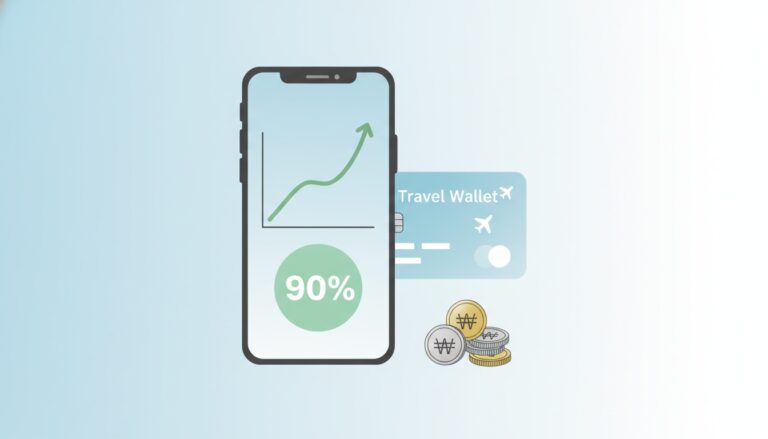
Today, we are tackling a C2-level topic: Currency Exchange Strategies (환전 전략). specifically using the 90% Preferential Rate Coupon (90% 환율 우대 쿠폰) and the game-changer for travelers, the Travel Wallet (트래블 월렛).
Why does this matter? Because understanding the difference between “changing money” and “applying a preferential rate to the spread” can save you enough Won for a whole extra K-BBQ dinner. Plus, walking into a bank and discussing interest rates and commissions makes you look incredibly sophisticated.
Let’s stop losing money on commissions and start speaking like a smart local.
Phase 2: Deep Dive (Advanced Terminology)
Since this is a C2 (Advanced) lesson, we aren’t just learning “How much?”. We are learning the financial mechanics.
1. 환율 우대 (Preferential Exchange Rate)
- Pronunciation: [Hwanyul-Udae] Sound analogy: ‘Hwan’ sounds like ‘Juan’, ‘yul’ like the ‘yule’ in yule-tide, ‘U-dae’ sounds like ‘Ooh-day’.
- Meaning: Literally “Exchange Rate Preferential Treatment.” In banking terms, this refers to a discount on the exchange spread (the bank’s commission).
- Editor’s Insight: Many foreigners think “90% Coupon” means they get money for 10% of the cost. No! It means the bank is discounting their profit margin (the spread) by 90%.
- Situation Check: Used at bank counters or mobile banking apps. Essential for large transactions.
2. 수수료 면제 (Commission Exemption / Fee Waiver)
- Pronunciation: [Susuryo-Myeonje]
- Meaning: “No Service Fee.”
- Editor’s Insight: This is the magic phrase associated with cards like Travel Wallet or Travel Log. When you withdraw cash from a WOWPASS or specific bank ATM, you want to confirm this.
- Usage: “이 ATM에서 출금하면 수수료 면제되나요?” (Is the fee waived if I withdraw from this ATM?)
3. 매매 기준율 vs. 현찰 살 때 (Trading Standard Rate vs. Cash Buying Rate)
- Pronunciation: [Maemae-Gijunyul] vs. [Hyeonchal-Salttae]
- Meaning:
- 매매 기준율: The market mid-rate (the “real” price).
- 현찰 살 때: The rate you actually pay (Market rate + Bank spread).
- Editor’s Insight: If you look at a currency app, don’t get excited by the Maemae-Gijunyul. You need to look at Hyeonchal-Salttae. Your “90% coupon” closes the gap between these two figures.
Phase 3: Textbook vs. Real Life
| Textbook Korean (Standard) | Real Life (Smart Traveler/C2) |
|---|---|
| 돈을 바꾸러 왔어요. (I came to change money.) |
환전하러 왔는데, 90% 우대 쿠폰 적용 가능한가요? (I came to exchange, is the 90% prime rate coupon applicable?) |
| 수수료가 얼마예요? (How much is the fee?) |
스프레드(spread) 제외하고 실질 수수료가 어떻게 되나요? (Excluding the spread, what is the actual commission?) |
| 카드로 돈을 뽑고 싶어요. (I want to pull out money with a card.) |
트래블 월렛으로 외화 계좌에서 바로 인출하려고요. (I intend to withdraw directly from the foreign currency account using Travel Wallet.) |
Note: Using words like 적용 (application/apply) and 인출 (withdrawal) instead of just “use” or “take out” signals high proficiency.
Phase 4: Cultural Context & Manners
1. The “Cashless” Reality & T-Money
While we are talking about exchange, remember that Korea is practically a cashless society. However, street food vendors (Pocha) and charging your T-Money (transport card) still require cash. The Travel Wallet card acts as a debit card and a transport card (if enabled), bridging this gap.
2. Bank Etiquette: The Number Ticket (번호표)
When you enter a Korean bank, do not walk to the counter. Look for a machine near the door. You usually have two options on the screen:
* 예금/입출금 (Deposit/Withdrawal)
* 대출/외환 (Loan/Foreign Exchange)
Make sure you press 외환 (Foreign Exchange) to get the right ticket. Waiting in the wrong queue is a rookie mistake!
Phase 5: Roleplay Scenario
Setting: A major bank branch in Seoul (Woori or Hana Bank). You have a digital coupon on your phone.
Characters:
* Alex: An experienced traveler (You).
* Banker: Korean bank teller.
Banker: (Smiling) 어서 오세요. 어떤 업무 보시겠어요?
(Welcome. What business can I help you with?)
Alex: (Showing phone screen) 안녕하세요. 달러 환전 좀 하려고 하는데요. 이 90% 환율 우대 쿠폰 지금 사용할 수 있나요?
(Hello. I’d like to exchange some Dollars. Is this 90% preferential rate coupon usable right now?)
Banker: 아, 네. 확인해 보겠습니다. (Typing) 네, 적용 가능합니다. 신분증 주시겠어요?
(Ah, yes. Let me check. Yes, it is applicable. May I have your ID?)
Alex: (Handing passport) 여기요. 그리고 혹시 소액권으로 섞어서 받을 수 있을까요?
(Here you are. And by chance, can I receive it mixed with small denomination bills?)
Banker: 네, 만 원짜리랑 천 원짜리 섞어 드릴게요.
(Yes, I will mix 10,000 won and 1,000 won bills for you.)
Phase 6: 10-Second Shadowing Drill
Listen to the rhythm. Focus on the pauses / to sound natural and professional.
“환전 수수료 우대율이 / 가장 높은 방법으로 / 진행해 주시겠어요?”
(Could you proceed with the method that has the highest exchange fee preferential rate?)
Pronunciation: Hwan-jeon su-su-ryo / u-dae-yul-i / ga-jang nop-eun bang-beob-eu-ro / jin-haeng-hae ju-si-gess-eo-yo?
Phase 7: FAQ & Troubleshooting
Q: Can I use “Travel Wallet” everywhere?
A: Mostly, yes. It works like a local check card. However, some older kiosks or delivery apps might require a domestic card with a Korean resident number. For tourists, it works for 99% of cafes, taxis, and stores.
Q: Should I change all my money at the airport?
A: NO. Airport banks have the worst spread. Change a minimum amount for the bus/taxi (~$50), then use an ATM in the city with your Travel Wallet/Log card, or go to a city bank branch with your coupon.
Q: Is asking for “small bills” (소액권) rude?
A: Not at all. It’s smart. 50,000 KRW bills are sometimes annoying for taxi drivers or convenience stores to break early in the morning.
Phase 8: Wrap-up
One-Liner Summary:
Stop saying “Money change please” and start demanding your “90% Preferential Rate” (90% 우대) like a financial pro.
Action Mission:
Download a Korean banking app (like Hana Money for Travel Log or the Travel Wallet app) and check today’s Buying Rate (현찰 살 때) vs. the Trading Rate (매매 기준율). See the gap? That’s what you’re saving!
Tell me in the comments: Have you ever used a Travel Wallet card in Korea, or are you still a “Cash is King” traveler?
Phase 9: Quiz
- What does “환율 우대” (Exchange Rate Preferential Treatment) actually discount?
a) The total amount of money you buy.
b) The bank’s commission (spread).
c) The VAT tax on items you buy. -
When you arrive at the bank, which button do you press on the ticket machine?
a) 예금 (Deposit)
b) 대출 (Loan)
c) 외환 (Foreign Exchange) -
To ask for small bills, what word should you use?
a) 큰돈 (Big money)
b) 소액권 (Small denomination bills)
c) 용돈 (Pocket money)
Click for Answers
1. b, 2. c, 3. b
Frequently Asked Questions (FAQ)
Q: What does "환율 우대 (Preferential Exchange Rate)" mean in Korean and how do you pronounce it?
A: In Korean, "환율 우대 (Preferential Exchange Rate)" is pronounced [Hwanyul-Udae] and means: Literally "Exchange Rate Preferential Treatment." In banking terms, this refers to a discount on the exchange spread (the bank's commission).
Q: What does "수수료 면제 (Commission Exemption / Fee Waiver)" mean in Korean and how do you pronounce it?
A: In Korean, "수수료 면제 (Commission Exemption / Fee Waiver)" is pronounced [Susuryo-Myeonje] and means: "No Service Fee."
Q: What does "매매 기준율 vs. 현찰 살 때 (Trading Standard Rate vs. Cash Buying Rate)" mean in Korean and how do you pronounce it?
A: In Korean, "매매 기준율 vs. 현찰 살 때 (Trading Standard Rate vs. Cash Buying Rate)" is pronounced [Maemae-Gijunyul] and means: 매매 기준율: The market mid-rate (the "real" price).







