

Phase 1: Introduction
Hello! This is your Senior Editor from Daily Hangul. 👋
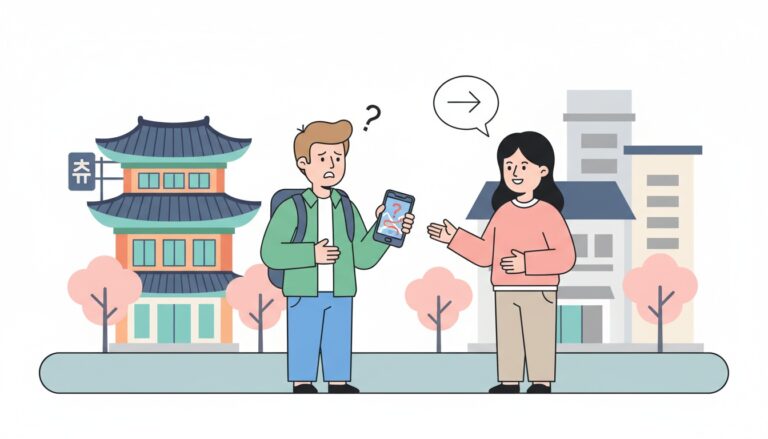
Picture this: You just stepped out of a subway station in Seoul. Your phone says your destination is 5 minutes away, but your GPS is spinning in circles, and you are staring at five different alleys that all look exactly the same. We’ve all been there. It’s the classic “Seoul Maze” experience.
Many of my students tell me, “I wanted to ask for help, but I was afraid I’d sound rude or they wouldn’t understand my pronunciation.” So they just walked in circles for 30 minutes.
Today, we are going to fix that. I’m going to teach you how to stop a passerby politely and ask for directions without panic. These aren’t just textbook phrases; these are the phrases that will make Koreans think, “Oh, this person knows how to handle themselves in Korea!”
Phase 2: Deep Dive (Key Expressions)
Here are the top 3 phrases you need when you are completely lost.
1. 저기요, 길 좀 여쭤볼게요.
(Excuse me, let me ask for directions.)
- Pronunciation: [Jeo-gi-yo, gil jom yeo-jjeo-bol-kke-yo]
- Sound Analogy: Jeo-gi-yo (sounds like ‘Jug’ + ‘E’ + ‘Yo’), Gil (sounds like ‘Gill’ of a fish).
- Meaning:
- Literal: Excuse me, I will ask about the street a little.
- Real Nuance: “Sorry to bother you, but I need help finding my way.”
- Editor’s Insight: This is the perfect “soft opener.” You can’t just walk up to someone and say “Where is the station?” That can feel abrupt. This phrase gives the listener time to switch their brain to “helping mode.”
- Situation Check: ✅ Stranger (Polite) | ✅ Police Officer
2. [Place] + 어디예요?
(Where is [Place]?)
- Pronunciation: [[Place] + eo-di-ye-yo?]
- Sound Analogy: Eo-di (sounds like ‘Uh’ + ‘Dee’).
- Meaning: Where is [Place]?
- Editor’s Insight: This is your A2 survival weapon. It is short, grammatical, and gets the job done. Just make sure to put the place name before “eodi-yeyo.”
- Situation Check: ✅ Anyone
3. 여기서 멀어요?
(Is it far from here?)
- Pronunciation: [Yeo-gi-seo meo-reo-yo?]
- Sound Analogy: Meo-reo-yo (sounds like ‘Muh’ + ‘Run’ without the ‘n’ + ‘Yo’).
- Meaning: Is it far from here?
- Editor’s Insight: Why is this important? Because if they say “Yes,” you should probably hail a taxi or take a bus instead of walking!
- Situation Check: ✅ Anyone
Phase 3: Textbook vs. Real Life
Let’s look at how a robot speaks versus how a Seoulite speaks.
| Textbook Korean (A bit stiff) | Real Life Korean (Natural) |
|---|---|
| 실례합니다. 길을 알려주시겠습니까? (Excuse me. Would you please inform me of the way?) |
저기요, 죄송한데 길 좀 물어볼게요. (Excuse me, sorry but let me ask about the way.) |
| 이쪽으로 가십시오. (Please go this way.) |
이쪽으로 쭉 가시면 돼요. (You can just go straight this way.) |
Editor’s Note: “실례합니다” (Shillye-hamnida) is perfectly fine and very polite, but “저기요” (Jeogiyo) or “죄송한데” (Joesong-hande – meaning ‘Sorry, but…’) is much more common on the street to grab attention.
Phase 4: Cultural Context & Manners
🛑 The “No-Touch” Rule
In some Western cultures, a light tap on the shoulder to get attention is okay. In Korea, avoid touching strangers. It can startle people. Instead, bow your head slightly, wave your hand a little low near your waist, and say “저기요” (Jeogiyo) clearly.
👀 The Art of “Nunchi” (Reading the Room)
When choosing whom to ask, use your Nunchi.
* Avoid: People walking very fast, people on the phone, or people with earphones in both ears.
* Target: People walking slowly, couples (they are usually generous), or someone waiting at a crosswalk.
📱 The Magic of the Screen
Since you are at an A2 level, listening to complex directions like “Turn right at the second intersection after the bakery” might be hard. Show them the map on your phone while asking. Koreans are very visual and will likely point at your screen to help.
Phase 5: Real-Life Scenario (Roleplay)
Setting: You are lost in Hongdae (a busy area) looking for the subway station.
Characters: Alex (You), Local (Korean passerby)
Alex: (Approaching cautiously with a slight bow)
저기요, 죄송한데 길 좀 물어볼게요.
(Jeogiyo, joesong-hande gil jom mureo-bol-kke-yo.)
Excuse me, sorry but I need to ask for directions.
Local: (Stops walking) 네, 어디 가세요?
(Ne, eodi gaseyo?)
Yes, where are you going?
Alex: 홍대입구역이 어디예요?
(Hongdae-ipgu-yeok-i eodi-ye-yo?)
Where is Hongdae Entrance Station?
Local: (Pointing) 저기 스타벅스 보이세요? 오른쪽으로 쭉 가세요.
(Jeogi Starbucks bo-i-se-yo? Oreun-jjok-eu-ro jjuk ga-se-yo.)
Do you see that Starbucks? Go straight to the right.
Alex: 아, 감사합니다!
(Ah, gamsa-hamnida!)
Ah, thank you!
Phase 6: 10-Second Shadowing Drill
Read this sentence aloud for 10 seconds. Pay attention to the pause.
“저기요, / 혹시 / 지하철역 / 어디예요?”
- Pronunciation: Jeogiyo, / hok-shi / ji-ha-cheol-yeok / eodi-ye-yo?
- Meaning: Excuse me, / by any chance / the subway station / where is it?
- Focus: Raise your tone slightly at the end of “Jeogiyo” to sound friendly, not aggressive.
Phase 7: FAQ & Troubleshooting
- Q: Can I just say “Help me” (도와주세요 – Dowa-juseyo)?
- A: I wouldn’t recommend it for just asking directions. “도와주세요” sounds like an emergency (like you are hurt or being chased). Use “길 좀 물어볼게요” (Ask for directions) instead.
- Q: What if I don’t understand their answer?
- A: Just smile and say “지도 좀 봐주시겠어요?” (Could you look at my map?). It saves time for everyone!
Phase 8: Wrap-up
- Summary: Don’t touch people. Say “Jeogiyo” first. Keep it simple: “[Place] + Eodi-yeyo?”
- Action Mission: Next time you are out, even if you aren’t lost, find a convenience store and practice asking the clerk: “화장실 어디예요?” (Where is the restroom?). It’s the best low-stakes practice!
- Tell me: Have you ever gotten lost in a foreign country? How did you solve it? Let me know in the comments!
Phase 9: Quiz
- Which phrase is the most natural way to get a stranger’s attention on the street?
- A) 여보세요 (Yeoboseyo)
- B) 저기요 (Jeogiyo)
- C) 야! (Ya!)
- You want to ask “Where is the bus stop?” Fill in the blank: 버스 정류장이 _____?
- A) 어디예요 (eodi-yeyo)
- B) 누구예요 (nugu-yeyo)
- C) 언제예요 (eonje-yeyo)
- True or False: It is polite to tap someone on the shoulder to ask for directions.
- A) True
- B) False
(Answers: 1. B, 2. A, 3. B)
Frequently Asked Questions (FAQ)
Q: What does ""저기요"" mean in Korean and how do you pronounce it?
A: In Korean, ""저기요"" is pronounced [Jeogiyo] and means: clearly.







