

Phase 1: Introduction (The “Wait, What Do I Do?” Moment)
Hello! This is your Head Editor at Daily Hangul.
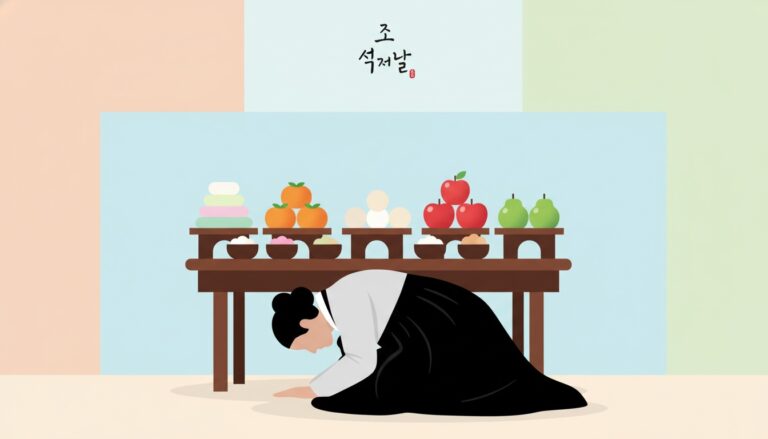
Imagine this: You’ve been invited to your Korean friend’s house for Seollal (Lunar New Year). It’s a huge honor! You enter the living room, and there’s a table full of amazing food, incense burning, and a solemn atmosphere. Suddenly, everyone stands in rows and looks at a picture of a grandfather.
Your friend whispers, “We are going to greet the ancestors now.”
Panic sets in. Do you say “Hello”? Do you wave? Do you shake the photo’s hand? (Please don’t do that!).
Many of my students tell me, “I felt like a statue because I was scared to move.” Don’t worry. Today, I will teach you how to handle this sacred moment called Charye (차례) without freezing up. It’s easier than you think!
Phase 2: Deep Dive (Core Expressions)
Unlike meeting living people, you don’t have a conversation with ancestors. The “greeting” is mostly action. However, there are key phrases used around this ritual.
1. 절 올리겠습니다 (Jeol olligess-seumnida)
- Pronunciation: [Jeol ol-li-get-sum-ni-da]
- Sound analogy: Jeol (like ‘Jol’ly) + Olli (like ‘Ollie’ on a skateboard) + Get-sum (get some) + Ni-da (knee-da).
- Meaning: “I will perform a bow.”
- Editor’s Insight: This is the Alert Button. You aren’t talking to the ghost; you are announcing to the living elders that you are ready to show respect. It signals, “I know the culture, and I am ready.”
- Situation Check: Very Formal (Used during ceremonies or to elders).
2. 새해 복 많이 받으세요 (Saehae bok mani badeuseyo)
- Pronunciation: [Sae-hae bok ma-ni ba-du-se-yo]
- Sound analogy: Sae-hae (Say hey) + Bok (Book) + Mani (Money) + Ba-du-se-yo.
- Meaning: “Please receive a lot of luck in the New Year.”
- Editor’s Insight: This is the Golden Key. You say this immediately after the ritual is finished and you bow to the living family members. It works for everyone, everywhere.
- Situation Check: All situations (Formal & Casual).
3. 차례 지내요 (Charye jinaeyo)
- Pronunciation: [Cha-rye ji-nae-yo]
- Meaning: “Let’s do the ancestral rite” or “We are doing the ancestral rite.”
- Editor’s Insight: You will hear this a lot. When someone says this, it means “Stop looking at your phone and come to the living room.”
Phase 3: Textbook vs Real Life
Books teach you formal words, but reality is about vibe and timing. Since you are A1 level, simpler is better.
| Textbook Korean 📚 | Real Life Korean (Survival) 🚀 |
|---|---|
| 조상님께 제사를 지냅니다. (We perform rites for ancestors.) |
차례 지내요. (It’s Charye time!) |
| 안녕히 계십시오. (Goodbye – to ancestors) |
(Silence + Bowing) (Action speaks louder!) |
| 절을 하십시오. (Please bow.) |
절! or 같이 절 해요. (Bow! / Let’s bow together.) |
Editor’s Note: During the actual ritual, silence is the best Korean you can speak.
Phase 4: Cultural Context (Manners & Nunchi)
Language is only 20% of communication here. The other 80% is Body Language.
- The “Jeol” (Deep Bow):
- This isn’t a waist bow. You go down to the floor on your knees.
- Hand Tip: For men, left hand goes over the right hand. For women, right hand over left. (If you forget, just hide your hands, nobody will kick you out!).
- The “Hyang” (Incense):
- If asked to offer incense, hold the stick with two hands. Never blow it out with your mouth! Shake it gently to extinguish the flame.
- Nunchi (Eye-measure):
- Don’t start bowing first. Look at the “Eldest Son” (or the person leading). When he moves, you move. Like a shadow!
Phase 5: Roleplay Scenario
Setting: Minji’s living room on Seollal morning. The table is full of food.
Characters: Alex (Beginner Student), Minji (Korean Friend).
(Minji’s father lights the incense. The room goes quiet.)
Minji: (Whispering) 알렉스 씨, 이제 시작해요. 차례 지내요.
(Alex, we are starting now. Let’s do Charye.)
[Al-lek-su ssi, i-je si-jak-hae-yo. Cha-rye ji-nae-yo.]
Alex: (Nervous) 네! 저는 뭐 해요?
(Okay! What do I do?)
[Ne! Jeo-neun mwo hae-yo?]
Minji: 그냥 저를 따라하세요. 자, 절 해요!
(Just follow me. Okay, bow!)
[Geu-nyang jeo-reul tta-ra-ha-se-yo. Ja, jeol hae-yo!]
(Everyone bows twice to the floor. Alex follows Minji perfectly.)
Alex: (Thinking to himself) 새해 복 많이 받으세요…
(Happy New Year…)
Phase 6: 10-Second Shadowing Drill
Let’s practice the announcement phrase. Say it with confidence!
절 / 올리겠습니다.
(I / will perform a bow.)
Listen & Repeat:
1. Jeol (Pause)
2. Ol-li-get-sum-ni-da.
3. Jeol Ol-li-get-sum-ni-da!
Phase 7: FAQ (Troubleshooting)
- Q: Can I take a picture of the food table? It looks amazing!
- A: NO. Wait until the ritual is completely over. Taking photos during the ceremony is considered rude to the spirits (and the grandmother watching you).
- Q: My religion doesn’t allow me to bow to ancestors. What do I do?
- A: This is common! You don’t have to bow. Just stand respectfully with your head slightly down while others bow. Koreans understand this.
Phase 8: Wrap-up
One-Liner Summary:
During Seollal ancestor greetings, “Silence + Following the Leader” is your best fluency.
Your Mission:
Do you have a Korean friend? Ask them: “이번 설날에 차례 지내요?” (Do you do Charye this Seollal?). They will be shocked you know that word!
Tell me in the comments:
Have you ever seen a Charye table in a drama? What food looked the best?
Phase 9: Pop Quiz
1. What is the “Alert Phrase” to say before bowing?
A) 안녕히 가세요 (Goodbye)
B) 절 올리겠습니다 (I will bow)
C) 사랑해요 (I love you)
2. How do you put out the incense stick?
A) Blow on it hard like a birthday cake 🎂
B) Dip it in the soup 🍲
C) Shake it gently 👋
3. If you don’t know when to bow, what do you do?
A) Ask Siri loudly.
B) Use Nunchi and follow the leader.
C) Just leave the room.
(Answers: 1-B, 2-C, 3-B)
Frequently Asked Questions (FAQ)
Q: What does "절 올리겠습니다 (Jeol olligess-seumnida)" mean in Korean and how do you pronounce it?
A: In Korean, "절 올리겠습니다 (Jeol olligess-seumnida)" is pronounced [Jeol ol-li-get-sum-ni-da] and means: a key conversational Korean expression covered in this lesson.
Q: What does "새해 복 많이 받으세요 (Saehae bok mani badeuseyo)" mean in Korean and how do you pronounce it?
A: In Korean, "새해 복 많이 받으세요 (Saehae bok mani badeuseyo)" is pronounced [Sae-hae bok ma-ni ba-du-se-yo] and means: a key conversational Korean expression covered in this lesson.
Q: What does "차례 지내요 (Charye jinaeyo)" mean in Korean and how do you pronounce it?
A: In Korean, "차례 지내요 (Charye jinaeyo)" is pronounced [Cha-rye ji-nae-yo] and means: "Let's do the ancestral rite" or "We are doing the ancestral rite."







