

Phase 1: Introduction
Greeting: Hello, Daily Hangul family! It’s your Senior Editor here.
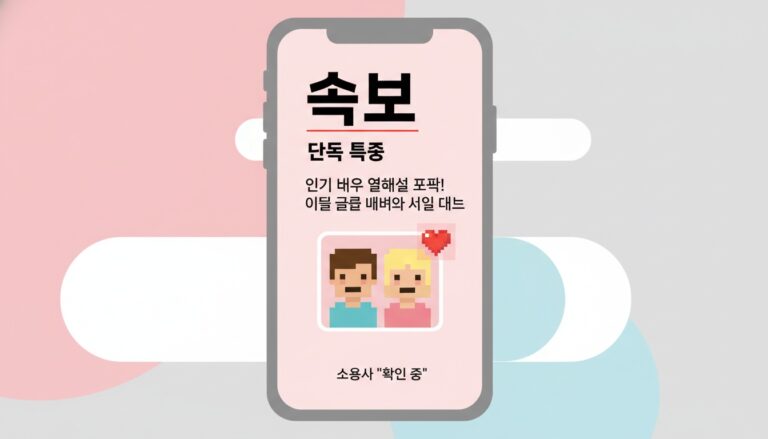
Scenario Setup: Picture this: It’s January 1st (a famous date for breaking news in Korea), or just a random Tuesday morning. You open Naver or Instagram, and suddenly you see your favorite K-Pop idol’s name next to a heart emoji and a blurry photo of a car. Your heart stops. Is it true? Or is it just a rumor?
The ‘Why’: Reading entertainment news isn’t just about gossip; it’s a fantastic way to reach B1 (Intermediate) level because it mixes formal agency language with emotional context. If you rely only on Google Translate, you might miss the subtle difference between “We are checking” (Panic mode) and “They are meeting with good feelings” (Confirmed).
Transparency: This guide is built from a real tutoring session with ‘Mark,’ a student who panicked when he misread a headline and thought his favorite actress was getting married when she was actually just cast in a romance movie!
Phase 2: Deep Dive into Core Expressions
Here are the top 3 phrases you will see in every dating scandal article. Mastering these will let you scan headlines in seconds.
1. 열애설 (Yeol-ae-seol)
- Pronunciation: [Yeo-rae-seol] Sounds like ‘Yo’ + ‘Ray’ + ‘Seol’ (rhymes with ‘Hull’). Note: The ‘ㄹ’ moves to the empty spot in ‘애’, making it sound like ‘Yeo-rae’.
- Meaning: Dating Rumor / Romantic Relationship Report
- Yeol-ae (Passionate love) + Seol (Theory/Rumor).
- Editor’s Insight: This word doesn’t mean it’s true yet. It just means the news is out. If you see this in a headline with a question mark, take a deep breath. It’s not confirmed.
- Situation Check: Used in news, blogs, and casual conversations about news. “Did you see the Yeol-ae-seol?”
2. 호감을 갖고 알아가는 단계 (Ho-gam-eul gat-go a-ra-ga-neun dan-gye)
- Pronunciation: [Ho-gam-eul gat-go a-ra-ga-neun dan-gye]
- Meaning: “In the stage of getting to know each other with good feelings.”
- Editor’s Insight: This is the Magic Phrase. This is the standard, safe, PR-approved way for an agency to say, “Yes, they are dating.” It sounds polite and cautious. They almost never say “Yes, they are boyfriend and girlfriend” directly in official statements.
- Situation Check: Highly formal. Used in official agency statements. You wouldn’t say this to your mom about your new boyfriend unless you are being funny.
3. 사실무근 (Sa-sil-mu-geun)
- Pronunciation: [Sa-sil-moo-geun]
- Meaning: Groundless / Not true at all
- Sa-sil (Fact) + Mu (None) + Geun (Root/Basis).
- Editor’s Insight: This is the strongest denial. It means “Fake News.” If the agency says this, the rumor is usually dead within an hour.
- Situation Check: Formal news and official statements.
Phase 3: Textbook vs. Real Life News
News headlines have their own “dialect.” Let’s see how they differ from what you learned in basic Korean.
| Textbook / Basic Korean | Real Korean News / Headlines | Nuance Difference |
|---|---|---|
| 사귀어요. (They are dating.) | 핑크빛 기류 포착 (Pink air currents detected) | “Pink” is a metaphor for romance. “Detected” sounds more dramatic. |
| 사랑에 빠졌어요. (They fell in love.) | 열애 중 (In the middle of passionate love) | Used often in headlines for brevity. |
| 아니라고 했어요. (They said no.) | 부인… “친한 선후배 사이” (Denial… “Just close senior-junior relationship”) | The classic “Friendzone” defense in the K-industry. |
Note: At the B1 level, start paying attention to the noun forms (열애, 부인, 인정) rather than just verbs (사랑하다, 아니다, 맞다). It makes your Korean sound much more educated.
Phase 4: Cultural Context & Manners
The “Nunchi” of Agency Statements
In Western media, a celebrity might tweet “Yeah, we’re dating.” In Korea, there is a formal process. The news breaks $\rightarrow$ The agency goes silent (checking) $\rightarrow$ The official statement is released.
- Tip: If an agency says “사생활이라 확인 불가” (Cannot confirm because it is private life), this is often interpreted by Korean netizens (Netizens) as a silent confirmation. It means “It’s true, but we don’t want to talk about it.”
Phase 5: Roleplay Script (Real Life Scenario)
Setting: A cafe in Hongdae. Two friends, Minji (Korean) and Alex (Foreigner), are looking at their phones.
Minji: (Eyes widening, showing phone screen) 헐! 대박. 알렉스, 이 기사 봤어?
(Heol! Daebak. Alex, did you see this article?)
Alex: 아니, 왜? 누구 열애설 났어?
(No, why? Did a dating rumor break out about someone?)
Minji: 어! 너가 좋아하는 그 배우! 소속사에서 벌써 인정했대.
(Yeah! That actor you like! The agency already admitted it.)
Alex: 진짜? ‘호감을 갖고 만나는 중’이라고 했어?
(Really? Did they say ‘meeting with good feelings’?)
Minji: (Laughing) 오, 알렉스 한국말 진짜 많이 늘었네! 정확해.
(Oh, Alex, your Korean really improved! That’s exactly it.)
Phase 6: 10-Second Shadowing Drill
Let’s practice reading a headline like a news anchor. Focus on the pause after the subject.
Sentence:
“양측 소속사는 / 열애설을 인정하며 / 따뜻한 시선을 부탁했습니다.”
(Both agencies / admitted to the dating rumors and / asked for a warm perspective.)
Guide:
* Yang-cheuk so-sok-sa-neun (Pause)
* Yreo-rae-seo-reul in-jeong-ha-myeo (Link ‘reul’ and ‘in’ smoothy)
* Tta-tteu-tan si-seo-neul bu-ta-kaet-seum-ni-da. (Make ‘Tta’ sound strong and crisp!)
Phase 7: FAQ & Troubleshooting
- Q: Can I tell my Korean friend “나 열애 중이야” (I am in yeol-ae)?
- A: Maybe, but be careful. Yeol-ae (열애) is a very dramatic, passionate word usually reserved for celebrities or written text. If you say this in conversation, your friend might cringe or laugh because it sounds like a movie title. Just say “나 만나는 사람 있어” (I’m seeing someone) or “나 연애해” (I’m dating).
- Q: What does “디스패치” (Dispatch) mean?
- A: It is the name of a famous media outlet known for breaking dating news, usually on January 1st. It has become a proper noun for “paparazzi style news” in Korea.
Phase 8: Wrap-up & Action Item
One-Liner Summary: Celebrity dating news relies on code words: 열애설 (Rumor), 인정 (Admit), and 사실무근 (Groundless).
Action Mission: Go to Naver Entertain (TV연예) right now. Find one article with the word ‘열애’ or ‘결별’ (Breakup) in the headline. Can you tell if the agency admitted it or denied it?
Engagement: Have you ever been heartbroken by a Yeol-ae-seol of your favorite idol? Tell me in the comments (in Korean if you can)!
Phase 9: Quiz
1. Which phrase means the agency is denying the rumor?
A) 호감을 갖고 만나는 중
B) 사실무근이다
C) 핑크빛 기류
2. How do you pronounce ‘열애설’?
A) [Yeol-ae-seol]
B) [Yeo-rae-seol]
C) [Yeol-lae-seol]
3. Which word is most natural for you to use when telling a friend you have a boyfriend/girlfriend?
A) 열애 중이야
B) 연애해
C) 기류가 포착됐어
(Answers: 1. B, 2. B, 3. B)
Frequently Asked Questions (FAQ)
Q: What does "열애설 (Yeol-ae-seol)" mean in Korean and how do you pronounce it?
A: In Korean, "열애설 (Yeol-ae-seol)" is pronounced [Yeo-rae-seol] and means: Dating Rumor / Romantic Relationship Report
Q: What does "호감을 갖고 알아가는 단계 (Ho-gam-eul gat-go a-ra-ga-neun dan-gye)" mean in Korean and how do you pronounce it?
A: In Korean, "호감을 갖고 알아가는 단계 (Ho-gam-eul gat-go a-ra-ga-neun dan-gye)" is pronounced [Ho-gam-eul gat-go a-ra-ga-neun dan-gye] and means: "In the stage of getting to know each other with good feelings."
Q: What does "사실무근 (Sa-sil-mu-geun)" mean in Korean and how do you pronounce it?
A: In Korean, "사실무근 (Sa-sil-mu-geun)" is pronounced [Sa-sil-moo-geun] and means: Groundless / Not true at all







