

Phase 1: Introduction
Hello! This is your Senior Editor at Daily Hangul.
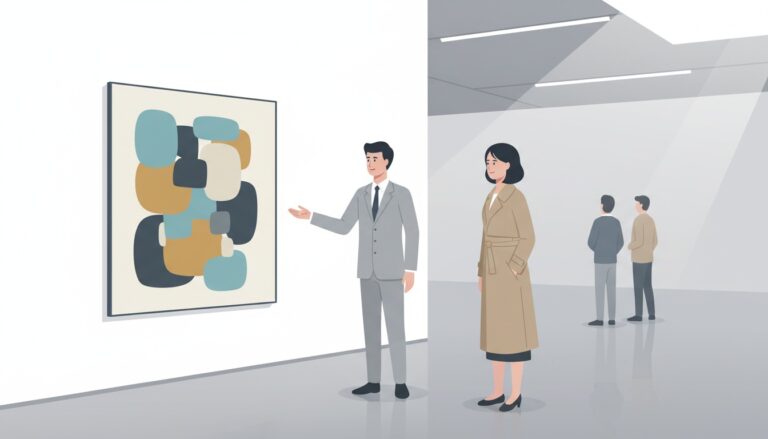
So, you’ve mastered ordering at restaurants and navigating taxis. You can even hold a decent conversation about your weekend. But now, you find yourself standing in the middle of the MMCA (National Museum of Modern and Contemporary Art) in Seoul, listening to a docent explain an abstract installation.
The docent asks, “어떤 느낌이 드시나요?” (How does this make you feel?), and suddenly, your C1-level brain freezes. You want to say, “The juxtaposition of colors implies a critique of modern capitalism,” but all that comes out is, “음… 예뻐요” (Um… it’s pretty).
Frustrating, isn’t it? As an advanced learner, the gap between your thoughts and your speech can feel widest in intellectual settings like art exhibitions. Today, we bridge that gap. We’re going to equip you with the sophisticated vocabulary and nuances needed to not just understand a docent tour, but to participate in it like a true Seoulite intellectual.
Phase 2: Deep Dive into Key Expressions
Here are three expressions that will instantly elevate your status from “Tourist” to “Art Enthusiast.”
1. 작가의 의도 (Artist’s Intent)
- Pronunciation: Jak-ga-ui ui-do [Note: ‘의’ is tricky. In this possession case, it’s often pronounced like ‘에(e)’, but keep it closer to ‘ui’ for formal clarity here.]
- Meaning: The artist’s intention / What the artist meant to convey.
- Editor’s Insight: At a C1 level, we stop asking “What is this?” and start asking about the why. This phrase is your golden key. It shows you respect the creative process.
- Situation Check: Perfect for formal Q&A sessions with a docent or curator.
2. 여운이 남다 (To leave a lingering impression)
- Pronunciation: Yeo-un-i nam-da [Sounds soft and flowing, like the feeling itself.]
- Meaning: Literal: “The resonance remains.” / Real nuance: The artwork continues to move me even after looking away.
- Editor’s Insight: “I liked it” is boring. “It was touching” is A2. “여운이 남아요” is pure poetry. Use this when a piece makes you think or feel deeply for a long time.
- Situation Check: Use this to compliment the exhibition or when chatting with a friend afterwards.
3. 현대적으로 재해석하다 (To reinterpret in a modern way)
- Pronunciation: Hyeon-dae-jeok-eu-ro jae-hae-seok-ha-da
- Meaning: To give a modern twist to a classic concept.
- Editor’s Insight: Korean contemporary art often blends traditional motifs (like Hanok or Hanbok) with modern styles. Identifying this specific trait makes you sound incredibly knowledgeable.
- Situation Check: Use this when observing fusion art or architecture.
Phase 3: Textbook vs. Real Life
Let’s upgrade your “Textbook Korean” to “Gallery Korean.”
| Textbook Korean (Correct but stiff) | Real Korean (Sophisticated & Natural) |
|---|---|
| 이 그림은 무엇을 의미합니까? (What does this picture mean?) |
작가가 이 작품을 통해 전하고자 하는 메시지는 무엇인가요? (What message does the artist wish to convey through this work?) |
| 설명이 재미있었습니다. (The explanation was fun.) |
해설 덕분에 작품을 이해하는 데 큰 도움이 되었습니다. (Thanks to the commentary, it was a huge help in understanding the work.) |
| 이것은 슬픈 느낌입니다. (This is a sad feeling.) |
전반적으로 애상적인 분위기가 감드네요. (Overall, a melancholy atmosphere hovers over it.) |
Note: Notice the use of words like ‘메시지’ (message), ‘해설’ (commentary), and ‘분위기’ (atmosphere). These are the markers of advanced proficiency.
Phase 4: Cultural Context & Manners (Nunchi)
The Art of “Listening Silence”
In Western galleries, casual chatter is often acceptable. In Korea, especially during a docent tour, silence is golden. The audience usually moves as a cohesive, silent unit.
- Eye Contact: Do not stare intensely at the docent the entire time. Alternate your gaze between the artwork and the speaker. This shows you are connecting their words to the visual.
- The Q&A Timing: Koreans rarely interrupt a speaker. Even if you have a burning question about the ‘작가의 의도’, hold it! Wait until the docent says, “질문 있으신가요?” (Do you have any questions?). Breaking the flow is considered bad Nunchi.
Phase 5: Roleplay Script
Setting: MMCA Seoul, standing before a complex abstract painting.
Characters: Julian (C1 Learner), Docent (Art Guide).
Docent: 이 작품은 작가의 고립감을 흑백의 대조로 표현했습니다. 보시다시피, 붓터치가 아주 거칠죠.
(This work expresses the artist’s isolation through the contrast of black and white. As you can see, the brushstrokes are very rough.)
Julian: (Nodding slowly and thoughtful expression)
혹시, 이 거친 붓터치가 작가의 당시 심리 상태를 반영한 건가요?
(By any chance, do these rough brushstrokes reflect the artist’s psychological state at that time?)
Docent: (Surprised and pleased)
네, 정확히 보셨습니다! 불안했던 내면을 시각화한 것이죠.
(Yes, you saw that exactly! It’s a visualization of their anxious inner self.)
Julian: 아, 그렇군요. 설명을 듣고 다시 보니 작품이 전혀 다르게 다가오네요.
(Ah, I see. Looking at it again after hearing the explanation, the work approaches me [feels] completely differently.)
Phase 6: 10-Second Shadowing
Read this aloud to practice your rhythm and intonation. Focus on the pause after ‘하지만’.
“처음에는 / 난해하게 느껴졌지만, / 도슨트님의 해설을 듣고 나니 / 작가의 의도가 / 명확하게 와닿았습니다.”
(At first / it felt difficult to understand, / but after hearing the docent’s commentary / the artist’s intent / hit home clearly.)
Phase 7: FAQ & Troubleshooting
- Q: Can I use informal language (Banmal) if I’m just muttering to myself about the art?
- A: Yes! It is very natural to whisper to yourself, “와, 이거 대박이다…” (Wow, this is amazing…) or “색감이 진짜 독특하네” (The color scheme is really unique). Just keep the volume low.
- Q: Is it okay to take photos during the tour?
- A: Unless explicitly forbidden (check for “No Photography” signs), it is usually okay. However, mute your shutter sound or use a silent camera app. The ‘Click!’ sound is very distracting in a quiet Korean gallery.
Phase 8: Wrap-up
- Summary: Move beyond simple descriptions. Use words like ‘의도’ (intent), ‘재해석’ (reinterpretation), and ‘여운’ (lingering impression) to discuss art deeply.
- Action Mission: Visit a local gallery or look up a famous Korean painting online (like Kim Whan-ki’s work). Write one sentence in your journal using “~한 여운이 남았다.”
- Tell me: Have you ever visited an art gallery in Korea? Which one was your favorite? Let me know in the comments!
Phase 9: Quiz
1. Which phrase is the most sophisticated way to ask about the meaning of a painting?
A) 이 그림 뭐예요? (What is this picture?)
B) 작가의 의도가 궁금합니다. (I am curious about the artist’s intent.)
C) 이거 무슨 뜻이에요? (What does this mean?)
2. How do you say “The explanation helped me understand” in a formal, grateful way?
A) 설명 굿. (Explanation good.)
B) 말 잘하시네요. (You speak well.)
C) 해설 덕분에 이해하는 데 큰 도움이 되었습니다. (Thanks to the commentary, it was a huge help in understanding.)
3. True or False: It is considered polite to interrupt the docent immediately if you don’t understand a word.
(Answer: False. Use your Nunchi and wait for the Q&A session!)
(Answers: 1-B, 2-C, 3-False)
Frequently Asked Questions (FAQ)
Q: What does "작가의 의도 (Artist's Intent)" mean in Korean and how do you pronounce it?
A: In Korean, "작가의 의도 (Artist's Intent)" is pronounced [Jak-ga-ui ui-do [Note: '의' is tricky. In this possession case, it’s often pronounced like '에(e] and means: The artist's intention / What the artist meant to convey.
Q: What does "여운이 남다 (To leave a lingering impression)" mean in Korean and how do you pronounce it?
A: In Korean, "여운이 남다 (To leave a lingering impression)" is pronounced [Yeo-un-i nam-da [Sounds soft and flowing, like the feeling itself.] and means: Literal: "The resonance remains." / Real nuance: The artwork continues to move me even after looking away.
Q: What does "현대적으로 재해석하다 (To reinterpret in a modern way)" mean in Korean and how do you pronounce it?
A: In Korean, "현대적으로 재해석하다 (To reinterpret in a modern way)" is pronounced [Hyeon-dae-jeok-eu-ro jae-hae-seok-ha-da] and means: To give a modern twist to a classic concept.







