

Phase 1: Introduction
Hello, Daily Hangul readers! This is your Senior Editor.
We’ve all been there. You are in the middle of a heated debate—perhaps discussing a social issue, Korean politics, or even a disagreement at work. You make a perfectly logical point about a mistake someone made. Suddenly, they look at you and say, “Well, what about you? Didn’t you do that other thing last year?”
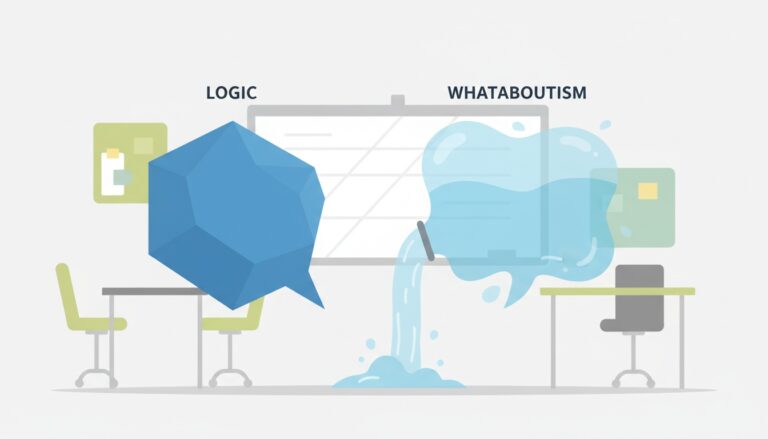
Welcome to the frustrating world of Whataboutism. In Korean, we often refer to the logical fallacy itself as 피장파장의 오류 (Pijangpajang-ui oryu), but in daily conversation, we call the act ‘물타기 (Mul-ta-gi – watering down)’.
As a C2 (Advanced) learner, simply understanding the words isn’t enough. You need the rhetorical tools to shut down this deflection without seeming emotionally rattled. Today, I’m going to teach you how to hold your ground like a seasoned Korean debater. These are the exact phrases I teach my students who work in Korean corporate environments or academia.
Phase 2: Deep Dive into Key Expressions
Here are the three most effective ways to pivot the conversation back to the main point.
1. 그건 별개의 문제죠 (That is a separate issue)
- Pronunciation: [Geu-geon byeol-gae-ui mun-je-jyo] “Geu” sounds like the ‘goo’ in ‘good’, “byeol” sounds like ‘byul’.
- Meaning: That’s a separate matter/issue.
- Editor’s Insight: This is the most dignified and logical way to respond. It acknowledges their point exists but firmly categorizes it as irrelevant to the current discussion. It screams “rational intellectual.”
- Situation Check: ✅ Formal Meetings ✅ Serious Debates ⚠️ Casual Chat (Might sound too stiff)
2. 논점을 흐리지 마세요 (Please don’t blur the point)
- Pronunciation: [Non-jjeom-eul heu-ri-ji ma-se-yo] “Heu” is a deep throat sound like a disgusted sigh.
- Meaning: Don’t blur/obscure the main point.
- Editor’s Insight: This is stronger. You are accusing the other person of intentionally making things messy. Use this when “별개의 문제죠” didn’t work and they keep deflecting.
- Situation Check: ✅ Debates ⚠️ Boss/Elders (Use with caution)
3. 본질을 호도하지 맙시다 (Let’s not distort the essence)
- Pronunciation: [Bon-ji-reul ho-do-ha-ji map-si-da]
- Meaning: Let’s not mislead/distort the essence of the matter.
- Editor’s Insight: This is a power move. ‘호도하다 (Hodo-hada)’ is high-level vocabulary often seen in news editorials or political statements. Using this shows you command the language at a native intellectual level.
- Situation Check: ✅ Academic/Political Discussions ❌ Casual Drinking (You’ll sound like a politician)
Phase 3: Textbook vs. Real Life
Textbooks teach you to be grammatically correct. Real life requires you to be effective. Here is how C2 speakers actually talk.
| Textbook (Correct but dry) | Real Korean (What you hear in debates) |
|---|---|
| 지금 주제와 다릅니다. (It is different from the current topic.) |
아니, 지금 그 얘기가 왜 나와요? (Wait, why is that story coming out right now?) |
| 오류를 범하고 계십니다. (You are committing an error.) |
지금 물타기 하시는 건가요? (Are you ‘watering down’ the issue right now?) |
| 저의 행동은 관계가 없습니다. (My actions are irrelevant.) |
제 얘기는 나중에 하시죠. (Let’s talk about me later.) |
Editor’s Note: ‘물타기 (Mul-ta-gi)’ is essential vocabulary. Originally from stock market terms (buying more stock as prices fall to lower the average), in arguments, it means diluting the main point by pouring in irrelevant counter-accusations. Accusing someone of “Mul-ta-gi” is a sharp way to call out Whataboutism.
Phase 4: Cultural Context & Manners
The Art of “Saving Face” (Chemyon)
In Western debate, pointing out a logical fallacy is a victory. In Korea, if you point out a senior’s fallacy too bluntly, you win the logic but lose the relationship (and your future).
The “Yes, But” Strategy:
When a superior uses Whataboutism, do not cut them off.
1. Acknowledge: “네, 부장님 말씀도 일리가 있습니다.” (Yes, Director, your point also has merit.)
2. Pivot: “하지만 지금 시급한 것은…” (However, what is urgent right now is…)
By validating their “Whatabout” point first (even if it’s nonsense), you save their Chemyon (Face), making them more likely to listen to your actual argument.
Phase 5: Roleplay Script
Situation: A foreign team leader (Mark) is pointing out a missed deadline to a Korean coworker (Min-su). Min-su tries to deflect by mentioning Mark’s past mistake.
Mark: 이번 프로젝트 마감이 늦어진 이유를 명확히 해야 할 것 같아요.
(We need to clarify why the deadline for this project was delayed.)
Min-su: 팀장님도 저번에 보고서 늦게 내셨잖아요. 우리 팀 전체 분위기 문제 아닌가요?
(Team leader, you also submitted your report late last time. Isn’t it a problem with the whole team atmosphere?)
Mark: (calmly but firmly) 민수 씨, 그건 별개의 사안입니다. 제 실수는 그때 처리된 일이고요.
(Min-su, that is a separate issue. My mistake was handled back then.)
Min-su: 아니, 제 말은 상황이 비슷하다는 거죠.
(No, I’m saying the situation is similar.)
Mark: 지금은 민수 씨의 일정 관리에 대해 이야기하고 있습니다. 논점을 흐리지 않았으면 좋겠네요.
(Right now, we are talking about your schedule management. I would appreciate it if you didn’t blur the point.)
Phase 6: 10-Second Shadowing
Practice this sentence to build your “logical authority.” Focus on the pause after ‘하지만’.
“그 말씀도 이해는 합니다만, / 본질적인 문제는 그게 아니지 않습니까?”
(I understand what you are saying, but / isn’t the essential problem not that?)
Key Points:
* Raise your intonation slightly on “이해는” to show empathy.
* Drop your pitch on “아니지 않습니까” to sound decisive.
Phase 7: FAQ & Troubleshooting
Q: Can I use “물타기 하지 마세요” to my boss?
A: Absolutely not. Unless you plan to resign that day. “Mul-ta-gi” has a slightly accusatory nuance of being manipulative. To a boss, use “그 부분은 추후에 다시 논의하시죠” (Let’s discuss that part later).
Q: What if they keep doing it?
A: If they persist, stop arguing logic. Switch to outcome. “과거가 어쨌든, 결국 지금 이 문제를 해결해야 하지 않을까요?” (Regardless of the past, strictly speaking, shouldn’t we solve this problem right now?)
Phase 8: Wrap-up
Summary: When faced with Whataboutism, do not get angry. Calmly label it as a “separate issue” (별개의 문제) or ask them not to “blur the point” (논점 흐리기).
Your Mission: Next time you watch a Korean political debate or a K-Drama argument scene, listen for the word “물타기”. It appears more often than you think!
Let’s Chat: Have you ever lost an argument in Korean because you didn’t know how to stop the other person from changing the topic? Tell me in the comments!
Phase 9: Quiz
1. Which expression is the most polite/formal way to steer the topic back?
A) 물타기 하지 마세요.
B) 그건 별개의 문제입니다.
C) 너나 잘하세요.
2. What is the Korean slang for “Whataboutism” or “diluting the point”?
A) 불지르기 (Setting fire)
B) 물타기 (Watering down)
C) 밥하기 (Cooking rice)
3. In a business setting, what should you acknowledge first before refuting a superior?
A) Their mistake.
B) Their face (Chemyon) / Validity of their point.
C) Their age.
(Answers: 1.B, 2.B, 3.B)
Frequently Asked Questions (FAQ)
Q: What does "그건 별개의 문제죠 (That is a separate issue)" mean in Korean and how do you pronounce it?
A: In Korean, "그건 별개의 문제죠 (That is a separate issue)" is pronounced [Geu-geon byeol-gae-ui mun-je-jyo] and means: That's a separate matter/issue.
Q: What does "논점을 흐리지 마세요 (Please don't blur the point)" mean in Korean and how do you pronounce it?
A: In Korean, "논점을 흐리지 마세요 (Please don't blur the point)" is pronounced [Non-jjeom-eul heu-ri-ji ma-se-yo] and means: Don't blur/obscure the main point.
Q: What does "본질을 호도하지 맙시다 (Let's not distort the essence)" mean in Korean and how do you pronounce it?
A: In Korean, "본질을 호도하지 맙시다 (Let's not distort the essence)" is pronounced [Bon-ji-reul ho-do-ha-ji map-si-da] and means: Let's not mislead/distort the essence of the matter.






