

Phase 1: Introduction
Hello! This is your Daily Hangul Editor.
So, you’ve just walked out of the Charlotte Theater or the Seoul Arts Center after watching a blockbuster Korean musical like Jekyll & Hyde or Frankenstein. Your heart is racing, your hands hurt from clapping, and your Korean friend asks, “어땠어?” (How was it?)
If you answer with a simple “노래가 좋았어” (The song was good), you are missing a massive opportunity. Korean musical culture is intense. The audiences are incredibly discerning, and the actors are known for their “power vocals.” To truly connect with a Korean theater fan, you need expressions that capture the goosebumps, the vocal power, and the emotional journey.
Today, we are moving beyond “Good job.” We are going to learn how to critique and praise a musical number like a seasoned C1-level critic (or a passionate fan). This guide is built from real conversations overheard in the lobby during intermission!
Phase 2: Deep Dive into Core Expressions
Here are the three expressions that will make you sound like a true ‘뮤덕’ (Myu-deok – Musical Geek).
1. 성량이 폭발하다 [Seong-ryang-i pok-bal-ha-da]
- Pronunciation: [Seong-nyang-i pok-bal-ha-da] Note: The ‘R’ in ryang sounds like an ‘N’ due to nasalization rules.
- Meaning: “The vocal projection exploded.”
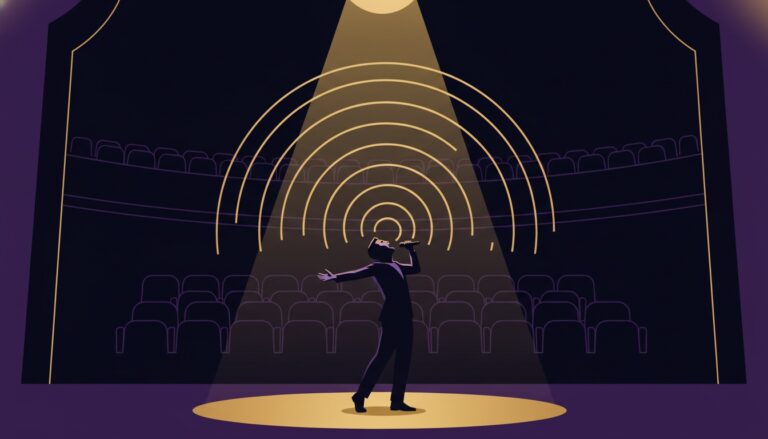
- Editor’s Insight: Koreans love powerful high notes (belting). Seong-ryang isn’t just volume; it’s the fullness and power of the voice. Use this when an actor hits that high note at the end of Act 1 and fills the entire concert hall without a microphone.
- Situation Check: Perfect for enthusiastic conversations with friends or writing a review online.
2. 감정선이 살아있다 [Gam-jeong-seon-i sa-ra-it-da]
- Pronunciation: [Gam-jeong-seo-ni sa-ra-it-da]
- Meaning: “The emotional line is alive.”
- Editor’s Insight: In musicals, singing well technically isn’t enough. You need to act through the song. Gam-jeong-seon refers to the subtle flow of emotions throughout the song. If an actor made you cry because their sadness felt so real, their “emotional line was alive.”
- Situation Check: Very sophisticated. Good for formal discussions or analyzing the play deeply.
3. 넘버 소화력이 미쳤다 [Neom-beo so-hwa-ryeo-gi mi-chyeot-da]
- Pronunciation: [Neom-beo so-hwa-ryeo-gi mi-chyeot-da]
- Meaning: “Their ability to digest (pull off) the number was insane.”
- Editor’s Insight: In Korean theater, songs are called “Numbers.” So-hwa-ryeok literally means “digestion power,” but here it means the ability to make a difficult song their own. Adding Mi-chyeot-da (Crazy/Insane) makes it a very common, emphatic compliment among younger generations.
- Situation Check: Casual/Slangy. Use this with friends, not with your professor.
Phase 3: Textbook vs. Real Life
Let’s upgrade your vocabulary from “Basic Student” to “Theater Insider.”
| Textbook Korean (Safe but dry) | Real Life / Trend (What locals say) |
|---|---|
| 배우가 노래를 정말 잘해요. (The actor sings really well.) |
와, 성대 갈아 끼운 줄 알았어. (Wow, I thought they swapped their vocal cords. Implies superhuman singing.) |
| 노래가 감동적이었어요. (The song was touching.) |
완전 전율이 돋았어. (I felt a total shiver/thrill.) |
| 고음이 높았어요. (The high notes were high.) |
지붕 뚫는 줄 알았어. (I thought they were going to pierce through the roof.) |
Editor’s Note: “성대 갈아 끼우다” is a hilarious but high-level compliment. It implies the actor sang so well today, they must have bought a fresh pair of vocal cords just for this show.
Phase 4: Cultural Context & Manners
The “Siche-gwan” (시체관) Culture
Korean musical audiences are famous for being incredibly quiet and focused. This is sometimes jokingly called “Siche-gwan” (Corpse Viewing) – meaning you sit still like a corpse so you don’t disturb others.
- Movement: Do not lean forward (it blocks the view behind you) or shift constantly during a quiet ballad.
- Reaction: During the song, remain silent. Save your Hwan-ho (cheering) and applause for the exact moment the music stops. If you clap too early (while the orchestra is playing the final note), you might get glared at!
- Curtain Call: This is the ONLY time you can go wild. Scream, clap, and give a standing ovation if you liked it.
Phase 5: Real-Life Scenario (Roleplay)
Setting: Two friends walking out of the theater after watching a heavy tragedy musical.
Characters:
* Mark (Foreigner, C1 Level): Deeply moved by the performance.
* Ji-eun (Korean Friend): A huge fan of the lead actor.
Dialogue:
Ji-eun: 와, 오늘 조승우 배우 연기 봤어? 진짜 대박이다.
(Wa, did you see Jo Seung-woo’s acting today? It was daebak.)
Mark: 솔직히 1막 마지막 곡에서 소름 돋았어. 성량이 폭발하는데 압도당하는 기분이었어.
(Honestly, I got goosebumps during the last song of Act 1. His vocal projection exploded, and I felt completely overwhelmed.)
Ji-eun: 그치! 역시 믿고 보는 배우라니까. 노래만 잘하는 게 아니라 연기 디테일도 장난 아니지?
(Right! That’s why he’s an actor you trust and watch. He’s not just good at singing; his acting details are no joke, right?)
Mark: 응. 특히 슬픈 장면에서 감정선이 끊기지 않고 끝까지 이어지는 게 인상적이었어.
(Yeah. Especially in the sad scene, it was impressive how his emotional line didn’t break and carried through to the end.)
(Mark pauses and puts his hand on his chest dramatically)
Mark: 아직도 여운이 남아서 심장이 뛰어.
(I still have the lingering feelings, my heart is racing.)
Phase 6: 10-Second Shadowing
Practice this sentence to describe that overwhelming feeling after a great song. Focus on the pause to emphasize the impact.
“배우의 성량이 너무 커서 / 가만히 앉아 있는데도 / 온몸이 울리는 느낌이었어.”
(The actor’s volume was so huge / that even though I was sitting still / it felt like my whole body was vibrating.)
- Intonation Guide: Raise your pitch slightly on ‘커서’ (huge) and ‘있는데도’ (even though) to build tension, then drop comfortably on ‘느낌이었어’ (felt like).
Phase 7: FAQ & Troubleshooting
Q: Can I use “성량” (Seong-ryang) for K-Pop idols too?
A: Yes, but it’s most commonly used for “powerhouse” vocalists or musical actors. If an idol has a thin voice, using this word might sound sarcastic. Use it for main vocalists known for belting.
Q: Is it rude to say a musical was “boring” (지루하다)?
A: Koreans usually soften the blow. Instead of “지루했어” (It was boring), try “취향에 좀 안 맞았어” (It didn’t really fit my taste) or “서사가 좀 아쉬웠어” (The narrative was a bit lacking). This is much more polite and C1-level sophisticated!
Phase 8: Wrap-up
One-Liner Summary:
When praising a musical number, focus on the energy (성량), the emotion (감정선), and the immersion (몰입감) rather than just the melody.
Action Mission:
Next time you listen to a powerful song (even on YouTube), try writing a comment in Korean: “와, 이 부분에서 성량 폭발이네요! 소름 돋았어요.” (Wow, the volume explosion at this part! I got goosebumps.)
Which Korean musical actor do you think has the best ‘Seong-ryang’? Tell me in the comments!
Phase 9: Quiz
1. Which expression best describes an actor who maintained the sad emotions perfectly throughout a complex song?
A) 성량이 폭발하다
B) 감정선이 살아있다
C) 딕션이 좋다
2. What is the slang term for swapping out your vocal cords because you sang so well?
A) 성대 갈아 끼우다
B) 성대 청소하다
C) 성대 버리다
3. Which audience behavior is considered RUDE during a Korean musical number?
A) Crying silently
B) Sitting completely still (Siche-gwan)
C) Clapping rhythmically while the actor is still singing a ballad
(Answers: 1-B, 2-A, 3-C)
Frequently Asked Questions (FAQ)
Q: What does "성량이 폭발하다 [Seong-ryang-i pok-bal-ha-da]" mean in Korean and how do you pronounce it?
A: In Korean, "성량이 폭발하다 [Seong-ryang-i pok-bal-ha-da]" is pronounced [Seong-nyang-i pok-bal-ha-da] and means: "The vocal projection exploded."
Q: What does "감정선이 살아있다 [Gam-jeong-seon-i sa-ra-it-da]" mean in Korean and how do you pronounce it?
A: In Korean, "감정선이 살아있다 [Gam-jeong-seon-i sa-ra-it-da]" is pronounced [Gam-jeong-seo-ni sa-ra-it-da] and means: "The emotional line is alive."
Q: What does "넘버 소화력이 미쳤다 [Neom-beo so-hwa-ryeo-gi mi-chyeot-da]" mean in Korean and how do you pronounce it?
A: In Korean, "넘버 소화력이 미쳤다 [Neom-beo so-hwa-ryeo-gi mi-chyeot-da]" is pronounced [Neom-beo so-hwa-ryeo-gi mi-chyeot-da] and means: "Their ability to digest (pull off) the number was insane."






