

Hello, Daily Hangul family! 👋
This is your Chief Editor at Daily Hangul.
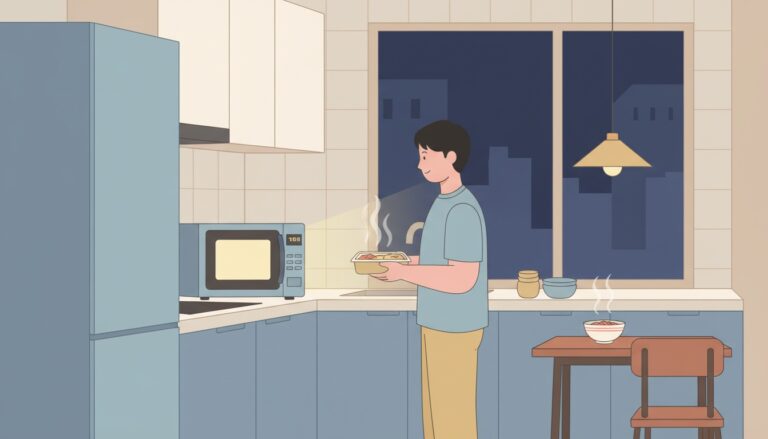
You’ve reached the advanced level (C2), which means you can probably order Bibimbap with your eyes closed. But let’s be real—living in Korea isn’t always about royal court cuisine. Sometimes, it’s 11 PM, you are exhausted, and you are standing in front of a convenience store microwave or your tiny studio kitchen (Jachwibang), wondering how to turn a cold triangle kimbap into a gourmet meal.
Today, we are skipping the textbook phrases like “요리해요” (I cook). Instead, we are diving into the gritty, realistic vocabulary of the Korean ‘Solo Living’ (Jachwi) Pros—those who know how to make 5-minute microwave magic. Knowing these nuances separates the ‘Foreigner who speaks Korean’ from the ‘Person who lives in Korean.’
Let’s upgrade your survival cooking skills to C2 level.
1. 끼니를 때우다 (Kkini-reul ttae-u-da)
- Pronunciation: [Kkini-reul ttae-u-da] Sounds like ‘Kkini-reul’ + ‘te-woo-da’ (Imagine patching a hole in a tire, but you’re patching your hunger.)
- Meaning:
- Literal: To patch up a meal.
- Real Nuance: To grab a quick bite just to fill your stomach, rather than enjoying a proper meal. It implies simplicity, speed, and a lack of effort.
- Editor’s Insight: If you say “저녁 먹었어요?” (Did you eat dinner?) to a Korean friend, and they answer “그냥 편의점 김밥으로 대충 때웠어” (I just roughly patched it up with convenience store kimbap), it conveys a sense of weariness or busyness. It’s a very humble and common phrase for Jachwisaeng (solo dwellers).
- Situation Check: Casual (O) / Formal (Use with caution – implies you aren’t taking care of yourself).
2. 식감이 눅눅해지다 (Sik-gami nung-nuk-hae-ji-da)
- Pronunciation: [Sik-gami nung-nuk-hae-ji-da] Note: ‘Sik-gam’ is texture/mouthfeel.
- Meaning:
- Literal: The food texture becomes damp.
- Real Nuance: To get soggy. This is the Enemy #1 of microwave cooking. Knowing this word allows you to complain or warn about microwave failures with precision.
- Editor’s Insight: Beginners say “맛 없어요” (It tastes bad). Masters say “눅눅해서 별로야” (It’s not great because it’s soggy). Conversely, the goal is 바삭하다 (crispy) or the holy grail: 겉바속촉 (Geot-ba-sok-chok – Crispy outside, moist inside).
- Situation Check: All situations.
3. 전자레인지 사양 (Jeon-ja-re-in-ji Sa-yang)
- Pronunciation: [Jeon-ja-re-in-ji Sa-yang]
- Meaning:
- Literal: Microwave specifications.
- Real Nuance: Usually refers to the wattage (700W vs 1000W). In Korea, recipe instructions on instant food packages strictly differentiate between the two.
- Editor’s Insight: Why is this C2? because reading the tiny print that says “700W 기준 2분 30초” (2 min 30 sec based on 700W) saves your dinner from exploding. Discussing appliance specs shows you handle life’s details in Korean.
- Situation Check: Neutral / Informational.
Textbook vs. Real Life: The ‘Jachwi’ Edition
| Textbook (Correct but stiff) | Real Life (Korean Insider) |
|---|---|
| 요리를 간단하게 했어요. (I cooked simply.) | 냉털해서 대충 만들었어요. (I raided the fridge and threw something together.) |
| 음식이 너무 뜨거워요. (The food is too hot.) | 입천장 다 까질 뻔했어요. (I almost peeled off the roof of my mouth.) |
| 전자레인지에 3분 돌리세요. (Spin it in the microwave for 3 mins.) | 3분 윙~ 돌려주면 끝나요. (Just give it a ‘wing~’ for 3 mins and it’s done.) |
Note: 냉털 (Naeng-teol) is short for 냉장고 털기 (Raiding the refrigerator to use up leftovers). Use this, and Koreans will think you’ve lived there for 10 years.
4. Cultural Context: The Art of ‘Gwichanism’
In Korea, there is a philosophy called 귀차니즘 (Gwi-cha-ni-jeum)—a combination of ‘Gwi-chan-ta’ (bothersome) and ‘Ism’. It perfectly describes the state of wanting to do nothing.
Microwave cooking is the culinary expression of Gwichanism. However, Korean culture dictates that even if you are lazy, the food must taste good (specifically, it needs 감칠맛 – Umami).
- The Nunchi Factor: If a guest comes over to your small studio apartment, serving microwaved instant food is acceptable ONLY IF you add a personal touch (e.g., adding cheese, a fried egg, or sesame oil). Serving the plastic container as-is might be considered too ‘Jeong-eop-da’ (lacking affection/warmth).
5. Roleplay: The late-night snack hack 🌙
Setting: Two friends at a convenience store (Pyeon-u-jeom) at 11 PM.
Characters: Min-ji (Korean local), Alex (You, C2 learner).
Min-ji: 아, 배고픈데 뭐 해 먹기 귀찮다. 그냥 컵라면이나 먹을까?
(Ah, I’m hungry but too lazy to cook. Should I just eat cup noodles?)
Alex: (Shaking head with a smirk) 에이, 야식에 진심이어야지. 마크 정식 해 먹자.
(Hey, you have to be sincere about late-night snacks. Let’s make the ‘Mark Meal’.)
Min-ji: 오? 너 레시피 알아? 그거 손 많이 가지 않나?
(Oh? You know the recipe? Isn’t that a hassle?)
Alex: (Gesturing to the microwave) 전혀. 편의점 꿀조합은 전자레인지가 다 알아서 해 줘. 치즈랑 소시지만 골라.
(Not at all. The microwave handles all the convenience store honey-combos. Just pick the cheese and sausage.)
Min-ji: 와, 너 진짜 한국 사람 다 됐네.
(Wow, you’ve really become fully Korean.)
6. 10-Second Shadowing Drill 🗣️
Practice this sentence to sound like a pro complaining about soggy food.
“전자레인지에 / 너무 오래 돌려서 / 수분이 다 날아가고 / 퍽퍽해졌어.”
- Breakdown: Jeon-ja-re-in-ji-e / neo-mu o-rae dol-ryeo-seo / su-bun-i da nal-a-ga-go / peok-peok-hae-jyeo-sseo.
- Meaning: I microwaved it for too long, so all the moisture evaporated, and it became dry/stiff.
- Focus: Emphasize ‘퍽퍽해졌어’ (peok-peok-hae-jyeo-sseo) with a dry, disappointed tone. ‘Peok-peok’ sounds like hitting a dry wall.
7. FAQ & Troubleshooting
Q: Can I use “때우다” (patch up a meal) when talking to my boss?
* A: Maybe. It’s not rude, but it implies a lack of professional self-care. If your boss asks “Did you have lunch?”, saying “네, 김밥으로 때웠습니다” sounds humble but might make them worry. It’s better to use “간단히 먹었습니다” (I ate simply) in formal settings unless you want sympathy.
Q: Is “돌리다” (spin) the only verb for microwaves?
* A: It is the most common colloquial verb. “데우다” (to warm up) is the standard verb. “조리하다” (to cook) is written on packages. But in speech? 99% use 돌리다.
8. Wrap-up
- One-Liner: Don’t just “cook”—learn to “때우다” (fill in) your meals efficiently with “꿀조합” (honey combos) without letting the food get “눅눅하다” (soggy).
- Action Mission: Go to a convenience store, find a “2+1” microwave meal, and check the back for the “700W vs 1000W” instructions. Read them aloud!
- Comment below: What is your favorite Korean convenience store combination? Tell me in Korean using the word ‘조합’ (combo)!
9. Quick Quiz 📝
- Which word best describes the texture of fried food that has been microwaved too long and became soft/wet?
A) 바삭하다 (Basak-hada)
B) 눅눅하다 (Nung-nuk-hada)
C) 쫄깃하다 (Jjol-git-hada) -
What does “냉털” stand for?
A) Washing the refrigerator
B) Buying a new refrigerator
C) Raiding the refrigerator (using leftovers) -
If you want to say you just grabbed a quick, rough meal, which verb is best?
A) 요리하다 (Yori-hada)
B) 때우다 (Ttae-u-da)
C) 대접하다 (Dae-jeop-hada)
(Answers: 1. B, 2. C, 3. B)
Frequently Asked Questions (FAQ)
Q: What does "끼니를 때우다 (Kkini-reul ttae-u-da)" mean in Korean and how do you pronounce it?
A: In Korean, "끼니를 때우다 (Kkini-reul ttae-u-da)" is pronounced [Kkini-reul ttae-u-da] and means: Literal: To patch up a meal.
Q: What does "식감이 눅눅해지다 (Sik-gami nung-nuk-hae-ji-da)" mean in Korean and how do you pronounce it?
A: In Korean, "식감이 눅눅해지다 (Sik-gami nung-nuk-hae-ji-da)" is pronounced [Sik-gami nung-nuk-hae-ji-da] and means: Literal: The food texture becomes damp.
Q: What does "전자레인지 사양 (Jeon-ja-re-in-ji Sa-yang)" mean in Korean and how do you pronounce it?
A: In Korean, "전자레인지 사양 (Jeon-ja-re-in-ji Sa-yang)" is pronounced [Jeon-ja-re-in-ji Sa-yang] and means: Literal: Microwave specifications.







