

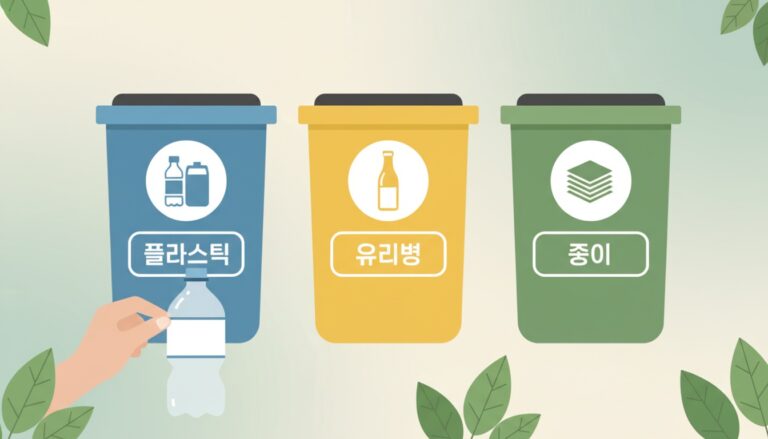
Phase 1: Introduction
안녕하세요! This is your Daily Hangul Editor.
Have you ever stood in front of a row of Korean trash bins, holding a plastic coffee cup, sweating nervously because an elderly building manager (we call them Gyeongbi-ajeossi) is watching your every move?
If you haven’t, you will. Korea takes recycling (재활용) and plastic pollution incredibly seriously. In a C1 (Advanced) context, simply knowing the word for “plastic” isn’t enough. You need to be able to discuss responsibility, inconvenience, and social trends regarding the environment.
Today, we move beyond survival Korean. We are going to talk about values. Knowing these expressions won’t just keep you out of trouble with the building manager—it will make you sound like an intellectual, conscientious resident who truly cares about Korean society.
Let’s dive into the deep end of ‘Bunri-sugo’ (Recycling/Sorting).
Phase 2: Deep Dive into Key Expressions
Here are three high-level expressions that will elevate your Korean from “tourist” to “resident.”
1. 분리배출 (Bunri-baechul)
- Pronunciation: [Bun-ni-bae-chul] Sound analogy: “Bun” as in bun, “Ni” as in knee, “Bae” as in bay, “Chul” sounds like ‘chew’ with an ‘L’ at the end.
- Meaning: Separation and Discharge (The official act of sorting trash).
- Editor’s Insight: Most beginners say 재활용 (Jae-hwal-yong – Recycling). However, strictly speaking, you don’t recycle; the factory does. You do 분리배출 (sorting and putting it out). Using this word shows you understand the administrative and civic side of the process.
- Situation Check: Formal & Written notices. Used when discussing rules.
2. 번거롭다 (Beon-geo-rop-da)
- Pronunciation: [Beon-geo-rop-da] Sound analogy: “Bun-go-rope-da”
- Meaning: To be cumbersome, a hassle, inconvenient (but often implies a necessary task).
- Editor’s Insight: Why teach this in an environment unit? Because recycling in Korea is a hassle! You have to wash containers, remove labels, and dry them. Being able to say, “It’s a bit cumbersome, but we have to do it,” (좀 번거롭긴 하지만 해야죠) creates immediate emotional solidarity with Koreans.
- Situation Check: Casual to Formal. Great for expressing empathy.
3. 일회용품 줄이기 (Ilhoeyongpum Jurigi)
- Pronunciation: [Il-hoe-yong-pum Ju-ri-gi]
- Meaning: Reducing disposable products.
- Editor’s Insight: 일회용품 (One-time use products) is a critical C1 noun. You will see this on posters in every cafe. It’s not just about “no plastic”; it’s about the movement of reducing consumption.
- Situation Check: Discussions about lifestyle, news, and cafe policies.
Phase 3: Textbook vs. Real Life
At the C1 level, you shouldn’t sound like a public service announcement. You should sound like a local complaining about the rules while still following them.
| Textbook (Standard/Formal) | Real Life (Natural/Nuanced) |
|---|---|
| 플라스틱을 씻어서 버리세요. (Please wash the plastic and throw it away.) |
이거 헹궈서 라벨 떼고 버려야 돼요. (You gotta rinse this and peel the label off before tossing it.) |
| 환경을 보호해야 합니다. (We must protect the environment.) |
요즘은 ‘필환경’ 시대잖아요. (These days, it’s the era where eco-friendly is ‘mandatory’, not just an option.) |
| 재활용 쓰레기는 어디에 둡니까? (Where do I put the recycling trash?) |
투명 페트병은 따로 모으는 거 아시죠? (You know transparent PET bottles are collected separately, right?) |
Note: ‘필환경’ (Pil-hwangyeong) is a trendy buzzword combining ‘Required’ (Pil) and ‘Environment’ (Hwangyeong). It means being eco-friendly is now a requirement for survival.
Phase 4: Cultural Context & Manners
The “Transparency” Rule (투명 페트병 별도 분리배출)
In Korea, there is a strict rule regarding transparent PET bottles (like water bottles). They must not be mixed with colored plastics.
- Empty the contents.
- Rinse the inside.
- Remove the label (This is the most crucial step! doing this shows high cultural intelligence).
- Crush it flat and close the cap.
The “Nunchi” of Trash Days
If you live in a villa or regular house (not a big apartment complex), trash days are specific (e.g., plastic on Tuesdays, paper on Thursdays). Putting mixed trash (무단 투기 – Mudan Tugi) out on the wrong day is a serious breach of etiquette. The CCTV cameras are watching, and neighbors will gossip about the “foreigner who doesn’t know how to sort trash.”
Phase 5: Roleplay Script
Setting: Two friends, Minji (Korean) and Sarah (Expat), are cleaning up after ordering delivery food (Baedal).
Minji: 아, 배부르다. 이제 치워볼까? 사라야, 그 플라스틱 용기는 그냥 버리면 안 돼.
(Ah, I’m full. Shall we clean up? Sarah, you can’t just throw away that plastic container.)
Sarah: 진짜? 그냥 재활용 통에 넣으면 되는 거 아니야? 좀 번거롭네.
(Really? Can’t I just put it in the recycling bin? It’s a bit of a hassle.)
Minji: 음식물이 묻어 있으면 재활용이 안 되거든. 물로 깨끗이 헹궈서 분리배출해야 해.
(If there’s food waste on it, it can’t be recycled. You have to rinse it clean and sort it properly.)
Sarah: 아, 맞다. 한국은 분리수거 규정이 엄격하지. 알겠어, 라벨도 제거할게.
(Ah, right. Korea has strict recycling rules. Okay, I’ll remove the label too.)
Minji: 오~ 역시! 너 이제 완전 한국 사람 다 됐는데? 환경 생각하는 모습 아주 칭찬해!
(Oh~ Nice! You’re basically fully Korean now? I praise your eco-conscious attitude!)
Phase 6: 10-Second Shadowing Drill
Let’s practice a sentence that expresses your sophisticated attitude towards recycling. Focus on the pause after ‘sasil’ (honestly).
사실 좀 귀찮긴 하지만, / 환경을 생각하면 / 일회용품을 줄이는 게 맞죠.
“Sasil jom gwichankin hajiman, / hwangyeongeul saeng-gak-hamyeon / ilhoeyongpumeul jurineun ge matjyo.”
(Honestly, it is a bit annoying, but considering the environment, it’s right to reduce disposables.)
Phase 7: FAQ & Troubleshooting
- Q: Can I use the word ‘쓰레기’ (Sseuregi – Trash) when asking where to put recyclables?
- A: It’s better to avoid it if possible. ‘Sseuregi’ usually implies general waste (burned or buried). For plastic/cans/paper, use ‘재활용품’ (Recyclables). Asking “Where is the Sseuregi?” might lead someone to point you to the general waste bin (Jongnyangje-bongtu), causing you to throw recyclables away incorrectly.
- Q: Is it rude to tell someone to pick up their trash?
- A: In Korea, direct confrontation is rare. Instead of “Pick that up,” try an indirect approach like, “저기요, 뭐 떨어뜨리셨는데요?” (Excuse me, you dropped something?). It gives them a chance to save face.
Phase 8: Wrap-up
- One-Liner Summary: Use ‘분리배출’ instead of just recycling, admit it’s ‘번거롭다’ (hassle) to build empathy, and always remove your labels!
- Action Mission: Next time you buy a bottle of water at a convenience store, peel off the label before you throw it in the bin, and if a Korean friend sees you, say: “환경 생각해야죠” (We gotta think about the environment).
- Engagement: Do you find Korea’s recycling system efficient or exhausting? Tell us in the comments below!
Phase 9: Quiz
- Which word best describes the official act of sorting and discharging trash?
- a) 쇼핑 (Shopping)
- b) 분리배출 (Bunri-baechul)
- c) 무단투기 (Mudan-tugi)
- What is the “trendy” word meaning “Eco-friendly is mandatory”?
- a) 필환경 (Pil-hwangyeong)
- b) 불환경 (Bul-hwangyeong)
- c) 친절 (Chin-jeol)
- Why did Minji stop Sarah from throwing away the plastic container immediately?
- a) She wanted to keep it.
- b) It had food waste on it (needs rinsing).
- c) It wasn’t Tuesday.
(Answers: 1-b, 2-a, 3-b)
Frequently Asked Questions (FAQ)
Q: What does "분리배출 (Bunri-baechul)" mean in Korean and how do you pronounce it?
A: In Korean, "분리배출 (Bunri-baechul)" is pronounced [Bun-ni-bae-chul] and means: Separation and Discharge (The official act of sorting trash).
Q: What does "번거롭다 (Beon-geo-rop-da)" mean in Korean and how do you pronounce it?
A: In Korean, "번거롭다 (Beon-geo-rop-da)" is pronounced [Beon-geo-rop-da] and means: To be cumbersome, a hassle, inconvenient (but often implies a necessary task).
Q: What does "일회용품 줄이기 (Ilhoeyongpum Jurigi)" mean in Korean and how do you pronounce it?
A: In Korean, "일회용품 줄이기 (Ilhoeyongpum Jurigi)" is pronounced [Il-hoe-yong-pum Ju-ri-gi] and means: Reducing disposable products.







