

Phase 1: Introduction
Hello! This is your editor from Daily Hangul. 👋
Picture this: You are sitting in a cozy restaurant in Seoul. The server places a bubbling stone pot (Ddukbaegi) in front of you. It smells amazing. You take a big spoonful, and—OUCH! 😱
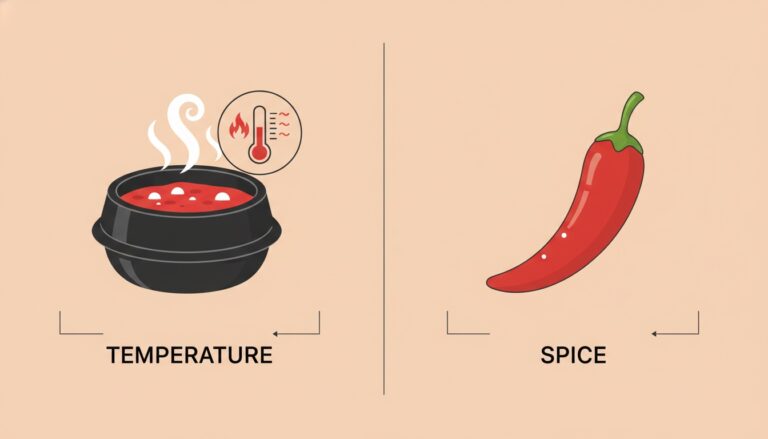
Your mouth is on fire. Not just because of the chili (spice), but because the soup is physically boiling. In English, we use the word “Hot” for both temperature and spice. But in Korea? Mixing these up can lead to confusing situations!
Today, in our Korean Tastes module, we are tackling the Unit: 뜨거워요 (It’s hot!). As a tutor, I’ve seen students sweating buckets because they couldn’t tell the waiter the food was too hot (temp) vs. too spicy. By the end of this post, you’ll know exactly how to save your tongue.
(Transparency Note: This guide is built from real questions asked by our A1 students during their first Korean BBQ experience!)
Phase 2: Deep Dive (Core Expressions)
Here are the absolute essentials. We are focusing on separating “Temperature” from “Spice.”
1. 뜨거워요 (It’s hot – Temperature)
- Pronunciation: [Tteu-geo-wo-yo]
- Sound Analogy: ‘Tteu’ sounds like the strong ‘T’ when you spit out a seed, followed by ‘geo’ (like ‘go’ but with your mouth open wider), and ‘wo-yo’.
- Meaning: It is hot (to the touch/taste).
- Editor’s Insight: 💡 Use this when your coffee burns your tongue or the soup is boiling. Do NOT use this to say the food is spicy!
- Situation Check: Polished casual. Good for servers, older friends, or strangers.
2. 매워요 (It’s spicy)
- Pronunciation: [Mae-wo-yo]
- Sound Analogy: ‘Mae’ sounds like the month ‘May’ or a sheep bleating ‘Mae~’.
- Meaning: It is spicy (flavor).
- Editor’s Insight: 💡 If your face is turning red from chili peppers, this is the word.
- Situation Check: Polished casual.
3. 아, 뜨거! (Ah, hot!)
- Pronunciation: [Ah, Tteu-geo!]
- Meaning: Ouch, hot!
- Editor’s Insight: 💡 This is an exclamation, like saying “Ouch!” reflexively. You say this to yourself when you accidentally touch a hot pot.
- Situation Check: Casual/Exclamation (Self-talk).
Phase 3: Textbook vs. Real Life
Textbooks often teach you full, robotic sentences. In a busy lunch rush in Gangnam, nobody talks like that. Here is the reality check:
| Textbook Korean 📚 | Real Life Korean (The Vibe) 😎 | Note |
|---|---|---|
| 이 음식은 매우 뜨겁습니다. (This food is very hot.) | 아, 너무 뜨거워요! (Ah, it’s too hot!) | ‘너무’ (Neomu) means ‘too/very’ and adds emotion. |
| 물을 좀 주시겠습니까? (Could you please give me some water?) | 물 좀 주세요. (Water, please.) | Simple and polite enough for any restaurant. |
| 이것은 맵습니까? (Is this spicy?) | 이거 매워요? (Is this spicy?) | Drop the robot ‘particle’ endings for natural flow. |
Editor’s Note: For A1 beginners, just remembering “Tteu-geo-wo-yo” effectively saves you from burns!
Phase 4: Cultural Context & Manners 🥢
1. The “Hoo-Hoo” Culture
In Western table manners, blowing on your food might be seen as rude. In Korea, when eating hot stews (Jjigae) or noodles, it is perfectly normal—and expected—to make a “Hoo-Hoo” sound while blowing on your spoon to cool it down. Don’t be shy!
2. The Magic of “Ap-jeop-si” (Front Plate)
If the main dish is boiling hot (like a shared stew), Koreans never eat directly from the bubbling pot. We use a small individual plate called 앞접시 (Ap-jeop-si).
* Tip: If you are struggling with the heat, just point to your table and ask: “Ap-jeop-si, please?” The server will understand immediately.
Phase 5: Real-Life Scenario (Roleplay)
Setting: A casual Kimchi-stew restaurant. The stew has just arrived, bubbling fiercely.
Characters:
* Alex: Hungry A1 Student 🇺🇸
* Server: Kind Korean Auntie (Imo-nim) 🇰🇷
(Server puts down a boiling stone pot)
Server: 김치찌개 나왔습니다. 뜨거우니까 조심하세요.
(Kimchi-jjigae is here. Be careful, it’s hot.)
Alex: (Touches the pot slightly) 아, 뜨거!
(Ah, hot! / Ah, Tteu-geo!)
Server: 네, 진짜 뜨거워요. 천천히 드세요.
(Yes, it’s really hot. Please eat slowly.)
Alex: (Tastes soup) 와… 안 매워요?
(Wow… is it not spicy? / Wa… An-mae-wo-yo?)
Server: 조금 매워요. 물 드릴까요?
(It’s a little spicy. Shall I give you water?)
Alex: 네, 물 좀 주세요!
(Yes, water please! / Ne, Mul jom ju-se-yo!)
Phase 6: 10-Second Shadowing Drill 🗣️
Let’s practice the sentence you will use most often when the food lands on your table. Read it aloud for 10 seconds.
“It is too hot. Please give me water.”
너무 뜨거워요. / 물 좀 주세요.
[Neo-mu Tteu-geo-wo-yo. / Mul jom Ju-se-yo]
💡 Coaching Point:
* Stress the Tteu in Tteugeowoyo. It implies the intensity of the heat.
* Pause briefly after wo-yo before asking for water.
Phase 7: FAQ & Troubleshooting ⚠️
Q: Can I use “Hot” (뜨거워요) to say someone is sexy?
A: No! 🙅♂️ If you point at a person and say “Tteu-geo-wo-yo,” you are saying their body temperature is high (fever) or they are physically burning. For “hot/popular,” we use different words (like Hat-hae), but stick to “Yeppeoyo” (Pretty) or “Meosisseoyo” (Cool) for now.
Q: Is it rude to say “Ah, Tteu-geo!” in front of an elder?
A: If it’s a reflex because you burned yourself, it’s fine! But try to cover your mouth slightly. It shows you have “Nunchi” (manners/sense).
Phase 8: Wrap-up & Mission 🚀
Today’s One-Liner:
Memorize 뜨거워요 (Temp) vs. 매워요 (Spice) to save your taste buds!
Your Mission:
Next time you order a coffee or tea, check the cup temperature with your hand and whisper to yourself: “Ah, tteugeowoyo!” (if it’s hot) or “An-tteugeowoyo” (if it’s not hot). Get used to the sound!
Have you ever burned your tongue in Korea? Tell me your story in the comments! 👇
Phase 9: Quick Quiz ✍️
1. The soup is boiling hot (temperature). What do you say?
a) 매워요 (Mae-wo-yo)
b) 뜨거워요 (Tteu-geo-wo-yo)
c) 추워요 (Chu-wo-yo)
2. You want to tell the waiter the food is too spicy. You say:
a) 너무 뜨거워요 (Too hot temp)
b) 너무 매워요 (Too spicy)
c) 물 주세요 (Give me water)
3. What is the “magic plate” used to cool down your food?
a) Kimchi
b) Ap-jeop-si (Front plate)
c) Bibimbap
Click to see answers
1. b, 2. b, 3. b
Frequently Asked Questions (FAQ)
Q: What does "뜨거워요 (It's hot - Temperature)" mean in Korean and how do you pronounce it?
A: In Korean, "뜨거워요 (It's hot - Temperature)" is pronounced [Tteu-geo-wo-yo] and means: a key conversational Korean expression covered in this lesson.
Q: What does "매워요 (It's spicy)" mean in Korean and how do you pronounce it?
A: In Korean, "매워요 (It's spicy)" is pronounced [Mae-wo-yo] and means: a key conversational Korean expression covered in this lesson.
Q: What does "아, 뜨거! (Ah, hot!)" mean in Korean and how do you pronounce it?
A: In Korean, "아, 뜨거! (Ah, hot!)" is pronounced [Ah, Tteu-geo!] and means: Ouch, hot!







