

🌿 Greetings from Daily Hangul!
Hello, language enthusiasts! It’s your Senior Editor at Daily Hangul.
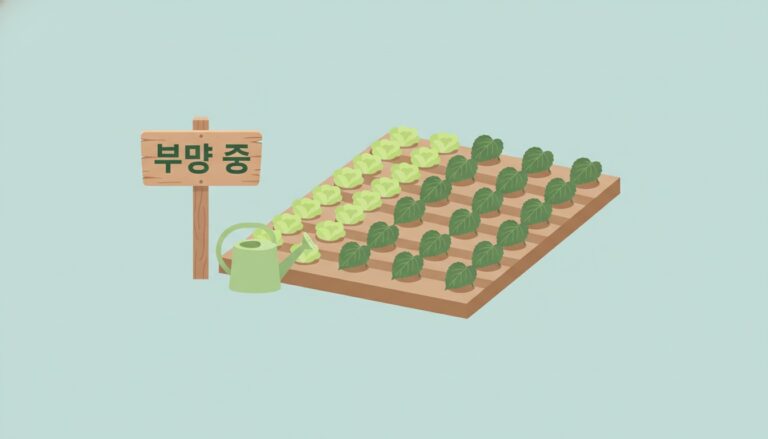
So, you’ve mastered ordering at a café and hailing a taxi. But now, you’re craving something greener. You want to escape the concrete jungle of Seoul and get your hands dirty. You’ve heard about “주말 농장 (Weekend Farms),” those magical little plots of land where city dwellers grow their own lettuce and peppers.
Here is the pain point: You walk into the administrative office (or call them), and suddenly, the vocabulary shifts from standard “textbook Korean” to specific real estate and agricultural terms. If you just say “I want to grow vegetables,” they might treat you like a tourist.
But if you know the word “분양 (Bun-yang)” or “구좌 (Gu-jwa),” their eyes will widen. They’ll think, “Oh, this person knows the system.”
Today, I’m going to help you secure the best plot of land with C1-level proficiency. Let’s get that dirt under your fingernails!
🔍 Phase 2: Deep Dive into Core Expressions
At the C1 level, we move beyond simple descriptions. We use specific terminology that fits the administrative context of renting land.
1. 분양 (Bun-yang)
- Pronunciation:
[bun-yang]Sounds like a hamburger ‘bun’ + ‘young’. - Meaning: Presale / Distribution / Parceling out
- Editor’s Insight: You might know this word from real estate news regarding apartments. However, it is the word used for renting these farm plots. You don’t “rent” (빌리다) a weekend farm; you “receive a bun-yang” (분양받다).
- Situation Check: Formal & Standard. Used when asking about availability.
2. 구좌 (Gu-jwa)
- Pronunciation:
[gu-jwa]‘Gu’ like ‘goo’ in goose + ‘jwa’ (soft j). - Meaning: Share / Account / Plot unit
- Editor’s Insight: This is the specific counter used for the plots of land. Usually, one gu-jwa is about 3~5 pyeong (approx. 10-16 sq meters). If you ask for “one piece of land,” you sound like a novice. Ask for “one gu-jwa.”
- Situation Check: Essential for discussing size and price.
3. 밑거름 (Mit-geo-reum)
- Pronunciation:
[mit-geo-reum]‘Mit’ (meat) + ‘geo’ (go) + ‘reum’ (room). - Meaning: Base fertilizer / Manure foundation
- Editor’s Insight: Before you plant, the land needs manure. A crucial question to ask is whether the farm provides this service included in the price. It separates the pros from the amateurs.
🆚 Phase 3: Textbook vs. Real Life
Let’s upgrade your Korean from “Student” to “Local Resident.”
| Textbook / Basic (A2-B1) | Real Korean / Advanced (C1) |
|---|---|
| 여기서 채소를 키우고 싶어요. (I want to grow vegetables here.) |
올해 주말 농장 분양 시작했나요? (Have you started the allotment for this year’s weekend farm?) |
| 땅이 얼마나 커요? (How big is the land?) |
한 구좌에 평수가 어떻게 되나요? (What is the square footage per share/plot?) |
| 물은 어디 있어요? (Where is the water?) |
관수 시설은 잘 되어 있나요? (Are the irrigation facilities set up well?) |
Note: Terms like 관수 시설 (irrigation facilities) make you sound incredibly professional, even if you’re just growing cherry tomatoes.
🇰🇷 Phase 4: Cultural Context & Manners
The “Water Hose” Nunchi (눈치)
When choosing your plot (자리 뽑기), don’t just look for the sun. The most coveted spots are near the water tank or hose. Carrying heavy watering cans back and forth in the Korean summer heat is brutal.
Pro Tip: If the manager likes you, they might “hint” at which numbers are closest to the water. This is why using polite, advanced vocabulary (honorifics) helps. It builds rapport.
The “Ssam” Culture
The purpose of these farms is 90% Samgyeopsal parties. You grow lettuce (상추) and perilla leaves (깻잎) to eat with grilled pork. It is culturally expected that if you have a surplus, you share it with your neighboring plot owners. It’s the “Jeong” (정) of the weekend farm.
🎭 Phase 5: Roleplay Scenario
Setting: You are calling the “City Weekend Farm” manager to inquire about a plot for this spring.
Characters:
* You: An expat who loves gardening.
* Manager: A friendly but busy Korean farm owner.
Manager: 행복 주말 농장입니다. (Happy Weekend Farm, speaking.)
You: (Cheerfully but politely) 안녕하세요! 올해 텃밭 분양 신청하려고 연락드렸는데요.
(Hello! I’m calling to apply for this year’s garden allotment.)
Manager: 아, 네. 그런데 기존 회원들이 많아서 자리가 얼마 안 남았어요.
(Ah, yes. But we have many existing members, so there aren’t many spots left.)
You: 아, 정말요? 혹시 딱 한 구좌만이라도 남은 거 없을까요?
(Oh, really? Is there perhaps not even a single share left?)
Manager: 음… 구석진 자리는 하나 있는데 괜찮으시겠어요?
(Hmm… There is one spot in the corner, would that be okay?)
You: 물 주는 곳이랑 너무 멀지만 않으면 괜찮습니다. 바로 입금할게요!
(As long as it’s not too far from the water source, it’s fine. I’ll transfer the money right away!)
🗣️ Phase 6: 10-Second Shadowing
Practice this sentence to sound like a seasoned gardener. Focus on the pauses /.
“혹시 분양 비용에 / 모종이랑 밑거름 작업도 / 포함되어 있는 건가요?”
- Pronunciation: Hok-si bun-yang bi-yong-e / mo-jong-i-rang mit-geo-reum ja-geop-do / po-ham-dwe-eo it-neun geon-ga-yo?
- Meaning: By any chance, does the allotment fee include the seedlings and the base fertilizer work?
❓ Phase 7: FAQ & Troubleshooting
Q: Can I use the word ‘임대 (Rent/Lease)’ instead of ‘분양’?
A: You can, and they will understand, but ‘임대’ sounds like a formal business contract for a building or large land. ‘분양’ is the culturally accepted term for these small community plots. Using ‘분양’ sounds much more natural.
Q: Is it okay to grill meat at the farm?
A: Maybe. This is the #1 question. Some farms have a designated BBQ zone (바베큐장), while others strictly ban fire. Always ask: “취사 가능한가요?” (Is cooking allowed?)
📝 Phase 8: Wrap-up & Action Item
One-Liner Summary:
To rent a garden plot, don’t ask to “rent land”; ask for a “Bun-yang (allotment)” of one “Gu-jwa (share).”
Action Mission:
Even if you aren’t renting a farm, look up “주말 농장” on Naver Maps near your area. Click on the reviews and see if you can spot the word “구좌” in the Korean comments!
Let’s Chat:
What vegetable would you plant first if you had a Korean garden? I’m Team Perilla Leaf (깻잎) all the way! Let me know in the comments.
🧩 Phase 9: Pop Quiz
1. Which word is the most natural counter for a weekend farm plot?
A) 개 (Gae)
B) 명 (Myeong)
C) 구좌 (Gu-jwa)
2. What is the Korean term for “base fertilizer” or “manure foundation”?
A) 겉거름
B) 밑거름
C) 옆거름
3. How do you politely ask if cooking (like BBQ) is allowed?
A) 밥 먹어도 돼요?
B) 취사 가능한가요?
C) 불장난 해도 돼요?
Click to see answers
1. C (구좌)
2. B (밑거름)
3. B (취사 가능한가요?) – Note: C means “Can I play with fire?”
Frequently Asked Questions (FAQ)
Q: What does "분양 (Bun-yang)" mean in Korean and how do you pronounce it?
A: In Korean, "분양 (Bun-yang)" is pronounced [bun-yang] and means: Presale / Distribution / Parceling out
Q: What does "구좌 (Gu-jwa)" mean in Korean and how do you pronounce it?
A: In Korean, "구좌 (Gu-jwa)" is pronounced [gu-jwa] and means: Share / Account / Plot unit
Q: What does "밑거름 (Mit-geo-reum)" mean in Korean and how do you pronounce it?
A: In Korean, "밑거름 (Mit-geo-reum)" is pronounced [mit-geo-reum] and means: Base fertilizer / Manure foundation







