

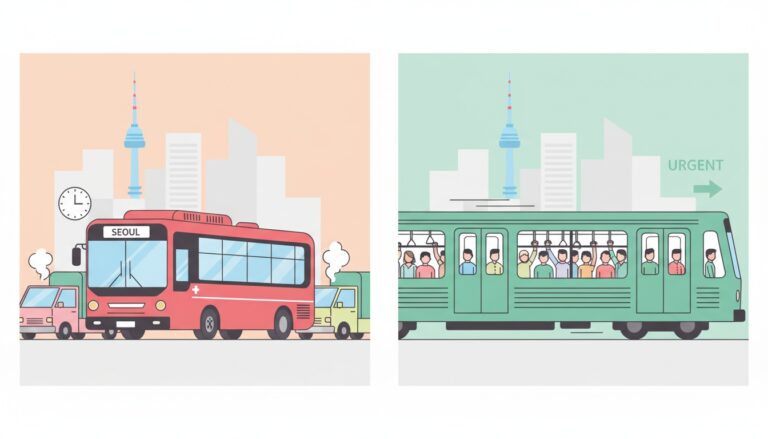
1. Introduction: The Eternal Dilemma – Bus or Subway?
Hello! I’m your editor at Daily Hangul. 👋
Imagine this: You are meeting a Korean friend in Gangnam. You check Naver Maps, and it gives you two options: the subway (Line 2, crowded but fast) or the bus (scenic but unpredictable).
When your friend asks, “Why did you take the bus?” do you just say “Bus… good”? 😅
Today, we are going to level up your Korean from simple facts to Intermediate (B1) comparisons. In Seoul, choosing between the Bus (버스) and Subway (지하철) is a daily debate. Being able to explain the pros and cons (장단점) is a huge step towards sounding like a local.
Let’s learn how to complain about traffic and praise the air-conditioning like a true Seoulite!
2. Deep Dive: Core Expressions for Comparison
Here are the top 3 structures you need to compare two things effectively.
1. A보다 B가 더 [Adjective]
(B is more [Adjective] than A)
- Pronunciation: [A-boda B-ga deo…]
- Meaning: This is the gold standard for comparison. ‘보다’ means ‘than’.
- Editor’s Insight: Don’t forget ‘더’ (more)! While you can drop it, adding it makes your emphasis stronger.
- Situation Check: Universal. Use it with friends or your boss.
- Example: 버스보다 지하철이 더 빨라요. (The subway is faster than the bus.)
2. [A]는 대신에 [B]
(Instead of/In return for A, B…)
- Pronunciation: [neun dae-sin-e]
- Meaning: Used when admitting a flaw to highlight a benefit (or vice versa). It shows you can see both sides.
- Editor’s Insight: This is the key to B1 level fluency. It shows nuance. “It’s fast, but in return, it’s crowded.”
- Situation Check: Great for discussions and expressing opinions.
- Example: 지하철은 빠른 대신에 계단이 많아요. (The subway is fast, but [in return] there are many stairs.)
3. 차가 막히다 / 지옥철
(Traffic is jammed / Hell-Subway)
- Pronunciation: [Cha-ga ma-ki-da] / [Ji-ok-cheol]
- Meaning:
- 차가 막히다: Traffic is bad/blocked.
- 지옥철: A slang combining ‘Hell’ (Jiok) + ‘Subway’ (Cheol).
- Editor’s Insight: If you use the word ‘지옥철’ regarding Line 9 during rush hour, every Korean will instantly bond with you over shared trauma.
3. Textbook vs. Real Life
Textbooks teach you to be polite. We teach you to be natural.
| Textbook Korean (Standard) | Real Life Korean (Natural/Vivid) |
|---|---|
| 지하철이 버스보다 편리합니다. (The subway is more convenient than the bus.) |
지하철이 빠르긴 한데, 갈아타기 귀찮아요. (The subway is fast, sure, but transferring is a hassle.) |
| 교통 체증이 심합니다. (Traffic congestion is severe.) |
지금 차 장난 아니게 막혀요. (The traffic is no joke right now.) |
| 사람이 너무 많아서 힘들어요. (It is hard because there are too many people.) |
완전 지옥철이라서 숨도 못 쉬겠어요. (It’s a total Hell-subway, I can’t even breathe.) |
💡 Editor’s Note: “귀찮아요” (annoying/hassle) is a very common feeling when deciding transport. Use it when you don’t want to walk or transfer!
4. Cultural Context: The “Pali-Pali” & Eye Contact
1. The Obsession with “Fastest Route”
Koreans live by “Pali-Pali” (Hurry, Hurry). When discussing transport, the time difference is usually the most important factor. If you say, “I took the bus because I like the view,” a Korean might look confused and ask, “But wasn’t the subway 10 minutes faster?”
2. Subway Manner (The Glare)
In the subway, if you are talking loudly about these pros and cons, you might get “noon-chi” (scolding with eyes) from others. Korean public transport is surprisingly quiet. Keep your voice volume low (low drama tone) when practicing these dialogues on the train!
5. Real-Life Roleplay
Scenario: You (Alex) meet your Korean friend (Minji) at a cafe. You are discussing how to get to the next location.
Characters:
* Alex (Foreigner): Wants comfort.
* Minji (Korean): Wants speed.
Dialogue:
Minji: 우리 강남역까지 어떻게 갈까? 지금 퇴근 시간이야.
(Uri Gangnam-yeok-kkaji eotteoke galkka? Jigeum toe-geun sigan-iya.)
How should we go to Gangnam station? It’s rush hour right now.
Alex: (Looking at phone) 버스 타는 건 어때? 지하철은 사람이 너무 많잖아.
(Bus taneun geon eottae? Jihacheol-eun saram-i neomu man-jana.)
How about taking the bus? You know the subway has too many people.
Minji: 음, 버스는 편한 대신에 차가 너무 막힐걸?
(Eum, bus-neun pyeonhan daesin-e cha-ga neomu makil-geol?)
Hmm, the bus is comfortable, but [in exchange] the traffic will probably be jammed?
Alex: 그래도 지옥철보다는 낫지 않을까? 앉아서 가고 싶어.
(Geuraedo jiokcheol-bodaneun nat-ji aneulkka? Anjaseo gago sipeo.)
Still, wouldn’t it be better than the Hell-subway? I want to go sitting down.
6. 10-Second Shadowing Drill
Read this aloud to practice your intonation. Pause where you see the /.
“Even though the bus is comfortable, the subway is better because there is no traffic.”
버스가 편하긴 하지만 / 차가 안 막히니까 / 지하철이 낫겠어요.
[Bus-ga pyeon-hagin haji-man / cha-ga an ma-ki-nikka / jihacheol-i nat-gesseoyo.]
🔑 Key Tip: Raise your intonation slightly at ‘하지만’ (but) to show you are contrasting ideas.
7. FAQ & Troubleshooting
Q: Can I use “지옥철” (Hell-subway) with my boss?
A: Maybe. It depends on your relationship. If your boss is complaining about their commute first, you can use it to agree lightly. But in a formal report? Absolutely not. Stick to “혼잡합니다” (It is crowded).
Q: What if I don’t know the word for “transfer”?
A: Just use “갈아타요” (Gal-a-ta-yo). The formal word is “환승” (Hwan-seung), but “Gal-a-ta-yo” is what everyone uses in conversation. Think of it as “Get off and get on.”
8. Wrap-up
One-Liner Summary: Use ~보다 (than) to compare, and remember that Subway = Fast but Crowded, Bus = Comfy but Traffic Jams.
📢 Action Mission: Next time you are with a friend, open your map app and say: “지금은 차가 막히니까 지하철 타자!” (Traffic is bad now, so let’s take the subway!)
Tell me in the comments: Are you Team Bus 🚌 or Team Subway 🚇 in Seoul? Why?
9. Pop Quiz
1. Which sentence means “The subway is faster than the bus”?
A) 버스가 지하철보다 빨라요.
B) 지하철이 버스보다 빨라요.
C) 지하철이 버스만큼 빨라요.
2. How do you say “Traffic is jammed” naturally?
A) 차가 아파요. (The car is sick.)
B) 차가 막혀요. (The car is blocked.)
C) 차가 없어요. (There is no car.)
3. What is the slang for an extremely crowded subway?
A) 천국철 (Heaven-subway)
B) 지옥철 (Hell-subway)
C) 사람철 (Human-subway)
(Scroll down for answers)
Click to see answers
1. B
2. B
3. B
Frequently Asked Questions (FAQ)
Q: What does "'더'" mean in Korean and how do you pronounce it?
A: In Korean, "'더'" is pronounced [more] and means: ! While you can drop it, adding it makes your emphasis stronger.
Q: What does ""갈아타요"" mean in Korean and how do you pronounce it?
A: In Korean, ""갈아타요"" is pronounced [Gal-a-ta-yo] and means: . The formal word is "환승" (Hwan-seung), but "Gal-a-ta-yo" is what everyone uses in conversation. Think of it as "Get off and get on."
Q: What does "~보다" mean in Korean and how do you pronounce it?
A: In Korean, "~보다" is pronounced [than] and means: to compare, and remember that







