

Phase 1: Introduction (공감)
Greeting: 안녕하세요! This is your Daily Hangul Editor.
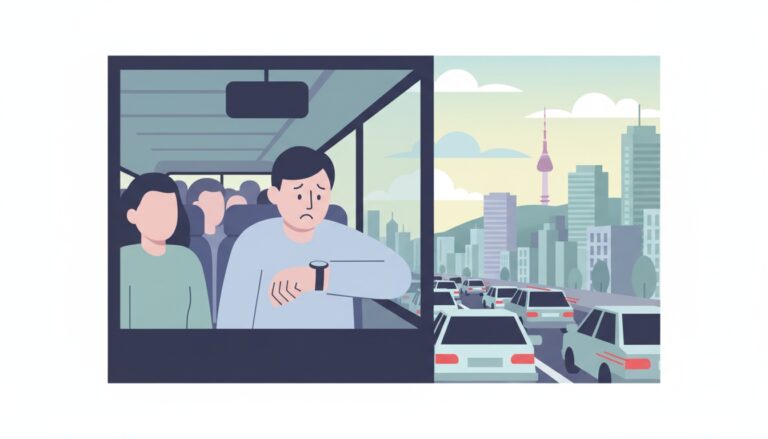
Imagine this: You are sitting in a taxi crossing the Hannam Bridge in Seoul. You have a dinner reservation with your Korean friends in 20 minutes. But looking out the window, all you see is a sea of red brake lights. The car hasn’t moved for 5 minutes. 😱
Panic sets in. You know how to say “I’m sorry” (미안해요), but that doesn’t explain why you are late. In Korea, simply saying sorry without a reason can sometimes feel insincere. Explaining the situation clearly—that it’s not your fault, but the traffic’s fault—is the key to being forgiven and maintaining your ‘insider’ status.
Today, we will learn how to explain that “Traffic is terrible, so I’m running late.” These are real phrases I’ve taught my students who actually live in bustling cities like Seoul and Busan.
Phase 2: Deep Dive (핵심 표현 심층 분석)
Here are the three most natural ways to handle this stressful situation. We are aiming for B1 Level—not too simple, but very natural.
1. 차가 너무 막혀요 (The traffic is blocked/jammed)
- Pronunciation: [Cha-ga neo-mu ma-kyeo-yo]
- Sound-alike: “Chah-gah nuh-moo mah-kyuh-yo”
- Meaning: Traffic is really backed up. (Lit: The car is blocked a lot.)
- Editor’s Insight: This is the bread-and-butter phrase. You can use this with anyone. Notice we use 차가 (car) instead of 교통이 (traffic) in daily conversation. ‘교통’ sounds like a news report.
- Situation Check: ✅ Friends (Casual) / ✅ Boss (Polite)
2. 사고가 났나 봐요 (It looks like there was an accident)
- Pronunciation: [Sa-go-ga nan-na bwa-yo]
- Sound-alike: “Sah-go-gah nan-nah bwah-yo”
- Meaning: It seems like an accident happened.
- Editor’s Insight: This is a great B1 expression. Using -나 봐요 (it seems/I guess) shows you are observing the situation. It shifts the blame entirely to the external environment. “I tried to be on time, but the universe said no!”
- Situation Check: ✅ Friends (Casual) / ✅ Co-workers (Polite)
3. 꼼짝 못 하고 있어요 (I’m stuck/I can’t move at all)
- Pronunciation: [Kkom-jjak mot ha-go i-sseo-yo]
- Sound-alike: “Kkom-jjak mot ha-go ee-ssuh-yo”
- Meaning: I am totally stuck. (Lit: I cannot make a budging movement.)
- Editor’s Insight: Use this when you want to emphasize your frustration. 꼼짝 (kkom-jjak) is a mimetic word for a small movement. Putting mot (cannot) after it means you are paralyzed in traffic. It triggers sympathy!
- Situation Check: ✅ Friends (Casual) / ⚠️ Boss (Use with caution, it sounds a bit dramatic)
Phase 3: Textbook vs. Real Life (교과서 vs 진짜 한국어)
Let’s see the difference between what a textbook teaches and what we actually say on KakaoTalk.
| Textbook (Formal/Stiff) | Real Life (Natural/Smart) |
|---|---|
| 교통이 혼잡해서 늦습니다. (Traffic is congested, so I am late.) |
차가 안 움직여요 ㅠㅠ (The cars aren’t moving crying emoji) |
| 약속 시간을 변경할 수 있습니까? (Can we change the appointment time?) |
한 10분 정도 늦을 것 같아요. (I think I’ll be about 10 mins late.) |
| 지금 가는 중입니다. (I am in the middle of going now.) |
거의 다 왔어요! (I’m almost there! Even if you are 15 mins away) |
Note: Koreans love using “거의 다 왔어요” (Almost there) to reassure the other person, even if they are actually still a few subway stops away. It’s a “White Lie” of kindness!
Phase 4: Cultural Context (문화와 매너)
💡 The “Update” Culture (보고 문화)
In Korea, being late is generally frowned upon, but silence is worse than lateness.
If you realize you are going to be even 5 minutes late due to traffic, send a message immediately. Do not wait until the meeting time has passed.
- The Golden Rule: If you are stuck in traffic, send a photo of the traffic jam. It acts as “visual proof” and makes the other person feel like you are sharing the pain with them. It instantly lowers their annoyance level!
Phase 5: Roleplay Scenario (실전 시나리오)
Setting: You are on a bus to Hongdae to meet your friend Minji. It is Friday night, and traffic is terrible.
(Phone rings. You pick up quietly because you are on a bus.)
Minji: 어디야? 벌써 7시인데! (Where are you? It’s already 7!)
You: 아, 민지야 미안해. 차가 너무 막혀. (Ah, Minji, I’m sorry. Traffic is backed up too much.)
* [Ah, Minji-ya mian-hae. Cha-ga neo-mu ma-kyeo.]
Minji: 진짜? 얼마나 걸려? (Really? How long will it take?)
You: 앞에서 사고가 났나 봐. 버스가 꼼짝 못 하고 있어. (I think there’s an accident ahead. The bus can’t move at all.)
* [A-pe-seo sa-go-ga nan-na bwa. Beo-seu-ga kkom-jjak mot ha-go i-sseo.]
Minji: 알겠어. 천천히 와. (Okay. Come slowly / take your time.)
You: 응, 금방 갈게! (Okay, I’ll be there soon!)
* [Eung, geum-bang gal-ge!]
Phase 6: 10-Second Shadowing (섀도잉)
Read this out loud to practice your intonation. Pause where you see the slash /.
“미안해요 / 차가 너무 막혀서 / 조금 늦을 것 같아요.”
- Meaning: I’m sorry / because traffic is so bad / I think I’ll be a little late.
- Focus: Put a sad/apologetic tone on “미안해요” and stress “너무 (too/very)” to emphasize the traffic situation.
Phase 7: FAQ (Troubleshooting)
Q: Can I use “차가 막혀요” when the subway is delayed?
A: No! “차” specifically means car/vehicle on the road. If the subway is delayed, say “지하철이 연착됐어요” (The subway is delayed) or simply “지하철이 안 와요” (The subway isn’t coming).
Q: How do I say “It’s rush hour”?
A: You can say “퇴근 시간이라서 막혀요” (It’s jammed because it’s get-off-work time). “퇴근 시간” is the Korean equivalent of evening rush hour.
Phase 8: Wrap-up & Action Mission
📝 One-Liner Summary:
When late, don’t just say sorry—blame the traffic with “차가 너무 막혀요” and predict your arrival with “~늦을 것 같아요.”
🚀 Action Mission:
Next time you are on public transport (even in your home country), look out the window and whisper to yourself: “와, 차가 진짜 많이 막히네” (Wow, traffic is really backed up). Getting used to the feeling of the phrase is half the battle!
🗣️ Editor’s Question:
What is the worst excuse you’ve ever heard for being late? Tell me in the comments! (I once heard “My cat hid my keys”…)
Phase 9: Quiz (퀴즈)
Let’s check if you are ready for Seoul traffic!
1. Your friend asks where you are. You are stuck in a taxi. What is the most natural reply?
A) 차가 아파요. (The car is sick.)
B) 차가 너무 막혀요. (The traffic is backed up.)
C) 나는 운전을 안 해요. (I don’t drive.)
2. Which phrase implies you are “completely stuck” and can’t move?
A) 꼼짝 못 하고 있어요.
B) 천천히 가고 있어요.
C) 빨리 갈게요.
3. How do you say “I think there was an accident”?
A) 사고가 좋아요.
B) 사고가 났나 봐요.
C) 사고를 샀어요.
(Answers: 1.B, 2.A, 3.B)
Frequently Asked Questions (FAQ)
Q: What does "차가 너무 막혀요 (The traffic is blocked/jammed)" mean in Korean and how do you pronounce it?
A: In Korean, "차가 너무 막혀요 (The traffic is blocked/jammed)" is pronounced [Cha-ga neo-mu ma-kyeo-yo] and means: a key conversational Korean expression covered in this lesson.
Q: What does "사고가 났나 봐요 (It looks like there was an accident)" mean in Korean and how do you pronounce it?
A: In Korean, "사고가 났나 봐요 (It looks like there was an accident)" is pronounced [Sa-go-ga nan-na bwa-yo] and means: a key conversational Korean expression covered in this lesson.
Q: What does "꼼짝 못 하고 있어요 (I'm stuck/I can't move at all)" mean in Korean and how do you pronounce it?
A: In Korean, "꼼짝 못 하고 있어요 (I'm stuck/I can't move at all)" is pronounced [Kkom-jjak mot ha-go i-sseo-yo] and means: a key conversational Korean expression covered in this lesson.







