

Phase 1: Introduction
안녕하세요! This is your Senior Editor at Daily Hangul.
Have you ever watched a Korean variety show like I Live Alone (나 혼자 산다) or The Manager (전지적 참견 시점) late at night? You see the cast visiting a rest stop or a hidden restaurant, and suddenly, you’re starving. They take a bite, eyes go wide, and captions fly across the screen.
But here’s the frustrating part for learners: the subtitles just say, “It’s delicious.”
Really? Just “delicious”? The Korean cast member actually shouted, “Wow, this is a total rice thief! (와, 이거 완전 밥도둑이네!)” or “The texture is crazy! (식감이 미쳤어!)”
If you stick to standard textbook Korean like “맛있어요 (It’s delicious),” you’re missing out on 80% of the fun. To truly connect with Korean friends over a meal—or just understand why the variety show editors are putting fire effects on the screen—you need to level up your food vocabulary.
Today, we are going to learn the “Mukbang (Eating Broadcast)” expressions that will take you from a beginner student to a foodie insider.
Phase 2: Deep Dive into Core Expressions
Here are the top 3 expressions you will hear in almost every Korean food show. Since you are at a B2 level, we are moving beyond simple adjectives.
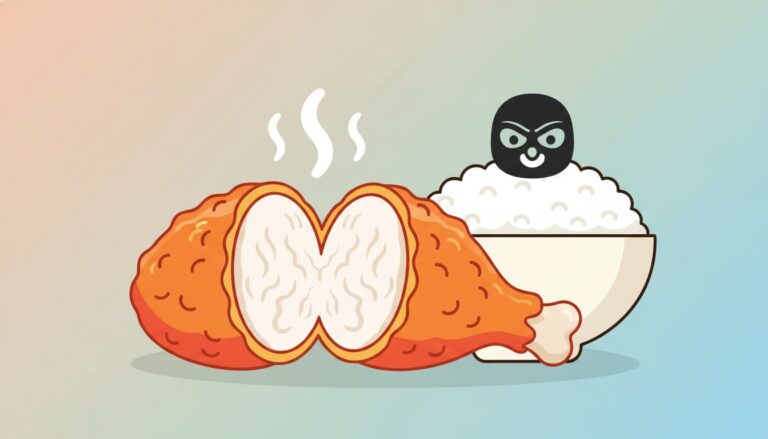
1. 겉바속촉 (Geot-ba-sok-chok)
- Pronunciation: [Geot-ba-sok-chok] Think of: ‘Got’ + ‘Ba’ (like sheep) + ‘Soak’ + ‘Choke’
- Meaning: Crispy on the outside, moist on the inside.
- It is an abbreviation of 겉은 바삭하고 속은 촉촉하다.
- Editor’s Insight: This is the holy grail of texture in Korea. You use this for fried chicken, pork cutlets (Tonkatsu), or even freshly baked croissants. If you bite into fried chicken and say this, your Korean friends will look at you with pure respect.
- Situation Check: Casual ✅ | Formal (Light) ✅ (It’s a slang acronym, but widely accepted even in semi-formal foodie contexts).
2. 입에서 살살 녹아요 (Ibeso salsal nogayo)
- Pronunciation: [Ibeso sal-sal no-ga-yo]
- Meaning: It literally melts gently in my mouth.
- Editor’s Insight: “맛있어요” is a fact. “입에서 살살 녹아요” is an experience. Use this for high-quality beef (Hanwoo), sashimi, or really soft stewed meat (Galbijjim). The word ‘살살 (sal-sal)’ is an adverb mimicking a gentle, sliding motion.
- Situation Check: Casual ✅ | Formal ✅ (Very polite and descriptive).
3. 밥도둑 (Bap-do-duk)
- Pronunciation: [Bap-doe-dook]
- Meaning: Rice Thief.
- Editor’s Insight: This doesn’t mean someone stole your rice! It refers to a side dish that is so savory and delicious (usually salty or spicy) that your bowl of rice disappears before you know it. It’s the highest compliment for dishes like Soy Sauce Marinated Crab (Ganjang-gejang) or Kimchi Stew.
- Situation Check: Casual ✅ | Formal ✅ (It’s an idiom, not slang).
Phase 3: Textbook vs. Real Life
Let’s see how a standard student speaks versus how a “Daily Hangul” insider speaks.
| Textbook (Safe, slightly robotic) | Real Korean (Natural, Variety Show Style) |
|---|---|
| 이 치킨은 아주 바삭해요. (This chicken is very crispy.) |
와, 이거 완전 겉바속촉 제대로다! (Wow, this is ‘geot-ba-sok-chok’ done right!) |
| 정말 맛있어요. (It is really delicious.) |
국물이 끝내줘요. (The broth is killer / ends it all.) |
| 배가 많이 고파서 빨리 먹었어요. (I was hungry so I ate fast.) |
완전 폭풍흡입 했어요. (I totally ‘storm-inhaled’ it.) |
Editor’s Note: “폭풍흡입 (Storm-inhaling)” is a classic caption you’ll see in variety shows when a cast member eats enthusiastically without talking.
Phase 4: Cultural Context & Manners
The Art of “Myeon-chigi” (면치기)
In many Western cultures, slurping noodles is considered rude. However, in Korean variety shows, you will see the concept of Myeon-chigi (Noodle-hitting).
This refers to slurping noodles loudly and continuously without biting them off, so the end of the noodles “hits” your face/lips. In the context of Mukbang, this is seen as showing appreciation for the food and stimulating the viewer’s appetite.
⚠️ Reality Check: While famous comedians do this on TV, do not do this excessively on a blind date or a formal business dinner. In real life, a quiet slurp is fine, but a variety-show-level slurp can be messy and distracting!
Phase 5: Roleplay Script
Setting: Two friends, Min-ji (Korean) and Alex (Expat), are at a Korean Fried Chicken restaurant.
Min-ji: (Taking a bite) 와, 여기 치킨 진짜 오랜만이다. 빨리 먹어봐.
(Wow, it’s been a while since I came to this chicken place. Hurry up and try it.)
Alex: (Taking a crunching bite) 음! 대박. 껍질은 진짜 바삭한데 살은 부드러워.
(Mmm! Daebak. The skin is really crispy but the meat is soft.)
Min-ji: 그치? 완전 겉바속촉이지?
(Right? It’s totally Geot-ba-sok-chok, isn’t it?)
Alex: 응, 완전! 그리고 양념 소스도 입에 착착 감기네.
(Yes, totally! And the seasoning sauce really ‘wraps around my mouth’ [tastes savory/addictive].)
Min-ji: 오, 알렉스! 이제 한국 사람 다 됐네. 표현이 살아있어!
(Oh, Alex! You’re basically Korean now. Your expressions are alive!)
Phase 6: 10-Second Shadowing
Let’s practice a sentence you can say when you eat something amazing. Focus on the pause to emphasize the drama.
“와, / 식감이 진짜 예술이네요. / 입에서 / 살살 녹아요.”
- Romanization: Wa, / sik-gami jinjja ye-surineyo. / Ibeseo / salsal nogayo.
- Translation: Wow, / the texture is truly art. / It / melts gently in my mouth.
💡 Tip: Put stress on ‘예술 (Art)’ and ‘살살 (Gently)’. It makes you sound like a gourmet judge.
Phase 7: FAQ & Troubleshooting
Q: Can I use “JMT (Jon-Mat-Taeng)” to my boss?
A: Absolutely NOT. JMT is an abbreviation for “John-Mat-Taeng” (Damn tasty). It is very casual slang. If you are with close friends, it’s fun. If you are with your boss or teacher, stick to “정말 꿀맛이에요 (It tastes like honey)” or “별미네요 (It’s a special delicacy).”
Q: What if the food actually tastes bad?
A: Koreans rarely say “It tastes bad (맛없어요)” directly to the cook. Instead, they might say “제 입맛에는 조금 특이하네요” (It’s a bit unique for my taste) or “건강한 맛이에요” (It tastes healthy… which often implies bland or bitter!).
Phase 8: Wrap-up
Summary: Today we moved beyond “Delicious” to describe texture (겉바속촉), experience (입에서 살살 녹아요), and addictiveness (밥도둑).
Mission: Next time you eat something crispy (even if it’s just toast), post a picture on your story and caption it #겉바속촉. See if your Korean friends react!
Comment below: What is a Korean food you tried that was a total “Rice Thief” (밥도둑)? Tell me in the comments!
Phase 9: Quiz
1. Which food is the best match for the expression “겉바속촉” (Crispy outside, soft inside)?
a) Kimchi Jjigae (Stew)
b) Fried Chicken
c) Porridge (Juk)
2. Your friend invites you to eat Soy Sauce Crab (Ganjang-gejang). After eating two bowls of rice, what is the best idiom to use?
a) It’s a Police Officer.
b) It’s a Rice Thief (밥도둑).
c) It’s a Water Thief.
3. You are eating with your company CEO. Which phrase is safest to use?
a) 와, JMT네요! (Wow, JMT!)
b) 식감이 미쳤네요. (The texture is crazy.)
c) 고기가 입에서 살살 녹습니다. (The meat melts gently in my mouth.)
(Answers: 1. b, 2. b, 3. c)
Frequently Asked Questions (FAQ)
Q: What does "겉바속촉 (Geot-ba-sok-chok)" mean in Korean and how do you pronounce it?
A: In Korean, "겉바속촉 (Geot-ba-sok-chok)" is pronounced [Geot-ba-sok-chok] and means: Crispy on the outside, moist on the inside.
Q: What does "입에서 살살 녹아요 (Ibeso salsal nogayo)" mean in Korean and how do you pronounce it?
A: In Korean, "입에서 살살 녹아요 (Ibeso salsal nogayo)" is pronounced [Ibeso sal-sal no-ga-yo] and means: It literally melts gently in my mouth.
Q: What does "밥도둑 (Bap-do-duk)" mean in Korean and how do you pronounce it?
A: In Korean, "밥도둑 (Bap-do-duk)" is pronounced [Bap-doe-dook] and means: Rice Thief.







