Hello! This is your Senior Editor at Daily Hangul.
Let’s be honest. As a C1 level learner, you can discuss Korean politics, talk about K-dramas in depth, and maybe even write a decent business email. But could you save a life in Korean?
Imagine you are walking down a street in Hongdae or hiking in Bukhansan, and suddenly, someone collapses. Your heart races. You call 119. In that split second, fancy grammar doesn’t matter. Accuracy and speed do.
Today, we are moving away from comfortable classroom dialogues. We are tackling survival Korean. Specifically, how to report an emergency (CPR situation) and, most importantly, how to pinpoint your location when there are no obvious landmarks.
This guide is based on real questions from advanced learners who realized they didn’t know the Korean word for “cardiac arrest” until they needed it.
Phase 2: Deep Dive (Critical Vocabulary)
At the C1 level, saying “He is sick” (아파요) is not enough. You need specific medical terminology to help the dispatcher prioritize the ambulance.
1. 심정지 (Cardiac Arrest)
- Pronunciation:
Sim-jeong-ji[Think of ‘Sim’ as in ‘Simulation’ + ‘Jeong’ as in ‘Junk’ without ‘k’ + ‘Ji’ as in ‘G’]- Meaning: Cardiac arrest (Heart stoppage)
- Editor’s Insight: This is the magic word that triggers the highest urgency code. If someone isn’t breathing and has no pulse, don’t say “기절했어요” (They fainted). Say “심정지 의심 환자입니다” (Suspected cardiac arrest patient).
- Situation Check: Urgent/Formal. Use this immediately with the 119 operator.
2. 의식/호흡이 없다 (Unconscious / No breathing)
- Pronunciation:
Ui-sik / Ho-heup-i eop-da- Meaning: No consciousness / No breathing
- Editor’s Insight: The operator will ask two things first: “의식 있습니까?” (Are they conscious?) and “숨은 쉽니까?” (Are they breathing?). Memorize this phrase to answer proactively.
3. 위치 추적 (Location Tracking) & 전신주 번호 (Utility Pole Number)
- Pronunciation:
Jeon-sin-ju beon-ho- Meaning: Utility pole number (unique serial number)
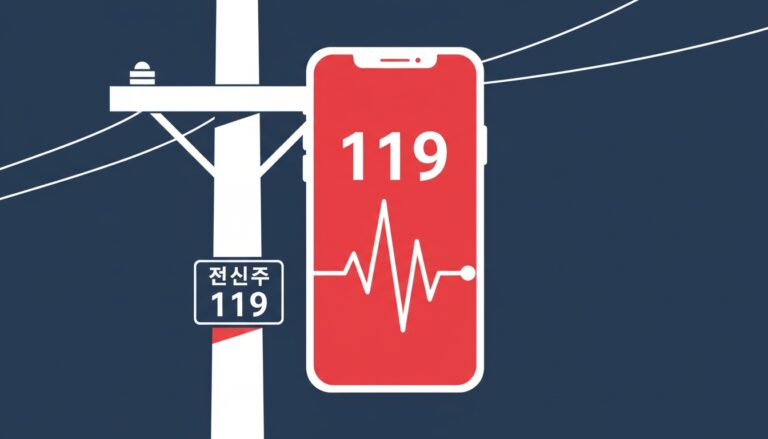
- Editor’s Insight: This is a Real Korean Pro Tip. If you are in an alleyway or on a hiking trail with no address, look for a utility pole (electrical pole). There is a silver plate with 8 digits (e.g., 1234A567). Read this to 119, and they can pinpoint your location to within meters.
Phase 3: Textbook vs. Real Life
In an emergency, brevity is key. Drop the honorifics cushioning (쿠션어) and get to the point.
| Textbook (Correct but Slow) | Real Life (Urgent & Natural) |
|---|---|
| 응급 환자가 발생했습니다. 도와주세요. (An emergency patient has occurred. Please help.) | 여기 사람 쓰러졌어요! 숨을 안 쉬어요! (Person collapsed here! Not breathing!) |
| 주소를 잘 모르겠습니다. (I don’t know the address well.) | 여기 OO건물 바로 앞이에요. / 전신주 번호 불러드릴게요. (Right in front of OO building. / I’ll read the utility pole number.) |
| 심폐소생술을 어떻게 하는지 모릅니다. (I do not know how to do CPR.) | CPR 할 줄 몰라요! 스피커폰으로 알려주세요! (I don’t know CPR! Tell me over speakerphone!) |
Note: Even in panic, using terms like ‘스피커폰’ (Speakerphone) helps the operator guide you through CPR (Chest Compressions: 가슴 압박) remotely.
Phase 4: Cultural Context & Manners
1. The “Golden Time” (골든타임)
Koreans often refer to the critical window for saving a life as “Golden Time.” You will hear news reports saying “골든타임을 놓쳤다” (Missed the golden time). Using this word shows you understand the urgency.
2. The Fear of Liability (Good Samaritan Law)
Historically, some Koreans were hesitant to help strangers due to fear of legal issues. However, the Good Samaritan Law (선한 사마리아인 법) protects you. If you are trained, act confidently. If you shout “도와주세요!” (Help me!), point to a specific person: “거기 파란 모자 쓰신 분, 119 신고 좀 해주세요!” (You in the blue hat, please call 119!). This breaks the bystander effect.
Phase 5: Real-Life Scenario (Roleplay)
Setting: A quiet hiking trail behind a neighborhood. A hiker suddenly clutches their chest and falls.
- You: (Phone out, dialing 119) 여보세요! 여기 관악산 등산로 입구 근처인데요, 등산객 한 분이 쓰러지셨어요.
- (Hello! I’m near the Gwanaksan trail entrance, a hiker has collapsed.)
- 119 Operator: 환자분 의식 있습니까? 호흡은요?
- (Is the patient conscious? How is the breathing?)
- You: (Checking pulse) 의식도 없고 숨도 안 쉬어요. 심정지 같아요! 빨리 와주세요!
- (No consciousness, not breathing. Looks like cardiac arrest! Come quickly!)
- 119 Operator: 정확한 위치가 어디죠? 근처에 큰 건물 있나요?
- (What represents your exact location? Any big buildings nearby?)
- You: (Looking around wildly) 산이라 건물이 없어요. 아! 전신주 번호 보여요. 5821A… 3912요!
- (It’s a mountain, no buildings. Ah! I see a utility pole number. It’s 5821A… 3912!)
- 119 Operator: 네, 위치 확인됐습니다. 구급차 출발합니다. 스피커폰 켜시고 제 지시에 따라 가슴 압박 시작하세요.
- (Okay, location confirmed. Ambulance departing. Turn on speakerphone and start chest compressions per my instructions.)
Phase 6: 10-Second Shadowing
Practice this sentence until it becomes muscle memory. Clarity is vital here.
“지금 / 환자가 의식이 없고 / 숨을 안 쉬어요. / 빨리 구급차 보내주세요!”
(Right now / the patient is unconscious / and not breathing. / Please send an ambulance quickly!)Pronunciation Guide: Ji-geum / hwan-ja-ga ui-si-gi op-go / su-meul an swi-o-yo / ppal-li gu-geup-cha bo-nae-ju-se-yo!
Phase 7: FAQ & Troubleshooting
- Q: Can I speak English to 119?
- A: Yes, but it takes time. 119 will conference in a volunteer interpreter (BBB Korea or similar). This adds a delay of 1-3 minutes. In a cardiac arrest situation, knowing simple Korean phrases like “주소 (Address)” and “심정지 (Cardiac Arrest)” saves precious time.
- Q: What if I don’t know the address?
- A: Look for: 1. Utility Poles (Top right numbers), 2. Store Signs (Call out the name and phone number on the sign), 3. Elevator ID numbers (Inside elevators).
Phase 8: Wrap-up & Action Item
Summary: Use precise terms like 심정지 (cardiac arrest), and use Utility Pole numbers (전신주 번호) if you are lost.
🔥 Today’s Mission:
Next time you walk outside in Korea, find a utility pole (전신주). Locate the silver plate with the 8-digit serial number. Take a picture of it. Knowing where to look is half the battle won.
Have you ever had to call emergency services in a foreign country? Tell me your story in the comments!
Phase 9: Quiz
- Which word should you use to indicate the patient’s heart has stopped?
a) 배가 아파요 (Stomachache)
b) 기절했어요 (Fainted)
c) 심정지 (Cardiac Arrest) -
If you are lost on a hiking trail, what number should you read to 119?
a) Your passport number
b) The utility pole number (전신주 번호)
c) The current time -
What is the Korean term for “Chest Compressions”?
a) 인공 호흡 (Artificial respiration)
b) 가슴 압박 (Chest compression)
c) 깁스 (Cast)
(Answers: 1. c, 2. b, 3. b)
Frequently Asked Questions (FAQ)
Q: What does "'스피커폰'" mean in Korean and how do you pronounce it?
A: In Korean, "'스피커폰'" is pronounced [Speakerphone] and means: helps the operator guide you through CPR (Chest Compressions: 가슴 압박) remotely.