

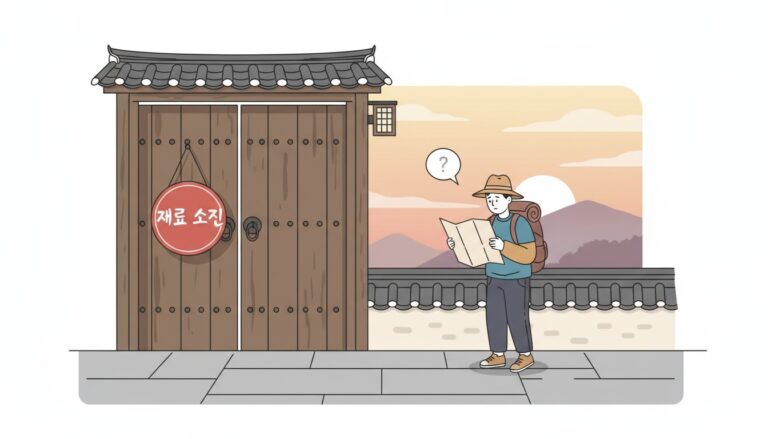
Introduction: The “Matjib” Heartbreak
Hello! This is your Daily Hangul Senior Editor.
Imagine this: You’ve traveled 40 minutes by subway and walked another 15 minutes uphill to try that famous pork cutlet place you saw on Instagram. You arrive, hungry and excited. But wait—the lights are dim, and there’s a sign on the door. You see people turning away with disappointed faces.
One of them mutters, “재료 소진으로 문 닫았대.” (Jaeryo sojin-euro mun dad-at-dae.)
If you don’t know this phrase, you might knock on the door thinking they are just on a break. Today, we’re going to learn how to recognize this specific “Sold Out” situation and how to express your disappointment naturally. This isn’t just about food; it’s about the Korean grammar of indirect quotation—a crucial skill for B1 level learners to sound like a local!
Phase 2: Deep Dive into Key Phrases
1. 재료 소진 (Jaeryo Sojin)
- Pronunciation: [Jae-ryo So-jin] Think of ‘Jae’ like ‘Jazz’ without the zz, and ‘Jin’ like ‘Jean’.
- Meaning:
- Literal: Ingredients Exhaustion.
- Real Nuance: “We sold everything we prepared for today, so go home.”
- Editor’s Insight: You will see this written on signs more often than you hear it spoken. It’s a sign of a true Matjib (tasty place). If a restaurant never puts this sign up, are they really that popular? 😉
- Situation Check: Mostly Written (Formal) / Spoken (News or announcements).
2. 문 닫았대(요) (Mun dad-at-dae-yo)
- Pronunciation: [Moon da-dat-dae-yo]
- Meaning: They say it’s closed.
- Grammar Point: The -대 (-dae) ending is a contraction of -다고 해 (-dago hae). It means you are reporting what you see or heard.
- “I see the sign, and the sign says it’s closed.”
- Editor’s Insight: Intermediate learners often say “문 닫았어요” (It is closed). But native speakers use “-대요” because they are passing on the bad news they just discovered.
3. 헛걸음했네요 (Heot-geol-eum-haet-ne-yo)
- Pronunciation: [Hut-gull-um-haet-ne-yo] ‘Hut’ sounds like the ‘hut’ in Pizza Hut.
- Meaning:
- Literal: I did a vain step.
- Real Nuance: “I came all this way for nothing! What a waste of time.”
- Editor’s Insight: This is a high-level emotional expression. Using this makes you sound very Korean. It perfectly captures the frustration of a wasted trip.
Phase 3: Textbook vs. Real Life
| Textbook Korean (Standard) | Real Life Korean (Natural) | Why? |
|---|---|---|
| 재료가 다 떨어졌어요. (The ingredients are all gone.) |
재료 소진이래 / 마감됐대. (They say it’s sold out / finished.) |
“-대” adds the nuance of “I heard/read that…” which fits the vibe of checking a restaurant status. |
| 시간을 낭비했어요. (I wasted time.) |
아, 완전 헛걸음했다. (Ah, totally made a wasted trip.) |
“Time wasting” sounds too serious. “Hut-geol-eum” is specific to traveling somewhere in vain. |
Note: At the B1 level, try to shift from describing facts (The door is closed) to describing the situation/hearsay (They say it’s closed).
Phase 4: Cultural Context & Manners
💡 The “Pride” of Closing Early
In many Western countries, running out of food might look like bad management. In Korea, “재료 소진 (Ingredients Sold Out)” is a badge of honor. It implies fresh ingredients and high demand.
Nunchi (Sense) Tip:
If you see a sign that says “금일 재료 소진 (Today’s ingredients sold out),” do not open the door to ask, “Can I just get one serving?” The staff are likely cleaning up and exhausted. The “Cool Customer” move is to take a picture of the sign (to prove you tried) and look for a “Plan B” restaurant nearby.
Phase 5: Real-Life Roleplay
Setting: Outside a popular pasta bar in Seongsu-dong. 7:30 PM.
Characters: Sam (Foreigner, B1 Level), Min-ji (Korean Friend).
(Sam and Min-ji arrive at the restaurant, but the lights are off.)
Sam: 어? 불이 꺼져 있는데요?
(Huh? The lights are off?)
Min-ji: (Looking at the door) 헐, 벌써? 저기 안내문 붙어 있어.
(No way, already? There is a notice attached over there.)
Sam: (Reading slowly) 재료 소진으로… 조기 마감합니다? 이게 무슨 뜻이에요?
(Due to jaeryo sojin… closing early? What does this mean?)
Min-ji: 재료가 다 떨어져서 문 닫았대. 우리 늦었나 봐.
(They say they closed because ingredients ran out. I guess we are late.)
Sam: 와, 우리 여기까지 왔는데… 완전 헛걸음했네요.
(Wow, we came all the way here… We totally made a wasted trip.)
Min-ji: 그러게. 아쉽지만 다른 데 가자.
(I know. It’s a shame, but let’s go somewhere else.)
Phase 6: 10-Second Shadowing Drill
Let’s practice the rhythm. Read the chunks separated by /.
“Unfortunately / they say they closed early / because ingredients ran out.”
아쉽게도 / 재료가 소진돼서 / 일찍 문 닫았대요.
[A-swip-ge-do] / [Jae-ryo-ga So-jin-dwae-seo] / [Il-jjik Moon Da-dat-dae-yo]
- Focus Point: Put a slight stress on ‘소진 (Sojin)’ and lift your tone at ‘대요 (daeyo)’ to show you are reporting news.
Phase 7: FAQ & Troubleshooting
Q: Can I use this if a clothing store is closed?
A: No! “재료 (Ingredients)” is only for food. For a clothing store, just say “문 닫았대 (They say it’s closed)” or “영업 끝났대 (They say business hours are over).”
Q: Is “Sold Out” used in Korea?
A: Yes, Koreans use the English word “Sold Out” (솔드아웃) frequently, but usually for specific menu items (e.g., “The latte is sold out”). For the entire restaurant closing down for the day, “재료 소진” is the standard term on signs.
Phase 8: Wrap-up & Mission
Today’s Summary:
When a restaurant is popular, they close when the food is gone (재료 소진). Use -대요 to report this sad news to your friend, and express your regret by saying 헛걸음했네요 (Wasted trip).
🚀 Your Mission:
Next time you search for a restaurant on Naver Maps, look for reviews that say “재료 소진이 빨라요” (Ingredients run out fast). That is your clue to go early! If you find one, leave a comment below!
Phase 9: Quick Quiz
1. What does “헛걸음했다” mean?
A) My legs hurt.
B) I walked fast.
C) I made a wasted trip.
2. Which grammar point implies “I heard that…” or “The sign says…”?
A) -네요 (-neyo)
B) -대요 (-daeyo)
C) -세요 (-seyo)
3. You see a sign “재료 소진”. What should you do?
A) Knock loudly and ask for food.
B) Accept it and find another place.
C) Wait until they open again in 10 minutes.
(Scroll down for answers)
Click for Answers
1. C
2. B
3. B
Frequently Asked Questions (FAQ)
Q: What does "재료 소진 (Jaeryo Sojin)" mean in Korean and how do you pronounce it?
A: In Korean, "재료 소진 (Jaeryo Sojin)" is pronounced [Jae-ryo So-jin] and means: Literal: Ingredients Exhaustion.
Q: What does "문 닫았대(요) (Mun dad-at-dae-yo)" mean in Korean and how do you pronounce it?
A: In Korean, "문 닫았대(요) (Mun dad-at-dae-yo)" is pronounced [Moon da-dat-dae-yo] and means: They say it's closed.
Q: What does "헛걸음했네요 (Heot-geol-eum-haet-ne-yo)" mean in Korean and how do you pronounce it?
A: In Korean, "헛걸음했네요 (Heot-geol-eum-haet-ne-yo)" is pronounced [Hut-gull-um-haet-ne-yo] and means: Literal: I did a vain step.







