

Phase 1: Introduction (Greeting & Empathy)
Hello, Daily Hangul family! It’s your editor here.
Imagine this: You are walking out of a subway station in Seoul. Suddenly, a heavenly smell hits you. It’s butter, toasted bread, and sweet egg. It’s Gilgeori Toast (길거리 토스트 – Street Toast).
You walk up to the stall. The Ajumma (middle-aged lady) is moving incredibly fast, flipping bread with one hand and cracking eggs with the other. She looks at you and asks something quickly. You freeze. Panic sets in. You just point at the menu and nod, hoping for the best.
But what if you hate sugar on your toast? (Yes, Koreans love sugar on toast!) What if you wanted it to-go?
Today, we are going to stop the panic. I will teach you the exact phrases to order your toast exactly how you want it, so you can enjoy that buttery goodness like a true Seoulite.
Phase 2: Deep Dive (Key Expressions)
Here are the three tools you need to survive the speed of a Korean street food stall.
1. [메뉴 이름] 하나 주세요 (Please give me one [Menu Name])
- Pronunciation: [Menu Name] Ha-na Ju-se-yo
- Ju-se-yo sounds like “Juice” + “Say” + “Yo”.
- Meaning: Give me one [Menu Name], please.
- Editor’s Insight: You can replace “하나” (one) with “두 개” (two – Du-gae). Don’t worry about complex grammar particles like ‘을/를’ here. In spoken Korean, we often drop them. Just saying “Ham-Cheese Toast, Hana Juseyo” is perfect.
- Situation Check: Polite (Zone Green). Safe to use with vendors.
2. 설탕은 빼 주세요 (Please leave out the sugar)
- Pronunciation: Seol-tang-eun Ppae Ju-se-yo
- Ppae sounds sharp, like the sound you make when spitting out a watermelon seed.
- Meaning: Please remove/exclude the sugar.
- Editor’s Insight: This is crucial. Traditional Korean street toast often includes a sprinkle of brown sugar on the veggies. If you prefer a savory (salty) taste, you must say this.
- Situation Check: Polite request.
3. 포장해 주세요 (Please wrap it up/To-go)
- Pronunciation: Po-jang-hae Ju-se-yo
- Meaning: I’d like this to go.
- Editor’s Insight: Unlike cafes where we say “Take-out,” at food stalls or restaurants, “Po-jang” (packaging) is the magic word. If you want to eat it right there standing up, say “먹고 갈게요” (Meok-go Gal-ge-yo – I’ll eat and go).
- Situation Check: Standard phrase for any restaurant or stall.
Phase 3: Textbook vs. Real Life
Let’s see how to sound less like a robot and more like a local.
| Textbook Korean 🤖 | Real Street Korean 😎 | Why? |
|---|---|---|
| 햄 치즈 토스트를 원해요. (I want a ham cheese toast.) | 햄 치즈 하나 주세요. (Give me one ham cheese.) | “I want” sounds childish or overly dramatic. “Give me” is standard ordering. |
| 설탕을 넣지 마십시오. (Do not put sugar in.) | 설탕 빼 주세요. (Take out sugar, please.) | “Putting not in” is too long. “Subtract (Ppae)” is faster and clearer. |
| 이것은 얼마입니까? (How much is this?) | 이거 얼마예요? (How much is this?) | “Im-ni-kka?” is for the military or news anchors. Use “Ye-yo?” |
Editor’s Note: Street stalls are noisy and fast. Short, clear sentences are always better than long, grammatically perfect ones!
Phase 4: Cultural Context (The ‘Nunchi’ Game)
1. The “Speed” Culture (Palli-Palli)
At a toast stall, speed is everything. The vendor might be making 5 sandwiches at once.
* Tip: Have your card or cash in your hand before you order. Fumbling for your wallet while the toast burns causes a “traffic jam” behind you!
2. The “Paper Cup” Method
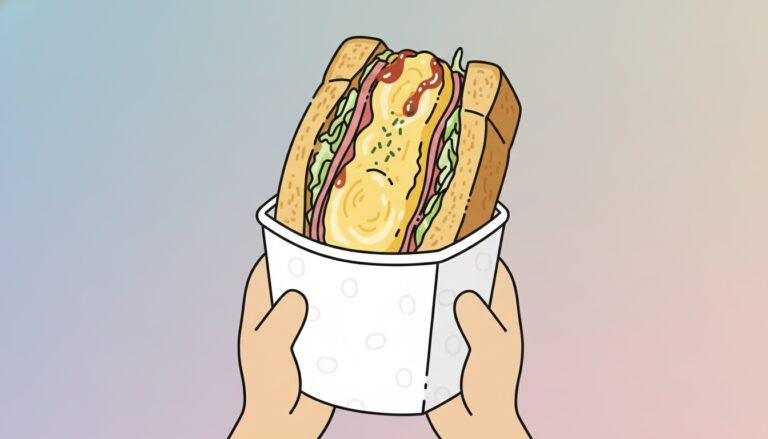
If you eat at the stall, they will likely hand you the toast folded inside a paper cup. This captures the melting butter and sauce so it doesn’t drip on your clothes. Do not throw this cup on the ground! Look for a trash bag tied to the side of the cart.
Phase 5: Real Life Scenario (Roleplay)
Setting: A busy toast truck near Hongdae Station, Exit 9.
Characters: Alex (Hungry Student), Sajangnim (Owner/Vendor)
(Alex steps up. The grill is sizzling loud.)
Sajangnim: (Fast) 뭐 드릴까요?
(Mwo deuril-kkayo? / What can I get you?)
Alex: (Confidently holding up one finger)
햄 치즈 토스트 하나 주세요.
(Ham-cheese toast hana juseyo. / One Ham-Cheese Toast, please.)
Sajangnim: 네~ 설탕 뿌려 드려요?
(Ne~ Seoltang bbu-ryeo deu-ryeo-yo? / Okay. Shall I sprinkle sugar?)
Alex: (Waving hand slightly)
아니요, 설탕은 빼 주세요!
(Aniyo, seoltang-eun ppae juseyo! / No, please leave out the sugar!)
Sajangnim: 네. 드시고 가세요?
(Ne. Deu-si-go ga-se-yo? / Okay. Eating here?)
Alex:
아니요, 포장해 주세요.
(Aniyo, po-jang-hae juseyo. / No, please pack it to-go.)
Phase 6: 10-Second Shadowing
Let’s practice the most important sentence. Read this out loud three times. Pay attention to the pause.
“사장님, / 햄 치즈 하나 / 포장해 주세요.”
(Sa-jang-nim, / Ham-cheese hana / Po-jang-hae ju-se-yo.)
- Intonation Tip: Raise your tone slightly on “Hana” to signal you are listing what you want.
Phase 7: FAQ (Troubleshooting)
- Q: Can I call the lady “Ajumma”?
- Editor: Careful! While not technically wrong, some vendors find it rude. It’s much safer and more polite to use “Sajangnim” (Boss/Owner) or “Imo-nim” (Auntie). When in doubt, stick to “Sajangnim.”
- Q: Can I pay with a credit card?
- Editor: Nowadays, 90% of stalls accept cards. However, having 3,000 ~ 4,000 KRW in cash is always safer for street food. If you see a sign saying “계좌이체” (Bank Transfer), they prefer cash or transfer.
Phase 8: Wrap-up
Today’s One-Liner: To order toast, remember the “OSP” rule: Order (Hana juseyo) -> Sugar (Ppae juseyo) -> Packaging (Pojang).
Your Mission: Next time you pass a street stall or an “Isaac Toast” shop, try ordering in Korean. Even if you are nervous, just say “Seoltang Ppae Juseyo” firmly!
Comment below: Do you prefer your toast sweet (with sugar) or savory (salty)? Let me know!
Phase 9: Pop Quiz
1. How do you say “Please remove the sugar”?
A) Seoltang Juseyo
B) Seoltang Ppae Juseyo
C) Seoltang Jo-ah-yo
2. Which title is the safest and most polite for the vendor?
A) Ya! (Hey!)
B) Ajumma
C) Sajangnim
3. You want to take the food to your hotel. What do you say?
A) Meok-go Gal-ge-yo
B) Po-jang-hae Ju-se-yo
C) An-nyeong-hi Gye-se-yo
(Answers: 1-B, 2-C, 3-B)
Frequently Asked Questions (FAQ)
Q: What does "[메뉴 이름] 하나 주세요 (Please give me one [Menu Name])" mean in Korean and how do you pronounce it?
A: In Korean, "[메뉴 이름] 하나 주세요 (Please give me one [Menu Name])" is pronounced [Menu Name] and means: a key conversational Korean expression covered in this lesson.
Q: What does "설탕은 빼 주세요 (Please leave out the sugar)" mean in Korean and how do you pronounce it?
A: In Korean, "설탕은 빼 주세요 (Please leave out the sugar)" is pronounced [Seol-tang-eun Ppae Ju-se-yo] and means: a key conversational Korean expression covered in this lesson.
Q: What does "포장해 주세요 (Please wrap it up/To-go)" mean in Korean and how do you pronounce it?
A: In Korean, "포장해 주세요 (Please wrap it up/To-go)" is pronounced [Po-jang-hae Ju-se-yo] and means: I'd like this to go.







