

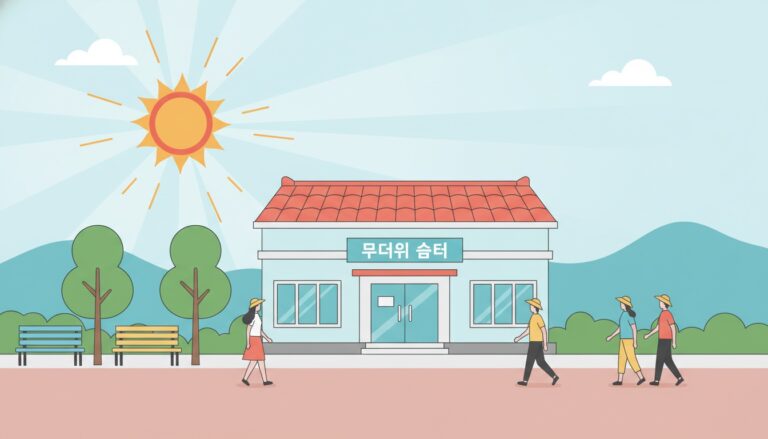
Survival Mode: Mastering the Language of Korea’s “Heat Shelters” 🌡️
Phase 1: Introduction
안녕하세요! This is your Senior Editor at Daily Hangul.
Summer in Korea isn’t just hot; it’s a physical force. We call it “jjimtong deowi” (찜통더위)—heat like a steamer. Imagine you are volunteering for a local NGO, or perhaps you are simply a concerned resident noticing an elderly neighbor struggling in this stifling humidity. You want to guide them to a safe, cool place, but looking for a café isn’t the right solution.
At the C2 level, your goal isn’t just to say “It is hot.” It is to understand the social infrastructure and administrative language used during disasters. Today, we are decoding “Operating Cooling Centers for Vulnerable Groups.” knowing these terms doesn’t just improve your Korean; it positions you as a socially responsible member of the community who understands how the Korean safety net functions.
This guide is curated from real questions asked by advanced learners working in Korean public sectors and community services. Let’s dive in.
Phase 2: Deep Dive (Core Expressions)
Here are the three heavy-hitting terms you will hear on the news (YTN, KBS) and in community announcements during a heatwave.
1. 무더위 쉼터 (Mudeowi Shimteo)
- Pronunciation: [Mudeowi Shimteo] Sounds like ‘Moo-doh-wi Sheem-tuh’
- Meaning: Cooling Center / Heat Shelter (Literal: Steaming Heat Resting Place)
- Editor’s Insight: This is the official administrative term. You won’t see signs saying “Free AC Zone.” You will see signs for 무더위 쉼터. These are often banks, community centers, or senior halls designated by the government.
- Situation Check: Formal & Public. Used in news, signage, and policy discussions.
2. 취약 계층 (Chwiyak Gyecheung)
- Pronunciation: [Chwiyak Gyecheung] Sounds like ‘Chwee-yak Gyeh-cheung’
- Meaning: Vulnerable social groups (e.g., the elderly, low-income families)
- Editor’s Insight: At the C2 level, specific terminology matters. Instead of saying “poor people” or “old people” (which can sound blunt or rude), use 취약 계층. It carries a nuance of sociological objectivity and care.
- Situation Check: Professional. Essential for reports, news discussions, or volunteering.
3. 안부를 살피다 (Anbu-reul salpida)
- Pronunciation: [Anbu-reul salpida]
- Meaning: To check on someone’s safety/well-being
- Editor’s Insight: This is arguably the most beautiful phrase in Korean community culture. It’s not just “checking.” It implies looking after their health, state of mind, and living conditions with genuine concern. In a disaster context, it means ensuring someone is still alive and safe.
- Situation Check: Universal. Can be used with friends (warm) or in formal reports (dutiful).
Phase 3: Textbook vs. Real Life
How does a C2 learner sound different from a textbook learner? Let’s compare.
| Textbook Korean (Grammatically Correct) | Real Life / Advanced Korean (Natural & Professional) |
|---|---|
| 여기 에어컨이 나오는 곳이에요? (Is this a place where AC comes out?) |
혹시 이곳이 무더위 쉼터로 지정된 곳인가요? (Is this place designated as a Cooling Shelter?) |
| 할머니들이 더워서 위험해요. (Grandmothers are in danger because of heat.) |
폭염 취약 계층에 대한 각별한 보호가 필요합니다. (Special protection is needed for groups vulnerable to heatwaves.) |
| 잘 지내는지 보러 왔어요. (I came to see if you are doing well.) |
어르신들 안부를 좀 살피러 왔습니다. (I came to check on the elders’ well-being.) |
Editor’s Note: Notice the use of ‘지정된’ (designated) and ‘각별한’ (special/particular). These vocabularies elevate your speech to a professional level instantly.
Phase 4: Cultural Context & Manners
The “Nunchi” of Cooling Centers
While 무더위 쉼터 (Cooling Centers) are technically open to the public, many are located inside 경로당 (Senior Citizen Centers).
- Hierarchy of Seats: Even if you enter a bank or community center designated as a shelter, realized that the “prime spots” (directly under the AC or on the most comfortable sofas) are implicitly reserved for the elderly. As a younger person, occupying these spots can be seen as lacking 눈치 (Nunchi).
- The Community Spirit: During disaster safety checks, the tone is never accusatory. When checking on neighbors (안부 확인), the vibe should be “I am worried about you because we are neighbors,” not “The government sent me to inspect you.” Soften your tone.
Phase 5: Real-Life Roleplay
Scenario: You are volunteering at a local community center (주민센터). You are asking the team leader about the operation plan for the cooling centers during an impending heatwave.
Characters:
* You (Alex): Foreign volunteer (Advanced Korean speaker).
* Team Leader (Park): Korean civil servant.
Alex: (Looking at the weather forecast with concern)
팀장님, 내일부터 폭염 경보가 발효된다고 하네요. 무더위 쉼터 운영 시간은 연장되나요?
(Team Leader, they say a heatwave warning goes into effect starting tomorrow. Will the cooling center operating hours be extended?)
Team Leader Park: 네, 맞아요. 밤 9시까지 연장할 계획입니다. 혹시 취약 계층 명단 파악됐나요?
(Yes, that’s right. We plan to extend it until 9 PM. By the way, is the list of vulnerable groups updated?)
Alex: (Nodding professionally)
네, 독거노인 분들 위주로 리스트 정리했습니다. 제가 오늘 오후에 직접 방문해서 안부를 살피고 오겠습니다.
(Yes, I’ve organized the list focusing on the elderly living alone. I will visit them personally this afternoon to check on their well-being.)
Team Leader Park: 오, 알렉스 씨. 정말 든든하네요. 수고 좀 부탁해요.
(Oh, Alex. You are really reliable. I appreciate your effort.)
Phase 6: 10-Second Shadowing
Read this out loud to practice the rhythm of a formal report or news briefing. Focus on the pauses marked by /.
“폭염 특보가 발효된 만큼 / 우리 주변의 취약 계층이 소외되지 않도록 / 수시로 안부를 살피는 것이 중요합니다.”
(Since the heatwave advisory has been issued / it is crucial to check the well-being frequently / so that the vulnerable groups around us are not alienated.)
Acting Tip: Drop your pitch slightly at the end of “중요합니다” to sound authoritative and sincere.
Phase 7: FAQ & Troubleshooting
- Q: Can I use the word ‘취약 계층’ directly to the person I am helping?
- No! Absolutely not. That is an administrative term used about them, not to them. Calling someone “vulnerable class” to their face is rude. Instead, address them as 어르신 (Elder) or simply by their name/title, and use honorifics.
- Q: Is ‘무더위 쉼터’ only for old people?
- Technically No, Culturally Yes. While banks are for everyone, shelters in community halls are dominated by the elderly. If you are young and healthy, it’s better to go to a library or a cafe.
Phase 8: Wrap-up
One-Liner Summary:
When the heat gets dangerous, look for the 무더위 쉼터 sign, remember the 취약 계층, and don’t forget to 안부를 살피다 for your neighbors.
Action Mission:
Next time you walk past a local bank or community center, look for the official “무더위 쉼터” sticker on the door. Take a picture and tag us! It’s practicing your observation skills.
Tell me in the comments: Does your country have a similar system for heatwaves or cold waves? How do you call it?
Phase 9: Quiz
1. What is the most natural way to ask if a place is an official cooling center?
* A) 여기 에어컨 공짜예요?
* B) 여기 무더위 쉼터로 지정된 곳인가요?
* C) 여기 취약 계층이 있어요?
2. Which term refers to socially vulnerable groups in a formal context?
* A) 가난한 사람들
* B) 불쌍한 계층
* C) 취약 계층
3. Fill in the blank: “부모님의 [_____]를 살피러 고향에 다녀왔습니다.” (I went to my hometown to check on my parents.)
* A) 안부
* B) 감시
* C) 경보
(Answers: 1. B, 2. C, 3. A)
Frequently Asked Questions (FAQ)
Q: What does "무더위 쉼터 (Mudeowi Shimteo)" mean in Korean and how do you pronounce it?
A: In Korean, "무더위 쉼터 (Mudeowi Shimteo)" is pronounced [Mudeowi Shimteo] and means: Cooling Center / Heat Shelter (Literal: Steaming Heat Resting Place)
Q: What does "취약 계층 (Chwiyak Gyecheung)" mean in Korean and how do you pronounce it?
A: In Korean, "취약 계층 (Chwiyak Gyecheung)" is pronounced [Chwiyak Gyecheung] and means: Vulnerable social groups (e.g., the elderly, low-income families)
Q: What does "안부를 살피다 (Anbu-reul salpida)" mean in Korean and how do you pronounce it?
A: In Korean, "안부를 살피다 (Anbu-reul salpida)" is pronounced [Anbu-reul salpida] and means: To check on someone's safety/well-being







