

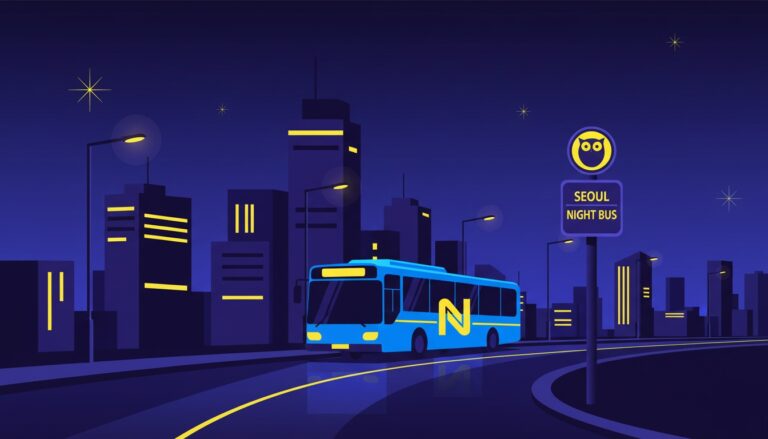
Phase 1: Hook & Empathy (Introduction)
Hello! This is your Senior Editor at Daily Hangul.
Imagine this: It’s 2:00 AM on a Friday night in Hongdae or Gangnam. The subway stopped running hours ago (around midnight). You open your taxi app, but there are zero cars available, or the drivers are demanding double the price. The streets are filled with people desperately waving at empty taxis that just zoom past. You feel stranded.
Sounds like a nightmare? This is a rite of passage for anyone living in Seoul. But here is the secret that separates the tourists from the locals (Hyunji-in): The “Owl Bus” (올빼미 버스).
At the C1 level, simply asking “Is there a bus?” isn’t enough. You need to understand the system—how to identify these routes, discuss intervals, and navigate the late-night transport landscape without panicking. Today, we turn that 2 AM panic into a confident ride home.
(Note: This guide is based on real struggles my advanced students faced when partying or working late in Seoul.)
Phase 2: Deep Dive into Core Expressions
1. 올빼미 버스 / 심야 버스 (Owl Bus / Late Night Bus)
- Pronunciation: [Ol-bbae-mi Beo-seu] / [Sim-ya Beo-seu]
- Tip: For ‘bbae’ (빼), tense your lips like you are holding back a breath before releasing it sharply. It’s a tense sound, not an airy ‘P’.
- Meaning:
- Literal: Owl Bus / Deep Night Bus.
- Real Nuance: Refers specifically to the ‘N’ buses (e.g., N62, N26) that only operate from roughly 11:30 PM to 4:00 AM.
- Editor’s Insight: While news reports say “심야 버스” (Simya bus), locals often use the nickname “올빼미 버스” lovingly. If you see a bus with an ‘N’ in front of the number, that is your savior.
- Fun Fact: The numbers aren’t random. N62 means it goes from District 6 (Guro/Yangcheon) to District 2 (Jungnang).
- Situation Check: Safe to use with everyone.
2. 배차 간격 (Dispatch Interval)
- Pronunciation: [Bae-cha Gan-gyeok]
- Meaning:
- Literal: Allocation Car Interval.
- Real Nuance: “How often does the bus come?” / Headway.
- Editor’s Insight: At C1, stop asking “When does it come?” (언제 와요?). Instead, use “이거 배차 간격이 어떻게 돼요?” (What is the dispatch interval for this?). Night buses often have long intervals (20-40 mins), so checking this is crucial to decide if you should wait or walk.
- Situation Check: Semi-formal to Formal. Very useful when checking apps or asking information desks.
3. 첫차 / 막차 (First Car / Last Car)
- Pronunciation: [Cheot-cha] / [Mak-cha]
- Meaning: The very first bus of the day (usually 4:00-5:00 AM) / The very last bus (usually 11:00 PM-12:00 AM).
- Editor’s Insight: The gap between the normal 막차 and the Owl Bus is the danger zone. If you miss the subway 막차, your next best bet is the Owl Bus. But if you miss the Owl Bus, you have to wait for the 첫차 (First car) of the morning regular routes.
- Expression: “첫차 뜰 때까지 존버하다 가자.” (Let’s just hang in there until the first bus/train starts.)
Phase 3: Textbook vs. Real Life
| Textbook Korean (Standard) | Real Life Korean (Insider Vibe) |
|---|---|
| 밤늦게 다니는 버스 있어요? (Is there a bus that goes late at night?) | 여기 N버스 다니나? / 올빼미 버스 노선 있어? (Does an N-bus run here? / Is there an Owl route?) |
| 버스가 얼마나 자주 와요? (How often does the bus come?) | 이거 배차 (간격) 길어? (Is the dispatch interval long for this?) |
| 택시가 너무 비싸요. (Taxis are too expensive.) | 이 시간에 택시 잡으면 할증 붙어서 에바야. (Catching a taxi at this hour involves a surcharge, so it’s ‘over’ [too much].) |
Editor’s Note: “에바야” (It’s Oba/Over) is slang derived from the English word “Over.” Use this only with close friends. In polite company, stick to “할증 때문에 너무 비싸요.”
Phase 4: Cultural Context & Manners
1. The “Taxi War” & The Safe Haven
In Seoul, from 11 PM to 1 AM, catching a taxi is officially called “택시 전쟁” (Taxi War). Drivers might refuse you if your destination isn’t profitable (though it’s illegal, it happens). The Owl Bus is considered a “Safe Haven.”
2. Quiet Manners (정숙)
Even though it’s late and many passengers might be slightly intoxicated after a Hoesik (company dinner), the Owl Bus is surprisingly quiet. Most people are exhausted.
* Nunchi Tip: If you are talking loudly with your friend, you will feel the piercing glare of 50 tired Seoulites. Keep your voice down (속삭이다 – to whisper).
Phase 5: Real-Life Scenario (Roleplay)
Setting: Gangnam Station, 1:30 AM. Two friends, Minji (Korean) and Alex (Foreigner), are trying to get home after drinks.
Alex: (Looking at the empty street)
와… 택시 진짜 안 잡히네. 카카오택시도 먹통이야.
(Wow… I really can’t catch a taxi. Kakao Taxi is frozen/unresponsive too.)
Minji: (Checking her phone map)
지금 심야 할증 붙어서 요금도 장난 아닐걸? 그냥 올빼미 버스 타자.
(The late-night surcharge is on now, so the fare will be no joke. Let’s just take the Owl Bus.)
Alex:
여기 N버스도 다녀? 배차 간격 너무 길지 않아?
(Do N-buses run here too? Isn’t the dispatch interval too long?)
Minji:
N64번이 10분 뒤에 온대. 이거 타고 가다가 환승하자.
(It says N64 is coming in 10 minutes. Let’s take this and transfer.)
Alex:
오, 다행이다! 첫차 기다려야 하는 줄 알았어.
(Oh, thank god! I thought we had to wait for the first morning bus.)
Phase 6: 10-Second Shadowing Drill
Read this aloud to practice speed and intonation. This is a complex C1 sentence using our keywords.
“택시 할증 때문에 너무 비싸니까, / 그냥 앱으로 올빼미 버스 배차 확인하고 / N버스 타는 게 훨씬 나아.”
- Phonetic: Taxi hal-jeung ttae-mu-ne neo-mu bi-ssa-ni-kka, / geu-nyang app-eu-ro ol-bbae-mi beo-seu bae-cha hwak-in-ha-go / N-bus ta-neun ge hwol-ssin na-a.
- Meaning: Since taxis are too expensive due to the surcharge, it’s much better to just check the Owl Bus dispatch on the app and take the N-bus.
Focus Point: Pause at the
/marks. Stress the words 할증 (surcharge) and 훨씬 (much/far).
Phase 7: FAQ & Troubleshooting
Q: Is the ‘N’ bus safe for solo travelers?
A: Yes, very. In fact, because they are equipped with CCTV and usually full of other tired commuters, they are often safer than walking alone on dark streets or taking a random unmarked taxi.
Q: Can I use my standard T-money card?
A: Absolutely. It costs slightly more than a regular daytime bus (approx. 2,150 KRW vs 1,200 KRW), but it transfers just the same.
Q: Does “배차 간격” apply to subways too?
A: Yes! You can use this word for buses, subways, and even trains. “지하철 배차 간격이 너무 길어요” (The subway interval is too long).
Phase 8: Wrap-up
- One-Liner: When the subway sleeps, look for the ‘N’ (Owl Bus) and save your wallet from taxi surcharges.
- Action Mission: Open your Korean map app (Naver/Kakao Map) right now. Search for “N” in the bus search bar and see which Owl Bus route passes closest to your house. Screenshot it for your next night out!
Have you ever been stranded in Seoul at night? Tell me your story in the comments! 👇
Phase 9: Pop Quiz
- What does the ‘N’ stand for in bus numbers like N62?
a) North
b) Night
c) New
d) No-stop -
Which word means “Dispatch Interval” (how often the bus comes)?
a) 배차 간격 (Bae-cha Gan-gyeok)
b) 심야 할증 (Sim-ya Hal-jeung)
c) 환승 할인 (Hwan-seung Hal-in) -
What is the Korean term for the “First bus/train” of the morning?
a) 막차 (Mak-cha)
b) 똥차 (Ttong-cha)
c) 첫차 (Cheot-cha)
(Answers: 1. b, 2. a, 3. c)
Frequently Asked Questions (FAQ)
Q: What does "올빼미 버스 / 심야 버스 (Owl Bus / Late Night Bus)" mean in Korean and how do you pronounce it?
A: In Korean, "올빼미 버스 / 심야 버스 (Owl Bus / Late Night Bus)" is pronounced [Ol-bbae-mi Beo-seu] and means: a key conversational Korean expression covered in this lesson.
Q: What does "배차 간격 (Dispatch Interval)" mean in Korean and how do you pronounce it?
A: In Korean, "배차 간격 (Dispatch Interval)" is pronounced [Bae-cha Gan-gyeok] and means: Literal: Allocation Car Interval.
Q: What does "첫차 / 막차 (First Car / Last Car)" mean in Korean and how do you pronounce it?
A: In Korean, "첫차 / 막차 (First Car / Last Car)" is pronounced [Cheot-cha] and means: The very first bus of the day (usually 4:00-5:00 AM) / The very last bus (usually 11:00 PM-12:00 AM).







