

안녕하세요! This is your editor from Daily Hangul.
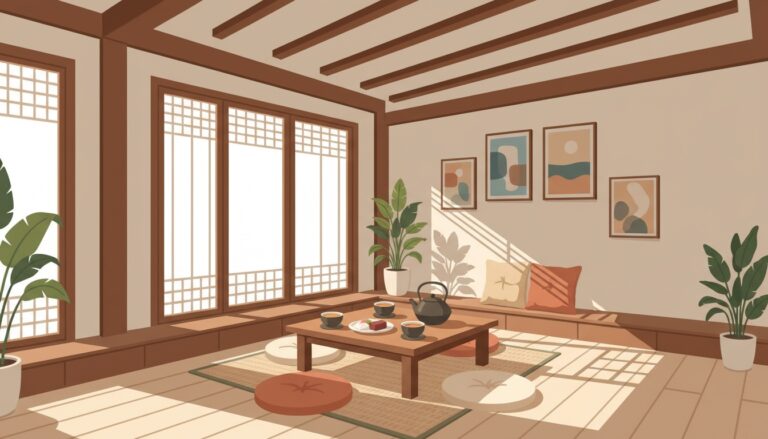
Imagine this: You’ve finally arrived at that famous Hanok Cafe (Traditional Korean House Cafe) you saw on Instagram. The architecture is stunning—wooden beams, tiled roofs, and a peaceful courtyard. You step inside, ready for a relaxed afternoon.
But wait.
Some people are sitting on chairs, but others are sitting on the floor. There’s a small step up to a room. Do you keep your sneakers on? Do you take them off? And that beautiful table by the window… is that bag on the chair waiting for someone, or did someone forget it?
I’ve seen many students freeze at the entrance, afraid of making a cultural mistake. Don’t worry! Today, we’re going to learn the essential phrases to navigate a Hanok cafe like a local “Inssa” (Insider).
Phase 2: Deep Dive (Core Expressions)
Here are the top 3 expressions you need to survive (and enjoy) a Hanok cafe.
1. 신발 벗어야 돼요? (Do I have to take off my shoes?)
- Pronunciation: [Sin-bal beo-seo-ya dwae-yo?]
- Sin-bal (Shoes)
- beo-seo-ya (sounds like ‘bus’ + ‘saw’ + ‘ya’)
- dwae-yo? (sounds like ‘day-yo?’)
- Meaning:
- Literal: Must I take off shoes?
- Real Nuance: “Is this a ‘no-shoes’ zone?”
- Editor’s Insight: Hanok cafes often have mixed zones. If you see a wooden floor elevated from the ground, 99% of the time, you need to take off your shoes. Asking this shows you are respectful of Korean culture.
- Situation Check: Essential for entering rooms with floor seating (Ondol).
2. 여기 앉아도 돼요? (Can I sit here?)
- Pronunciation: [Yeo-gi an-ja-do dwae-yo?]
- Yeo-gi (Here)
- an-ja-do (even if I sit)
- dwae-yo? (is it okay?)
- Meaning: Can I sit here?
- Editor’s Insight: In Korea, if there is a bag, a phone, or even a receipt on the table, the seat is taken. Never move personal items! Use this phrase when a seat looks empty but you are not 100% sure.
- Situation Check: Use with both staff and other customers.
3. 이거 많이 써요? (Is this very bitter?)
- Pronunciation: [I-geo ma-ni sseo-yo?]
- I-geo (This)
- ma-ni (Many/Much)
- sseo-yo (sounds like ‘saw-yo’)
- Meaning: Is this very bitter?
- Editor’s Insight: Hanok cafes specialize in traditional teas like Ssanghwa-cha (Medicial Tea) or Daechu-cha (Jujube Tea). They can be surprisingly bitter for foreigners! Ask this before ordering if you have a sweet tooth.
Phase 3: Textbook vs. Real Life
Textbooks are great, but sometimes they sound a bit robotic. Here is how to sound natural.
| Textbook (Too Formal/Stiff) | Real Life (Natural & Trendy) |
|---|---|
| 이 자리가 비어 있습니까? (Is this seat empty?) |
여기 앉아도 돼요? (Can I sit here?) |
| 추천을 부탁합니다. (I request a recommendation.) |
제일 잘 나가는 게 뭐예요? (What goes out the best / What’s most popular?) |
| 화장실은 어디입니까? (Where is the restroom?) |
화장실 어디예요? (Where’s the bathroom?) |
Editor’s Note: For A2 learners, “제일 잘 나가는 게 뭐예요?” is a magic phrase. It guarantees you get the tastiest item on the menu!
Phase 4: Cultural Context & Manners
1. The “Invisible” Bag Rule
In many Western countries, leaving a laptop on a table and going to the restroom is risky. In Korea, it’s normal. If you see a bag on a chair, that seat is occupied. Do not touch it! If you ask “여기 앉아도 돼요?” pointing at a table with a phone on it, people might look at you strangely.
2. Floor Seating (Jwasik) Etiquette
When sitting on the floor in a Hanok:
* Don’t: Stretch your legs out straight pointing at someone else (it’s considered rude).
* Do: Sit cross-legged (Yangban-dari) or to the side. If your legs go numb, it’s okay to stretch them under the table discreetly!
Phase 5: Roleplay Script
Scenario: You enter a Hanok cafe and want to sit by the window.
- You: (Pointing to a floor seat) 저기 신발 벗어야 돼요?
- [Jeo-gi sin-bal beo-seo-ya dwae-yo?]
- (Do I have to take off my shoes over there?)
- Staff: 네, 벗고 올라가셔야 해요.
- [Ne, beot-go ol-la-ga-syeo-ya hae-yo.]
- (Yes, you need to take them off and go up.)
- You: (Ordering) 쌍화차 하나 주세요. 아, 이거 많이 써요?
- [Ssanghwa-cha ha-na ju-se-yo. Ah, i-geo ma-ni sseo-yo?]
- (One Ssanghwa-tea, please. Ah, is this very bitter?)
- Staff: 조금 써요. 꿀 같이 드릴게요.
- [Jo-geum sseo-yo. Kkul ga-chi deu-ril-ge-yo.]
- (It’s a little bitter. I’ll give you honey with it.)
Phase 6: 10-Second Shadowing
Read this aloud to practice your intonation. Pause where you see the /.
“사장님, / 여기 앉아도 / 돼요?”
(Boss, / can I sit / here?)
- Tip: Raise your pitch slightly at the end of “돼요?” to sound polite and inquiring.
Phase 7: FAQ (Troubleshooting)
Q: Can I call the staff “Ahjumma” (Auntie) if she looks older?
A: NO! Avoid “Ahjumma” in cafes. It can be offensive in a service setting. Always use “Sajang-nim” (Boss/Owner) or “Jeogiyo” (Excuse me). Even if they are just an employee, calling them “Boss” is a compliment!
Q: Can I stay for a long time to study?
A: Hanok cafes are usually “Hot Places” (popular spots). If there is a line, it’s polite to stay only for 1-2 hours. If it’s empty, staying longer is fine.
Phase 8: Wrap-up
Summary:
* Check for shoes rules: “신발 벗어야 돼요?”
* Check for seat availability: “여기 앉아도 돼요?”
* Check taste: “이거 써요?”
Today’s Mission:
Go to a cafe (even a Starbucks in Korea) and instead of pointing, try asking “이거 써요?” or “이거 달아요?” (Is this sweet?) when looking at a new drink!
Leave a comment below: Have you ever accidentally walked into a “No Shoes” zone with your shoes on? Tell me your story! 😂
Phase 9: Quiz
1. You see a beautiful wooden floor area in a cafe. What should you ask?
a) 이거 얼마예요? (How much is this?)
b) 신발 벗어야 돼요? (Do I take off shoes?)
c) 화장실 어디예요? (Where is the bathroom?)
2. What is the most polite way to call the staff?
a) 야! (Hey!)
b) 아줌마! (Auntie!)
c) 사장님! (Boss!)
3. True or False: If you see a bag on a chair, someone forgot it, so you can move it.
(Answer: False! It means the seat is taken.)
Click to see answers
1. b, 2. c, 3. False
Frequently Asked Questions (FAQ)
Q: What does "신발 벗어야 돼요? (Do I have to take off my shoes?)" mean in Korean and how do you pronounce it?
A: In Korean, "신발 벗어야 돼요? (Do I have to take off my shoes?)" is pronounced [Sin-bal beo-seo-ya dwae-yo?] and means: a key conversational Korean expression covered in this lesson.
Q: What does "여기 앉아도 돼요? (Can I sit here?)" mean in Korean and how do you pronounce it?
A: In Korean, "여기 앉아도 돼요? (Can I sit here?)" is pronounced [Yeo-gi an-ja-do dwae-yo?] and means: a key conversational Korean expression covered in this lesson.
Q: What does "이거 많이 써요? (Is this very bitter?)" mean in Korean and how do you pronounce it?
A: In Korean, "이거 많이 써요? (Is this very bitter?)" is pronounced [I-geo ma-ni sseo-yo?] and means: a key conversational Korean expression covered in this lesson.







