

Phase 1: Introduction
Hello! This is your editor from “Daily Hangul.”
Imagine this: You are standing in the middle of Hongdae. The smell of spicy Tteokbokki (rice cakes) is calling your name from a street stall. You reach for your wallet, but… oh no. Only cards. And this vendor only takes cash.
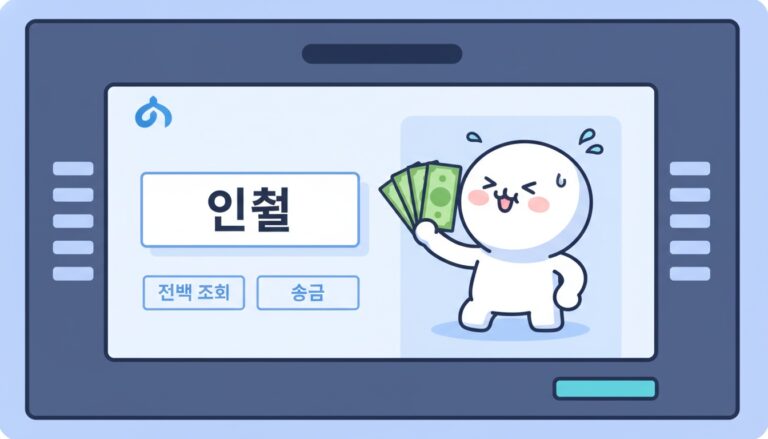
You rush to the nearest bank machine, but the “English” button is either missing or hidden. The screen is flashing formidable words like 예금 인출 and 명세표. Panic sets in.
Don’t worry! I’ve seen my students struggle with this exact moment dozens of times. Today, we aren’t just learning words; we are securing your survival (and your street food snacks). Let’s master the Korean ATM interface together.
Phase 2: Deep Dive (Core Vocabulary)
Here are the top 3 words you must recognize on the screen. These are formal words, so they look a bit scary, but they are actually quite simple.
1. 예금 인출 (Ye-geum In-chul)
- Pronunciation: [Ye-geum In-chul]
- Sound Analogy: In (as in inside) + Chul (sounds like chewing gum + ‘L’ at the end).
- Meaning: Withdrawal (Literally: Deposit Withdrawal)
- Editor’s Insight: You will often just see ‘인출’ on the button. This is the “Give me my money” button. Memorize the shape of ‘출’ (it looks like a little tree pushing up/out).
- Situation Check: Used strictly on banking screens and formal documents. In conversation, we say differently (see Phase 3).
2. 입금 (Ip-geum)
- Pronunciation: [Ip-geum]
- Sound Analogy: Ip (sounds like eep!) + Geum (sounds like gum).
- Meaning: Deposit (Putting money in)
- Editor’s Insight: Think of the ‘Ip’ (입) as the ‘Input’. You are putting money in.
3. 수수료 (Su-su-ryo)
- Pronunciation: [Su-su-ryo]
- Sound Analogy: Sue-Sue (a girl’s name repeated) + Rio (like the city).
- Meaning: Fee / Commission
- Editor’s Insight: The most painful word in banking! If you use an ATM after banking hours (usually after 4 PM) or a machine not from your specific bank, a pop-up with 수수료 will appear. It’s usually asking: “Are you okay with paying 1,000 won extra?”
Phase 3: Textbook vs. Real Life
What the machine says versus what you say to a friend is different. Let’s look at the difference.
| Screen / Textbook (Written) | Real Conversation (Spoken) | Note |
|---|---|---|
| 예금 인출 (Withdrawal) | 돈 뽑다 (Don ppop-da) | “Ppop-da” literally means to pull out or pluck. |
| 입금하다 (To deposit) | 돈 넣다 (Don neo-ta) | “Neo-ta” simply means to put in. |
| 잔액 조회 (Balance Check) | 얼마 남았는지 보다 | Literally “See how much is left.” |
Editor’s Note (A2 Level): When asking a friend, don’t say “인출하고 싶어요” (Too formal). Say “돈 뽑아야 돼요” (I need to withdraw money/pull out money). It sounds much more natural!
Phase 4: Cultural Context
1. The Legend of the “Global ATM”
Not all ATMs in Korea accept foreign cards. You must look for a machine specifically marked “Global ATM” or “Global Services.”
* Tip: Most machines inside 24-hour convenience stores (CU, GS25, 7-Eleven) usually work with foreign cards (Visa/Mastercard), but the 수수료 (Fee) is higher.
2. Privacy Manners
Koreans value privacy at the ATM. If someone is using the machine, do not stand right behind them. There is usually a line on the floor (yellow or red tape) that says “한 줄 서기” (Stand in a single line). Wait behind that line until they are completely finished.
Phase 5: Real-Life Scenario
Setting: You are at a bank entrance, but you can’t figure out which machine takes foreign cards. You ask the security guard (Cheong-won-gyeong-chal).
Characters:
* You: A thirsty traveler needing cash.
* Guard: A helpful bank security guard.
(You look confused and hold up your foreign credit card)
You: 저기요, 현금 인출 하고 싶은데요…
(Jeo-gi-yo, hyeon-geum in-chul ha-go si-peun-de-yo…)
Excuse me, I’d like to withdraw cash…
Guard: (Pointing to the machine on the far right) 아, 외국 카드세요?
(Ah, oe-guk ka-deu-se-yo?)
Ah, is it a foreign card?
You: 네, 맞아요. 수수료 비싸요?
(Ne, ma-ja-yo. Su-su-ryo bi-ssa-yo?)
Yes, that’s right. Is the fee expensive?
Guard: 여기는 은행이라서 괜찮아요. 저기 “Global” 써 있는 기계 쓰세요.
(Yeo-gi-neun eun-haeng-i-ra-seo gwaen-cha-na-yo. Jeo-gi “Global” sseo it-neun gi-gye sseu-se-yo.)
It’s okay because this is a bank. Please use that machine that says “Global” over there.
Phase 6: 10-Second Shadowing
Let’s practice the most useful phrase. Read this aloud while imagining you are looking for an ATM.
“Where can I withdraw cash?”
현금 / 인출 / 어디서 / 해요?
(Hyeon-geum / In-chul / Eo-di-seo / Hae-yo?)
- Focus: Pause slightly after ‘In-chul’. Raise your intonation at ‘Hae-yo?’ to show it is a question.
Phase 7: FAQ & Troubleshooting
- Q: The machine ate my card! What do I do?
- A: Look for the intercom phone on the machine. Pick it up and say: “카드를 먹었어요” (Ka-deu-reul meog-eoss-eo-yo). It literally means “It ate my card.” Everyone understands this!
- Q: Can I change the language to English?
- A: Yes! Look for buttons that say “Foreign Language,” “English,” or “Other Languages” usually located at the bottom right of the screen.
Phase 8: Wrap-up
- Summary: Look for 인출 (Withdrawal) to get money, remember 수수료 (Fee) costs extra, and use Global ATMs for foreign cards.
- Action Mission: Next time you pass a bank, just peek at the ATM screen (without using it). Try to spot the word ‘인출’. If you find it, you win!
Have you ever had a panic moment at a foreign ATM? Tell me in the comments!
Phase 9: Quiz
1. Which button should you press to take money OUT of the bank?
A) 입금 (Deposit)
B) 인출 (Withdrawal)
C) 통장 정리 (Passbook Update)
2. What does ‘수수료’ mean?
A) Thank you
B) Fee / Commission
C) Receipt
3. (True/False) You should say “인출하고 싶어” to your close friend.
A) True
B) False (Better to say “돈 뽑고 싶어”)
(Scroll down for answers)
Click to see answers
- B
- B
- B
Frequently Asked Questions (FAQ)
Q: What does "수수료" mean in Korean and how do you pronounce it?
A: In Korean, "수수료" is pronounced [Fee] and means: is higher.
Q: What does ""카드를 먹었어요"" mean in Korean and how do you pronounce it?
A: In Korean, ""카드를 먹었어요"" is pronounced [Ka-deu-reul meog-eoss-eo-yo] and means: . It literally means "It ate my card." Everyone understands this!







