

Don’t Panic at the Ticket Booth! How to Ask “How Much?” Like a Local
Introduction
Hello, this is Daily Hangul!
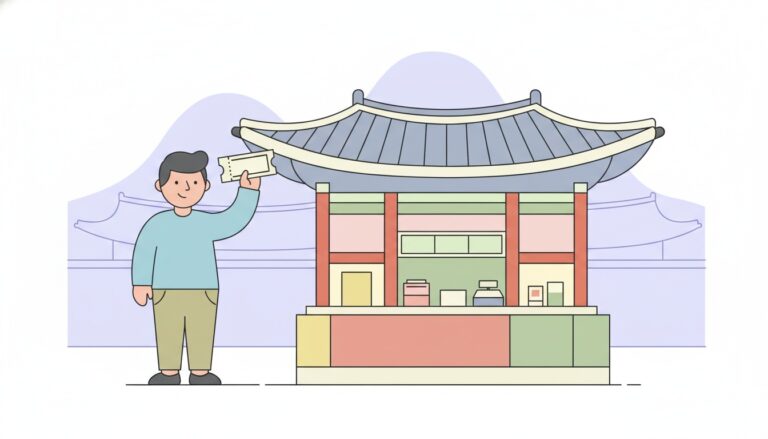
Imagine you have finally arrived at the majestic Gyeongbokgung Palace in Seoul. The weather is perfect, the Hanbok colors are vibrant, but there is one obstacle: the ticket booth. The sign is full of numbers and Hangeul, and the line is moving fast. Do you just hand over your credit card and hope for the best?
Here is a synthetic example based on stories from many of our beginner students. A learner named “Alex” once tried to buy tickets for a group. He panicked, held up five fingers, and just said “Five!” in English. The staff understood, but Alex felt he missed a great chance to practice. worse, he missed out on a discount because he didn’t know how to ask if his student ID was valid.
Textbooks often teach standard phrases like “How much is this?”, but they rarely cover the fast-paced reality of a ticket line, counting people, or asking for discounts. Today, we will learn the survival phrases to get you through the entrance gate smoothly.
At a Glance: Today’s Summary
- Key Phrases:
- 입장료 얼마예요? (How much is the admission fee?)
- 성인 두 명 주세요. (Two adults, please.)
- 할인 돼요? (Is there a discount?)
- Safe Zone: These phrases are polite (Jon-daet-mal) and perfect for strangers, staff, and clerks.
- Level A1 (Beginner): Essential because you will use this at every museum, palace, and theme park in Korea.
Table of Contents
- Today’s Deep Dive: Core Expressions
- Textbook vs. Real Korean
- Analysis: The “Counting People” Nuance
- Real-Life Role Play: Gyeongbokgung Palace
- Shadowing Challenge
- FAQ
- Final Quiz
Today’s Core Expressions: Deep Dive
1. The Magic Question: “How much is the admission?”
입장료 얼마예요?
[Ipjangnyo eolmayeyo?]
- Meaning: How much is the admission fee? (입장료 = Admission fee / 얼마예요 = How much is it?)
- Usage & Register:
- To whom: Ticket booth staff (polite/formal).
- Style:
해요체(Haeyo-che / Polite informal) – Friendly but respectful.
- Tutor’s Secret Note:
- 속마음 (Inner thought): You don’t always need to say “admission fee.” If you are standing right in front of the booth, you can just say “How much is it?” (얼마예요?).
- Warning: Do not just shout “How much?” (얼마? / Eolma?) or use casual speech to older staff. It is considered rude.
- Pronunciation Clinic:
- Trick: The word 입장료 is written as
Ip-jang-ryo, but pronounced as [Im-jang-nyo] due to nasal assimilation rules. Smooth it out!
- Trick: The word 입장료 is written as
- Examples:
- (At a museum) 입장료 얼마예요? [Ipjangnyo eolmayeyo?] (How much is the admission fee?)
- (At a club) 입장료 있어요? [Ipjangnyo isseoyo?] (Is there an entrance fee?)
- (Checking budget) 일인당 얼마예요? [Irindang eolmayeyo?] (How much is it per person?)
2. Buying the Tickets: “Two adults, please.”
성인 두 명 주세요.
[Seongin du myeong juseyo.]
- Meaning: Two adults, please. (성인 = Adult / 두 명 = Two people / 주세요 = Please give me)
- Usage & Register: Standard phrase for purchasing.
- Tutor’s Secret Note:
- Context: Koreans often shorten sentences. Instead of saying “I would like to buy tickets for two adults,” we just say “Adult, two people.”
- Pronunciation Clinic:
- Linking:
두 명[Du-myeong]. Make sure to use the Native Korean number system (Hana, Dul, Set…) for counting people, not Sino-Korean (Il, I, Sam…).
- Linking:
- Examples:
- 성인 한 명, 어린이 한 명 주세요. [Seongin han myeong, eorini han myeong juseyo.] (One adult and one child, please.)
- 학생 두 명요. [Haksaeng du myeong-yo.] (Two students, please.)
- 표 세 장 주세요. [Pyo se jang juseyo.] (Please give me three tickets.)
3. The Money Saver: “Is there a discount?”
할인 돼요?
[Harin dwaeyo?]
- Meaning: Is a discount available? (Can I get a discount?)
- Usage: When you have a student ID, are over 65, or have a special pass (like a Seoul City Pass).
- Examples:
- 학생 할인 돼요? [Haksaeng harin dwaeyo?] (Is there a student discount?)
- 외국인 할인 돼요? [Oegugin harin dwaeyo?] (Is there a foreigner discount?)
- 단체 할인 돼요? [Danche harin dwaeyo?] (Is there a group discount?)
Alternates
- More Formal: 성인 2매 부탁합니다. [Seongin i-mae butakamnida.] (Two adult tickets, please. Used in very formal settings)
- More Casual: 어른 둘이요. [Eoreun duriyo.] (Two adults. Okay for quick interactions)
Mini Quiz
Fill in the blank:
To ask “How much is it?”, you say: _________예요?
Click to see answer
얼마 [Eolma]
Textbook vs. Real Korean
| Context | Textbook (Book Korean) | Real Life (Real Korean) |
|---|---|---|
| Asking Price | 이것은 가격이 얼마입니까? (Igeoseun gagyeogi eolmaimnikka?) |
이거 얼마예요? (Igeo eolmayeyo?) |
| Ordering | 표 두 장을 사고 싶습니다. (Pyo du jangeul sago sipseumnida.) |
성인 둘이요. / 두 명 주세요. (Seongin duriyo / Du myeong juseyo) |
| Paying | 신용카드로 계산하겠습니다. (Sinyongkadeuro gyesanhagesseumnida.) |
카드로 할게요. (Kadeuro halgeyo.) |
Tutor’s Checklist:
* Use Textbook style if you are writing a formal email or report.
* Use Real Life style at the ticket booth to sound natural and speed up the line.
Unique Analysis: The “Counting People” Nuance
When counting people in Korean, the “counter” word you use changes the level of respect. Let’s look at the Respect Thermometer.
| Level | Counter Word | Nuance | Example |
|---|---|---|---|
| High Respect | 분 (Bun) | Used for guests, seniors, or customers. | 몇 분이세요? (How many people are you? – asked by staff) |
| Neutral/Standard | 명 (Myeong) | Standard. Used when YOU count your group. | 세 명이에요. (We are three people.) |
| Casual/Rough | 사람 (Saram) | Just means “person.” Can sound a bit blunt in counting. | 사람이 많아요. (There are many people.) |
Don’t make this mistake: Never refer to yourself as “Bun” (e.g., “We are two Bun”). It sounds arrogant, like calling yourself “His Highness.” Use Myeong for your own group!
Real-Life Role Play
Situation: You are at the ticket booth of Gyeongbokgung Palace. It is 10:00 AM on a Saturday.
- Staff: 안녕하세요. 몇 분이세요?
- (Annyeonghaseyo. Myeot buniseyo?)
- Hello. How many people in your party?
- You: 안녕하세요. 성인 두 명 주세요.
- (Annyeonghaseyo. Seongin du myeong juseyo.)
- Hello. Two adults, please.
- You: 아, 혹시 학생 할인 돼요?
- (A, hoksi haksaeng harin dwaeyo?)
- Ah, by chance, is there a student discount?
- Staff: 네, 학생증 보여주세요. 3,000원입니다.
- (Ne, haksaengjeung boyeojuseyo. Samcheon-won imnida.)
- Yes, please show me your student ID. It is 3,000 won.
- You: 여기요. 카드로 할게요.
- (Yeogiyo. Kadeuro halgeyo.)
- Here it is. I will pay by card.
Culture Tip: At palaces like Gyeongbokgung, wearing a Hanbok (traditional dress) often gets you free admission! You don’t even need to ask “Eolmayeyo?”—just head to the gate (but check the specific rules at the booth first).
Shadowing Challenge
Repeat this sentence 3 times to build muscle memory. Focus on the intonation!
“성인 한 명, 어린이 한 명, 얼마예요?”
[Seongin han myeong, eorini han myeong, eolmayeyo?]
(One adult, one child, how much is it?)
Checklist:
* [ ] Did you say “Myeong” clearly?
* [ ] Did you raise the tone at the end for “Eolmayeyo”?
* [ ] Did you link “han” and “myeong” smoothly?
FAQ: Questions You Might Have
Q1: Can I just show fingers for numbers?
A: Yes, body language is universal! But saying the number (Hana, Dul) + “Myeong” shows effort and respect. It makes the staff smile.
Q2: How do I say “ticket” specifically?
A: You can say 표 [Pyo]. Example: 표 두 장 주세요 (Two tickets, please). But at an admission booth, just saying “Two adults” is enough context.
Q3: Can I pay with cash?
A: Yes, but Korea is largely cashless. 현금 [Hyeongeum] is cash. 현금 영수증 [Hyeongeum yeongsujeung] is a cash receipt, which they might ask if you need (usually you can say “No” – 아니요).
Conclusion & Mission
Today we learned how to confidently buy tickets without panicking. You now know how to ask for the price, count people using “Myeong,” and check for discounts.
Today’s Mission:
Next time you enter a paid venue (even a movie theater or park in your country), imagine you are in Korea and whisper the phrase: “성인 한 명 주세요” (One adult, please).
Tell me in the comments:
Where is the first place you want to visit in Korea? A palace, a museum, or maybe a K-pop exhibition?
Final Quiz
- Which word is the correct counter for counting people in your own group?
A) Gae (개)
B) Myeong (명)
C) Bun (분) -
How do you say “How much is it?”
A) Eolmayeyo? (얼마예요?)
B) Eodiyeyo? (어디예요?)
C) Nuguyeyo? (누구예요?) -
Fill in the blank:
To ask for a discount, you say: “_________ 돼요?”
Answers:
1. B (Myeong)
2. A (Eolmayeyo?)
3. 할인 (Harin)
Frequently Asked Questions (FAQ)
Q: What does "속마음" mean in Korean and how do you pronounce it?
A: In Korean, "속마음" is pronounced [Inner thought] and means: You don't always need to say "admission fee." If you are standing right in front of the booth, you can just say "How much is it?" (







