

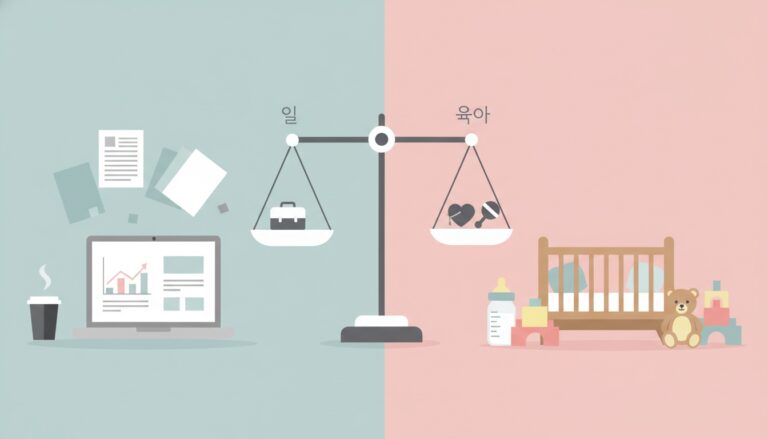
Introduction: The “Career vs. Kids” Dilemma in Korea
Hello! This is your Daily Hangul Senior Editor. 👋
If you are at a C1 level, you’re likely not just ordering bibimbap anymore. You might be working in Korea, watching social documentaries, or having deep conversations with Korean friends about their future. Today, we are tackling a heavy but essential topic: The reality of Parental Leave and Career Breaks.
Korea has one of the lowest birth rates in the world, and the friction between workplace culture and childcare is at the center of this crisis. Knowing how to discuss this shows you understand the real Korean society, not just the K-Drama version.
Let’s dive into the sophisticated vocabulary you need to navigate this sensitive topic like a true insider.
Phase 1: Deep Dive into Core Expressions 🧠
1. 육아 휴직 (Yuga-hyujik)
- Pronunciation: [Yuga-hyu-jik] (Sound analogy: Yu as in You, Ga as in Garden, Hyu like Hyugh, Jik like Jigsaw)
- Meaning: Parental Leave (literally: Childcare Rest Job)
- Editor’s Insight: This is distinct from 출산 휴가 (maternity leave). Yuga-hyujik is the long-term leave (often up to a year) that can be taken by both moms and dads. While legally guaranteed, actually taking it requires courage in many conservative companies.
- Situation Check: Formal & Professional. Used in contracts, news, and serious discussions.
2. 경단녀 (Gyeong-dan-nyeo)
- Pronunciation: [Gyeong-dan-nyeo] (Gyeong like Gyung-bok-gung, Dan like Don, Nyeo like New with a ‘y’ sound)
- Meaning: A woman whose career has been cut off due to marriage or childcare.
- Editor’s Insight: This is an abbreviation of 경력 단절 여성 (Career Discontinued Woman). It’s a sad but very common sociological term. Use this when discussing social issues, but be careful using it directly to describe a friend unless they use it first—it can imply a loss of professional identity.
- Situation Check: Casual to Formal (Sociological term).
3. 눈치(가) 보이다 (Nunchi-ga boida)
- Pronunciation: [Nun-chi-ga bo-i-da]
- Meaning: To feel uncomfortable/pressured by what others might think; to walk on eggshells.
- Editor’s Insight: You know Nunchi. But in the context of parental leave, phrases like “육아 휴직 쓰려는데 눈치가 보여요” are incredibly common. It means even though you can take leave, the atmosphere makes you feel guilty for burdening your team.
- Situation Check: Universal (Common in private conversations about work).
4. 복직 (Bokjik)
- Pronunciation: [Bok-jjik] (The ‘j’ doubles in sound)
- Meaning: Reinstatement / Returning to work.
- Editor’s Insight: The ultimate goal after leave. The fear is often: “Will my desk still be there when I bokjik?”
Phase 2: Textbook vs. Real Life 🗣️
Let’s upgrade your C1 vocabulary. Stop sounding like a dictionary and start sounding like a colleague at a dinner party.
| Textbook (Correct but dry) | Real Life (Nuanced & Natural) |
|---|---|
| 일을 그만뒀어요. (I quit working.) | 경력 단절이 될까 봐 무서워요. (I’m terrified of a career break.) |
| 육아 휴직을 썼어요. (I used parental leave.) | 눈치 보여서 육아 휴직 겨우 냈어요. (I barely managed to apply for leave because of the pressure.) |
| 아이를 키우는 것은 힘들어요. (Raising a child is hard.) | 독박 육아 때문에 너무 힘들어요. (It’s so hard because I’m doing ‘sole parenting’ [without help].) |
Note: 독박 육아 (Dok-bak Yuga) is a powerful slang term meaning one parent (usually the mother) is shouldering the childcare burden alone, like being stuck with a bad hand in cards.
Phase 3: Cultural Context & Manners 🇰🇷
The “Sorry” Culture of Leave
In many Western cultures, leave is a right you claim proudly. In Korea, when you announce your Yuga-hyujik, the attitude is often apologetic.
- The Team Dynamic: Because Korean companies often don’t hire temporary replacements, your team absorbs your workload. Therefore, when discussing your leave, it is “polite” to acknowledge the burden on your colleagues.
- The “Latte” Bosses: Older generations (Latte-is-horse generation) might say, “In my day, we worked until the day we gave birth!” Don’t argue. Just smile and say, “세상이 많이 변했죠” (The world has changed a lot, hasn’t it?).
Phase 4: Real-Life Scenario (Roleplay) 🎬
Setting: A cafe near the office. Two colleagues, Min-ji (30s, considering leave) and Soo-hyun (colleague), are talking.
Min-ji:
(Sighing deeply)
솔직히 말해서, 육아 휴직 신청하는 게 너무 겁나.
(To be honest, I’m so scared to apply for parental leave.)
Soo-hyun:
왜? 팀장님 눈치 보여서?
(Why? Because you’re worried about what the Team Manager thinks?)
Min-ji:
응. 1년 쉬고 오면 내 자리가 있을지도 모르겠고… 이러다 영영 경단녀 되는 거 아닌가 싶어.
(Yeah. I don’t know if my spot will be there after a year off… I’m afraid I’ll just end up as a ‘Gyeong-dan-nyeo’ forever.)
Soo-hyun:
에이, 너무 걱정 마. 너 능력 있잖아. 꼭 복직해서 멋지게 보여줘!
(Hey, don’t worry too much. You have the skills. Just make sure you return to work and show them what you’ve got!)
Phase 5: 10-Second Shadowing 🎧
Practice this sentence to express empathy and understanding of the social pressure. Read it aloud with the pauses.
“요즘은 / 남자도 육아 휴직을 많이 쓴다지만, / 아직은 현실적으로 / 눈치가 보이는 게 / 사실이에요.”
“Yojumeun / namjado yuga-hyujigeul mani sseundajiman, / ajigeun hyeonsiljeoguro / nunchiga boineun ge / sasirieyo.”
(People say men take parental leave a lot these days, but realistically, it is true that there is still pressure/hesitation.)
Phase 6: FAQ & Troubleshooting ⚠️
Q: Can I ask a Korean colleague, “Are you going to be a Gyeong-dan-nyeo?”
A: NO! 🛑 That is very rude. Gyeong-dan-nyeo implies a loss of status and is a negative social phenomenon. You can use it to discuss society (e.g., “Government policies for Gyeong-dan-nyeo”), but never label a person directly with it unless they use it on themselves first.
Q: Is it okay to ask a male colleague if he plans to take parental leave?
A: Yes, but do it cautiously. Since male usage is rising but still low (~20-30%), asking casually, “육아 휴직 계획 있으세요?” (Do you have plans for parental leave?) is acceptable between close colleagues.
Phase 7: Wrap-up & Mission 🚀
Today’s One-Liner: Parental leave in Korea is a mix of legal rights and social “Nunchi.”
Your Mission: Next time you see a news article or YouTube video about Korea’s birth rate, look for the word 경단녀 or 육아 휴직 in the comments. You will see them everywhere!
Phase 8: Pop Quiz 📝
1. Which word refers to a woman whose career was interrupted due to childcare?
A) 커리어 우먼 (Career Woman)
B) 경단녀 (Gyeong-dan-nyeo)
C) 된장녀 (Doenjang-nyeo)
2. What is the most appropriate verb to use with “Nunchi” when you feel pressure/hesitation?
A) 눈치가 없다 (Nunchi-ga eopda)
B) 눈치가 빠르다 (Nunchi-ga ppareuda)
C) 눈치가 보이다 (Nunchi-ga boida)
3. What do you call returning to work after a leave of absence?
A) 복직 (Bokjik)
B) 퇴직 (Toejik)
C) 이직 (Ijik)
(Answers: 1-B, 2-C, 3-A)
Frequently Asked Questions (FAQ)
Q: What does "육아 휴직 (Yuga-hyujik)" mean in Korean and how do you pronounce it?
A: In Korean, "육아 휴직 (Yuga-hyujik)" is pronounced [Yuga-hyu-jik] and means: Parental Leave (literally: Childcare Rest Job)
Q: What does "경단녀 (Gyeong-dan-nyeo)" mean in Korean and how do you pronounce it?
A: In Korean, "경단녀 (Gyeong-dan-nyeo)" is pronounced [Gyeong-dan-nyeo] and means: A woman whose career has been cut off due to marriage or childcare.
Q: What does "눈치(가) 보이다 (Nunchi-ga boida)" mean in Korean and how do you pronounce it?
A: In Korean, "눈치(가) 보이다 (Nunchi-ga boida)" is pronounced [Nun-chi-ga bo-i-da] and means: To feel uncomfortable/pressured by what others might think; to walk on eggshells.
Q: What does "복직 (Bokjik)" mean in Korean and how do you pronounce it?
A: In Korean, "복직 (Bokjik)" is pronounced [Bok-jjik] and means: Reinstatement / Returning to work.







