

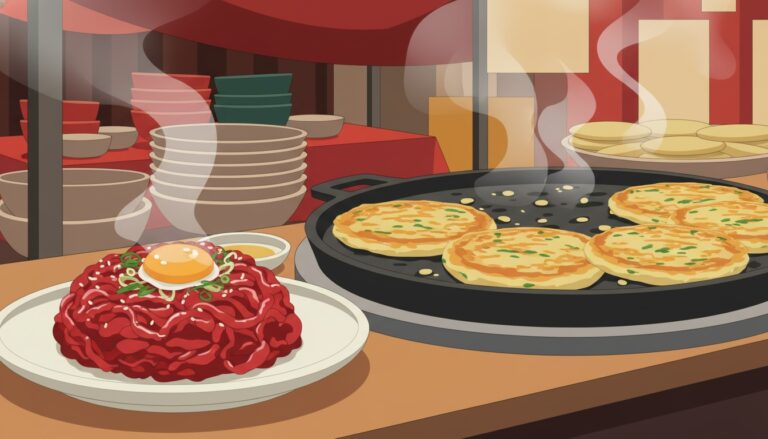
Eating Like a Local at Gwangjang Market: Survival Korean for Foodies
Introduction
Hello, this is Daily Hangul!
Have you seen the Netflix series Street Food: Asia? If you are planning a trip to Seoul, Gwangjang Market (Gwangjang Sijang) is likely at the top of your list. It is a paradise for food lovers, famous for its Yukhoe (Beef Tartare) and Bindaetteok (Mung Bean Pancakes).
However, the reality is often more chaotic than the documentary. The market is loud, crowded, and fast-paced.
Here is a synthetic example based on common struggles my students face:
Imagine “Alex,” a traveler who sat down at a busy stall. He wanted to order, but the “Ahjumma” (lady) was too busy shouting orders to the kitchen. He timidly said “Excuse me…” in English, but she didn’t hear him. Eventually, he just pointed at a picture, but he didn’t know he had to pay upfront (pre-pay), leading to an awkward silence when the food arrived.
Textbooks teach you standard polite sentences, but in a noisy market, you need volume, speed, and the right vocabulary. Today, we will learn how to shout confidently and order delicious food without panic.
Summary at a Glance
- Key Expressions: Calling the server, Ordering portions, Asking about payment.
- Safe Zone: Casual but polite. Perfect for busy markets or street food stalls.
- Level: B1 (Intermediate) – Easy grammar, but requires confidence in delivery.
Why this matters: In Gwangjang Market, hesitation might mean losing your seat or being ignored!
Table of Contents
- Today’s Key Expressions Deep Dive
- Textbook vs. Real Market Korean
- Analysis: The “Attention Getter” Thermometer
- Real Scenario Role Play
- Shadowing Challenge
- FAQ
- Wrap-up & Quiz
Today’s Key Expressions Deep Dive
1. 사장님 / 이모님 (Sajangnim / Imonim)
- Meaning: Boss / Aunt (used to call the server)
- Usage & Register:
- To whom: The staff or owner of the stall.
- Tone: Loud and energetic.
- Tutor’s Secret Note:
- “Excuse me” (Excuse me) is often too quiet for the market.
- Sajangnim is the safest bet for both men and women. Imonim feels friendlier but use it only for older ladies who look approachable.
- Warning: Do not call a young female server “Agassi” (Miss). It can sound rude or old-fashioned in this context.
- Pronunciation Clinic:
- Sajangnim: Don’t drag the end. Say it short and sharp like a clap. [Sa-jang-nim]
- Examples:
- 사장님, 여기 주문이요! (Sajangnim, yeogi jumuniyo!) – Boss, order here please!
- 이모님, 물 좀 주세요. (Imonim, mul jom juseyo.) – Auntie, please give me some water.
- 사장님, 자리가 없어요? (Sajangnim, jariga eopseoyo?) – Boss, are there no seats?
- Alternatives:
- 여기요! (Yeogiyo!) – Over here! (Standard)
- 저기요! (Jeogiyo!) – Excuse me! (A bit more distant)
- Mini Quiz:
- What should you shout if you want to order immediately? (____), order please!
Click to see answer
사장님 (Sajangnim)
- What should you shout if you want to order immediately? (____), order please!
2. ~인분 주세요 (~Inbun juseyo)
- Meaning: Please give me ~ portions.
- Usage & Register:
- To whom: Ordering main dishes like Yukhoe.
- Tone: Standard polite (Haeyo-che).
- Tutor’s Secret Note:
- Unlike Bindaetteok (which is counted by pieces like Hana, Dul), Yukhoe is often ordered by portions (Inbun).
- Koreans often omit the particle ‘~reul’ (object marker) in spoken language.
- Pronunciation Clinic:
- Inbun: The ‘n’ connects to ‘b’. It sounds almost like [Im-bun] due to nasalization rules.
- Examples:
- 육회 2인분 주세요. (Yukhoe i-inbun juseyo.) – Please give us 2 portions of Beef Tartare.
- 빈대떡 하나, 육회 하나 주세요. (Bindaetteok hana, Yukhoe hana juseyo.) – Give me one pancake and one beef tartare. (Mixing counters is okay!)
- 3인분 같은 2인분 주세요. (Sam-inbun gateun i-inbun juseyo.) – Give me 2 portions that look like 3. (A classic “ajae”/old man joke to ask for more food!)
- Alternatives:
- ~개 주세요 (~Gae juseyo) – Please give me ~ items (Simpler counter).
- 이거 하나요 (Igeo hanayo) – One of this (Pointing).
- Mini Quiz:
- If you are with a friend (2 people), you should order: Yukhoe (__)-inbun.
Click to see answer
2 (I / Yi)
- If you are with a friend (2 people), you should order: Yukhoe (__)-inbun.
3. 선불이에요? (Seonburieyo?)
- Meaning: Is it pre-paid? (Do I pay now?)
- Usage & Register:
- To whom: The server when ordering.
- Tone: Questioning tone, polite.
- Tutor’s Secret Note:
- Many stalls in Gwangjang Market require Seonbul (Pre-payment) because it’s so chaotic that customers might leave without paying. Asking this first makes you look like a pro.
- Pronunciation Clinic:
- Seonbul: Pronounce the ‘L’ (ㄹ) clearly at the bottom. [Seon-bul]
- Examples:
- 카드 돼요? 선불이에요? (Kadeu dwaeyo? Seonburieyo?) – Do you take cards? Is it pre-paid?
- 현금으로 하면 선불인가요? (Hyeongeumeuro hamyeon seonburingayo?) – Is it pre-paid if I pay with cash?
- 아, 선불이구나. (Ah, seonburiguna.) – Ah, I see it’s pre-paid.
- Alternatives:
- 지금 계산해요? (Jigeum gyesanhaeyo?) – Do I pay now?
- 나중에 내요? (Najunge naeyo?) – Do I pay later? (Opposite)
- Mini Quiz:
- Fill in the blank: (____) – i – e – yo? (Is it pre-paid?)
Click to see answer
선불 (Seonbul)
- Fill in the blank: (____) – i – e – yo? (Is it pre-paid?)
Textbook vs. Real Market Korean
| Context | Textbook Korean (Book Korean) | Real Market Korean (Survival) |
|---|---|---|
| Calling | 종업원님 / 저기요 (Employee / Excuse me) | 사장님! / 여기요! (Boss! / Here!) |
| Ordering | 메뉴판을 주시겠습니까? (May I have the menu?) | 메뉴 좀요! / 이거 주세요! (Menu pls! / This pls!) |
| Payment | 계산은 언제 합니까? (When do I calculate?) | 선불이에요? (Pre-paid?) |
| Sitting | 여기 앉아도 됩니까? (May I sit here?) | 여기 자리 있어요? (Is there a seat here?) |
Situational Checklist:
* Hotel/Fine Dining: Use Textbook Korean.
* Gwangjang Market/Street Food: Use Real Market Korean. Speed is key!
Unique Analysis: The “Attention Getter” Thermometer
In a noisy market, how you call someone determines how fast you get your food. Here is the temperature scale of effectiveness:
- Lv 1. (Cold/Invisible): Raising your hand silently.
- Result: You will be ignored for 10 minutes.
- Lv 2. (Lukewarm): “Excuse me…” (In English or quiet Korean)
- Result: The lady might hear you but assumes you are just chatting.
- Lv 3. (Warm): “저기요~” (Jeogiyo~)
- Result: standard, but might get buried in the noise.
- Lv 5. (Hot/Effective): “사장님!!” (Sajangnim!!) + Eye Contact
- Result: Immediate turn. “네! 뭐 드릴까요?” (Yes! What can I give you?)
Real Scenario Role Play
Setting: A Friday night at a packed stall in Gwangjang Market. You finally found two empty stools.
Characters:
* You: Hungry traveler.
* Sajangnim: Busy stall owner frying pancakes.
Dialogue:
You: (Loudly) 사장님! 여기 주문 받아주세요!
(Sajangnim! Yeogi jumun badajuseyo!)
[Boss! Please take the order here!]
Sajangnim: (Frying pancakes) 네, 뭐 드려요?
(Ne, mwo deuryeoyo?)
[Yes, what can I give you?]
You: 빈대떡 하나랑 육회 1인분 주세요.
(Bindaetteok hanarang Yukhoe il-inbun juseyo.)
[Give me one Bindaetteok and 1 portion of Yukhoe.]
Sajangnim: 술은 안 해요? 막걸리?
(Sureun an haeyo? Makgeolli?)
[No alcohol? Makgeolli?]
You: 아, 막걸리도 한 병 주세요. 선불이에요?
(Ah, Makgeolli-do han byeong juseyo. Seonburieyo?)
[Ah, give me one bottle of Makgeolli too. Is it pre-paid?]
Sajangnim: 응, 선불! 3만 원.
(Eung, Seonbul! Sam-man won.)
[Yep, pre-paid! 30,000 won.]
Culture Tip:
* In markets, owners often use “Banmal” (casual speech) or a mix of polite/casual language to younger customers. Don’t be offended; it’s a sign of friendliness (Jeong)!
* Ordering alcohol (Makgeolli or Soju) with pancakes is almost mandatory for the full experience.
Shadowing / Speaking Challenge
Let’s practice the most critical phrase to ensure you don’t starve.
Script:
“사장님, 빈대떡 하나 하고 막걸리 주세요! 선불인가요?”
(Sajangnim, bindaetteok hana hago makgeolli juseyo! Seonburingayo?)
Practice Checklist:
* [ ] Say it slowly, checking pronunciation.
* [ ] Say it with a loud voice (imagine the noise!).
* [ ] Say it fast without looking at the text.
Pronunciation Point:
* Ddaek (떡) in Bindaetteok is a tensed sound. Put more stress on it than usual. [Bin-dae-TTEOK].
FAQ (Frequently Asked Questions)
Q1: Is it rude to shout “Sajangnim”?
A1: Not at all! In a loud market, a quiet voice is considered ineffective, not polite. Shouting clearly helps the staff efficienty. Just smile when you say it.
Q2: Can I pay with a credit card at street stalls?
A2: Most established stalls (with tables) inside Gwangjang Market accept cards. However, having cash (Hyungeum) is always safer and sometimes appreciated.
* Express: “카드 돼요?” (Kadeu dwaeyo? – Do you take cards?)
Q3: How do I ask for the bathroom?
A3: Market bathrooms can be hard to find.
* Express: “화장실 어디예요?” (Hwajangsil eodiyeyo? – Where is the bathroom?)
Wrap-up & Action Item
Today, we learned how to survive the delicious chaos of Gwangjang Market using “Sajangnim”, “Inbun”, and “Seonbul”.
Today’s Mission:
Next time you watch a K-Drama or a YouTube vlog about Korean food, listen for the word “사장님 (Sajangnim)”. It appears everywhere!
Tell me in the comments:
Have you ever tried raw beef (Yukhoe)? If not, are you brave enough to try it in Korea?
Final Quiz
- Which word is BEST to call a server in a busy market?
A) Jeogiyo (저기요)
B) Sajangnim (사장님)
C) Agassi (아가씨)
D) Ya (야) -
How do you ask “Is it pre-paid?”
A) Seonbul-ieyo? (선불이에요?)
B) Hubul-ieyo? (후불이에요?)
C) Gongjjayeyo? (공짜예요?)
D) Bissayo? (비싸요?) -
Fill in the blank: To order 2 portions of Yukhoe -> “Yukhoe 2 (____) juseyo.”
Answers:
1. B (Sajangnim is loud and respectful)
2. A (Seonbul means Pre-pay)
3. Inbun (인분)
Frequently Asked Questions (FAQ)
Q: What does "사장님 / 이모님 (Sajangnim / Imonim)" mean in Korean and how do you pronounce it?
A: In Korean, "사장님 / 이모님 (Sajangnim / Imonim)" is pronounced [see lesson guide] and means: Boss / Aunt (used to call the server)
Q: What does "~인분 주세요 (~Inbun juseyo)" mean in Korean and how do you pronounce it?
A: In Korean, "~인분 주세요 (~Inbun juseyo)" is pronounced [see lesson guide] and means: Please give me ~ portions.
Q: What does "선불이에요? (Seonburieyo?)" mean in Korean and how do you pronounce it?
A: In Korean, "선불이에요? (Seonburieyo?)" is pronounced [see lesson guide] and means: Is it pre-paid? (Do I pay now?)







