

Don’t Let Rain Ruin Your Trip! Essential Korean Phrases for Weather & Travel Planning
Introduction
Hello, this is Daily Hangul!
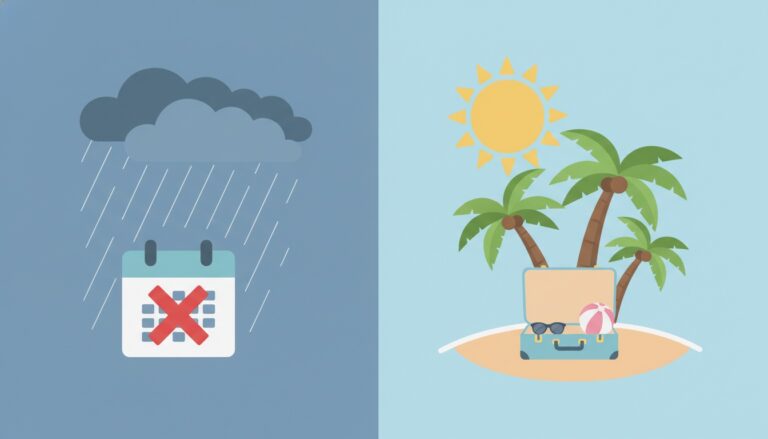
Have you ever planned a perfect vacation to a tropical paradise, only to spend the entire week staring at rain from your hotel window? 🌧️
Synthetic Case Study:
We often hear from learners like “Sarah” (a composite character representing common student experiences). Sarah planned a trip to Vietnam with her Korean friends in July. She didn’t know how to ask about the weather in Korean, so she just agreed to the dates. It turned out to be the peak of the rainy season, and they spent 4 days inside cafes!
Today, we aren’t just learning weather vocabulary; we are learning how to discuss travel timing, avoid bad weather, and plan smartly in Korean. These expressions are useful whether you are traveling to Southeast Asia or visiting Korea during the summer monsoon.
At a Glance
- Today’s Key Expressions: 우기 (Rainy Season), 피하다 (To avoid), 날씨 요정 (Weather Fairy)
- Safe to Use: With friends, travel agents, and coworkers.
- Level: B1-B2 (Intermediate). These words move beyond simple “It is raining” to discussing “Travel Strategy.”
Table of Contents
- Today’s Deep Dive: Key Expressions
- Textbook vs. Real Korean: Complaining about Humidity
- Nuance Analysis: The “Weather Complaint” Thermometer
- Real-Life Role Play: Planning a Trip
- Shadowing Challenge
- FAQ
- Final Quiz
Today’s Key Expressions Deep Dive
1. 우기 / 건기 (Ugi / Geongi)
- Meaning: Rainy Season / Dry Season
- Usage: Used in travel contexts, geography, or when deciding travel dates.
- Tutor’s Secret Note:
In Korea, we usually call the summer rainy season 장마 (Jangma). However, when talking about tropical countries (like Thailand, Vietnam, Philippines), we specifically use 우기 (Ugi) and 건기 (Geongi). Using Jangma for Thailand sounds a bit awkward! - Pronunciation Clinic:
- Geongi: The ‘G’ is soft, almost like a K but voiced. [Geon-gi]
Examples:
* 베트남은 지금 우기예요? (Beteunameun jigeum ugi-yeyo?)
Is it the rainy season in Vietnam now?
* 건기에 가는 게 제일 좋아요. (Geongie ganeun ge jeil joayo.)
It is best to go during the dry season.
* 우기라서 비가 많이 와요. (Ugiraseo biga mani wayo.)
It rains a lot because it is the rainy season.
2. 피하다 (Pihada)
- Meaning: To avoid / To dodge
- Usage: Very common when talking about traffic, bad weather, or people you dislike.
- Tutor’s Secret Note:
This is a “survival verb.” You want to avoid typhoons, avoid rush hour, or avoid paying too much. It implies an active effort to stay away from something negative. - Pronunciation Clinic:
- H sound: When ‘h’ is between vowels, it often becomes very weak. Pihada often sounds like Pi-ada in fast speech.
Examples:
* 태풍을 피해서 여행 날짜를 잡았어요. (Taepungeul pihaeseo yeohaeng naljjareul jabasseoyo.)
I set the travel dates to avoid the typhoon.
* 성수기는 피하고 싶어요. (Seongsugineun pihago sipeoyo.)
I want to avoid the peak season.
* 비를 피할 곳이 필요해요. (Bireul pihal gosi piryohaeyo.)
We need a place to take shelter from the rain.
3. 날씨 요정 (Nalssi Yojeong)
- Meaning: Weather Fairy (Someone who brings good weather)
- Usage: Casual slang / affectionate nickname.
- Tutor’s Secret Note:
If you travel with a friend and the sun always shines, call them a 날씨 요정. Conversely, if it always rains when a specific friend joins, they might jokingly be called 비를 몰고 다니는 사람 (Someone who drives rain around with them).
Examples:
* 저는 날씨 요정이에요! (Jeoneun nalssi yojeong-ieyo!)
I am a weather fairy! (I bring good weather).
* 네가 와서 날씨가 좋아졌어. (Nega waseo nalssiga joajyeosseo.)
The weather got better because you came.
* 이번 여행엔 날씨 요정이 필요해. (Ibeon yeohaengen nalssi yojeong-i piryohae.)
We need a weather fairy for this trip.
Better Alternative Expressions
- Formal: 기상 악화 (Gisang akhwa) – Worsening weather conditions (used in news/announcements).
- Casual: 꿉꿉하다 (Kkupkkuphada) – To be unpleasantly humid/sticky.
Mini Quiz (Click to see answer)
Fill in the blank: “I want to go during the dry season, not the rainy season.”
OO 말고 OO에 가고 싶어요.
Answer: 우기 (Ugi), 건기 (Geongi)
Textbook vs. Real Korean
| Context | Textbook Korean (Formal) | Real Korean (Natural/Slang) |
|---|---|---|
| It’s humid | 습도가 높습니다. (Seupdoga nopseumnida) | 완전 찜통이에요. (Wanjeon jjimtong-ieyo) – It’s a total steamer. |
| It’s raining | 비가 옵니다. (Biga omnida) | 하늘에 구멍 났나 봐요. (Haneure gumeong nanna bwayo) – Looks like a hole in the sky. |
Situation Checklist:
* News Report: Use Textbook Korean.
* Talking to friends about your ruined hair: Use Real Korean.
Unique Analysis: The “Complain” Thermometer
How to express your frustration about the weather, from mild to extreme.
| Intensity | Korean Phrase | Romanization | Meaning |
|---|---|---|---|
| Lv. 1 (Mild) | 비가 좀 오네요. | Biga jom oneyo. | It’s raining a bit. |
| Lv. 3 (Annoyed) | 날씨가 왜 이래? | Nalssiga wae irae? | Why is the weather like this? |
| Lv. 5 (Angry) | 여행 다 망쳤어! | Yeohaeng da mangchyeosseo! | The whole trip is ruined! |
Real-Life Role Play: Planning a Vacation
Scenario: You are at a cafe with your Korean friend Minji, planning a trip to Bangkok.
You: 태국 여행 언제 갈까? 7월 어때?
(Taeguk yeohaeng eonje galkka? Chirwol eottae?)
When shall we go to Thailand? How about July?
Minji: 7월? 그때 태국은 우기 아니야?
(Chirwol? Geuttae Taegugeun ugi aniya?)
July? Isn’t that the rainy season in Thailand?
You: 아 정말? 비 오면 돌아다니기 힘든데.
(A jeongmal? Bi omyeon doradanigi himdeunde.)
Ah really? It’s hard to walk around if it rains.
Minji: 응, 태풍도 올 수 있어. 그냥 건기인 12월에 가자.
(Eung, taepungdo ol su isseo. Geunyang geongiin sibiwore gaja.)
Yeah, typhoons might come too. Let’s just go in December, the dry season.
You: 좋아. 태풍은 무조건 피해야지!
(Joa. Taepungeun mujogeon pihaeyaji!)
Good. We absolutely must avoid typhoons!
💡 Culture Tip:
In Korea, checking the weather forecast regarding Typhoons (태풍) is taken very seriously in summer. If a friend suggests changing dates due to a typhoon, it is wise to agree immediately!
Shadowing & Speaking Challenge
Script (Read aloud 3 times):
“우기에는 비가 갑자기 쏟아질 수 있어요.”
(Ugieneun biga gapjagi ssodajil su isseoyo.)
(Meaning: During the rainy season, rain can pour down suddenly.)
Checklist:
* [ ] 1st Try: Read slowly checking pronunciation.
* [ ] 2nd Try: Read at natural speed.
* [ ] 3rd Try: Read without looking at the text.
Pronunciation Point:
Pay attention to 쏟아질 (Ssodajil). The double ‘ss’ (ㅆ) needs to be strong and sharp, with tension in your tongue.
FAQ
Q1: Can I use “Monsoon” in Korean?
Technically, yes (몬순), but in daily conversation, we almost exclusively use 장마 (Jangma) for the Korean rainy season and 우기 (Ugi) for tropical rainy seasons.
Q2: How do I ask “Is the weather nice?” politely?
날씨가 좋은가요? (Nalssiga joeungayo?) is polite. If asking a friend, simply say 날씨 좋아? (Nalssi joa?).
Wrap-up & Action Item
Today’s Summary:
When planning travel, check if it is 우기 (Rainy Season) or 건기 (Dry Season), and always try to 피하다 (Avoid) the typhoons!
Today’s Mission:
Open your weather app, find a city in Southeast Asia (like Bangkok or Manila), and say out loud in Korean whether it looks like the rainy season or not.
Have you ever been a “Weather Fairy” or a “Rain Bringer” on a trip? Tell us in the comments!
Final Quiz
1. Which word refers to the “Dry Season”?
A) 장마 (Jangma)
B) 우기 (Ugi)
C) 건기 (Geongi)
D) 태풍 (Taepung)
2. How do you say “I want to avoid the rain”?
A) 비를 피하고 싶어요. (Bireul pihago sipeoyo.)
B) 비를 먹고 싶어요. (Bireul meokgo sipeoyo.)
C) 비를 좋아해요. (Bireul joahaeyo.)
D) 비가 오고 있어요. (Biga ogo isseoyo.)
3. Fill in the blank:
“You bring good weather! You are a weather OO!”
(날씨 OO)
Answers:
1. C (건기)
2. A (비를 피하고 싶어요)
3. 요정 (Yojeong – Fairy)
Frequently Asked Questions (FAQ)
Q: What does "우기 / 건기 (Ugi / Geongi)" mean in Korean and how do you pronounce it?
A: In Korean, "우기 / 건기 (Ugi / Geongi)" is pronounced [Clinic:] and means: Rainy Season / Dry Season
Q: What does "피하다 (Pihada)" mean in Korean and how do you pronounce it?
A: In Korean, "피하다 (Pihada)" is pronounced [Clinic:] and means: To avoid / To dodge
Q: What does "날씨 요정 (Nalssi Yojeong)" mean in Korean and how do you pronounce it?
A: In Korean, "날씨 요정 (Nalssi Yojeong)" is pronounced [see lesson guide] and means: Weather Fairy (Someone who brings good weather)







