

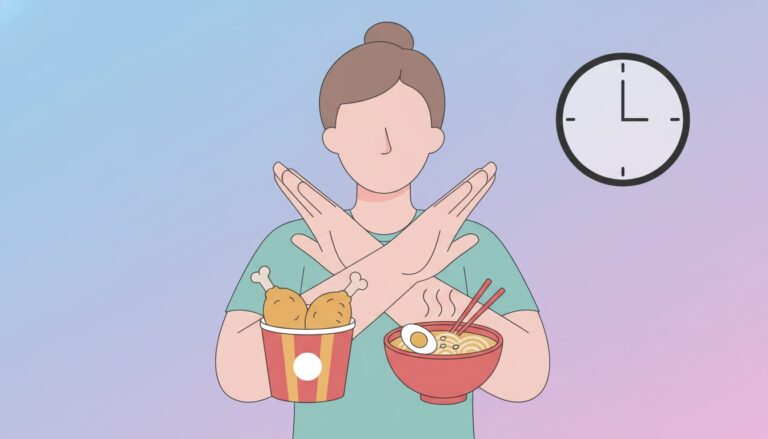
Resisting the Midnight Chicken: How to Say “No” to Late-Night Snacks in Korean 🍗
Introduction
Hello, this is Daily Hangul!
Have you ever been in this situation? It’s 11 PM, you are relaxing in your hotel or dorm in Korea, and suddenly your Korean friend asks, “Shall we order chicken?” (치킨 시킬까?). The smell of Yangnyeom Chicken (seasoned chicken) is tempting, but you are on a strict diet.
Case Study (Synthetic Example):
This is a compiled case based on common struggles shared by learners.
Many students tell us that refusing food in Korea feels harder than in other cultures. Why? Because sharing food is a sign of affection (Jeong, 정). A learner named “Sarah” mentioned she gained 3kg in her first month in Seoul because she didn’t know how to politely say “No” to late-night delivery culture (Yasik, 야식).
In Korea, simply saying “No” can sometimes feel cold. Today, we will learn how to refuse food firmly but politely, while letting them know you are managing your health. Let’s protect your diet and your friendships!
At a Glance: Today’s Summary
- Target: Rejecting food offers late at night without being rude.
- Key Expressions:
- Yasi-k kkeun-eosseoyo (I quit late-night snacks)
- Da-ie-teu jung-ieyo (I am on a diet)
- Nae-il bu-eo-yo (I’ll get puffy tomorrow)
- Difficulty: A1 (Beginner) – These are survival phrases you will use every single night in Korea.
Table of Contents
- Deep Dive: Core Expressions
- Textbook vs. Real Korean
- Analysis: The “Puffiness” Excuse
- Role Play: The Chicken Temptation
- Shadowing Challenge
- FAQ
Deep Dive: Core Expressions
1. 야식 끊었어요 (Yasik kkeun-eosseoyo)
- Meaning: I quit late-night snacks. / I’ve stopped eating late at night.
- Usage & Register:
- To whom: Friends, close colleagues.
- Tone: Polite informal (Haeyo-che). Use this to show determination.
- Tutor’s Secret Note:
- “Yasik” (야식) specifically refers to late-night meals. Saying you “quit” (끊었다) sounds stronger than just “I won’t eat.” It implies a lifestyle change.
- Warning: If you eat even one bite after saying this, your friends will tease you forever!
- Pronunciation Clinic:
- 끊었어요 [Kkeun-eosseoyo]: The bottom
ㅎis silent. Theㄴcarries over. Pronounce it like [끄너써요 / Kkeun-neo-sseo-yo].
- 끊었어요 [Kkeun-eosseoyo]: The bottom
- Examples:
- (Friend) 라면 먹고 갈래? (Want to eat Ramyeon?) -> (You) 아니요, 저 야식 끊었어요. (No, I quit late-night snacks.)
- (Doctor) 위가 안 좋아요. (Your stomach is bad.) -> (You) 네, 그래서 야식 끊었어요. (Yes, so I stopped eating late at night.)
- (Self-talk) 오늘부터 야식 끊었어요. (I quit late-night snacks starting today.)
2. 다이어트 중이에요 (Da-ie-teu jung-ieyo)
- Meaning: I am on a diet / I am in the middle of a diet.
- Usage & Register:
- To whom: Anyone (Standard Polite).
- Tone: Fact-based and neutral.
- Tutor’s Secret Note:
- Koreans use the English word “Diet” (다이어트), but it strictly means “weight loss” here. It doesn’t usually mean a general nutritional plan.
- Adding “-jung” (중) means “in the middle of doing something.”
- Pronunciation Clinic:
- 중이에요 [Jung-i-e-yo]: Link the
ㅇsound. It flows like [중이에여].
- 중이에요 [Jung-i-e-yo]: Link the
- Examples:
- (Colleague) 쿠키 좀 드실래요? (Want some cookies?) -> (You) 죄송해요, 다이어트 중이에요. (Sorry, I’m on a diet.)
- (Phone) 치킨 시킬까? (Shall we order chicken?) -> (You) 나 다이어트 중이에요. 안 먹을래요. (I’m on a diet. I won’t eat.)
- (Gym) 저 지금 다이어트 중이에요. (I am dieting right now.)
3. 내일 부어서 안 돼요 (Naeil bu-eoseo an dwaeyo)
- Meaning: I can’t because I’ll get puffy/swollen tomorrow.
- Usage & Register:
- To whom: Friends who care about appearance.
- Tone: Casual logic (giving a valid reason).
- Tutor’s Secret Note:
- This is the most “Korean” excuse. Koreans are very sensitive to facial swelling (Butgi, 붓기) in the morning caused by salty food. Using this excuse makes you sound like a local!
- Pronunciation Clinic:
- 부어서 [Bu-eo-seo]: Make sure to pronounce the vowels clearly. No strong consonants here.
- Examples:
- (Friend) 딱 한 입만 먹어. (Just eat one bite.) -> (You) 내일 부어서 안 돼요. 촬영 있어요. (I can’t because I’ll swell up. I have a photoshoot.)
- (Mom) 짠 음식 먹지 마. (Don’t eat salty food.) -> (You) 네, 내일 부어서 안 돼요. (Okay, I can’t because I’ll get puffy.)
- (Dinner) 국물은 안 먹을래요. 내일 부어서 안 돼요. (I won’t drink the soup. I’ll get puffy tomorrow.)
Alternatives:
* More Casual: 살 쪄! (Sal jjyeo!) – “I’ll get fat!”
* More Polite: 건강 관리 하고 있어요. (Geongang gwalli hago isseoyo.) – “I am managing my health.”
Mini Quiz (Click to see answer)
Fill in the blank: “Sorry, I can’t eat. I am ______ late-night snacks.”
미안해요, 못 먹어요. 저 야식 ______.
Answer: 끊었어요 (kkeun-eosseoyo)
Textbook vs. Real Korean
What books teach you vs. what you hear at a Han River picnic at 10 PM.
| Context | Textbook Korean (Book) | Real Korean (Street) |
|---|---|---|
| Reason | 체중 감량을 하고 있습니다. (Chejung gam-ryang-eul hago isseumnida) I am in the process of weight reduction. |
나 살 빼야 돼. (Na sal ppae-ya dwae) I gotta lose weight. |
| Refusal | 저는 먹지 않겠습니다. (Jeoneun meok-ji an-kets-seumnida) I will not eat. |
참을게. (Chameul-ge) I’ll resist/pass. |
Quick Tip: usage of “참을게” (I’ll resist/hold back) sounds very polite yet firm because it implies you want to eat, but you are controlling yourself. It makes the offerer feel less rejected.
Analysis: The “Tone Thermometer”
How strong is your refusal? Choosing the right ending particle changes the vibe.
| Level | Expression | Nuance | Distance |
|---|---|---|---|
| 1 (Hot) | 먹자! (Meok-ja!) | “Let’s eat!” No diet today. | Very Close |
| 2 (Warm) | 조금만 먹을게. (Jogeum-man meok-eul-ge.) | “I’ll eat just a little.” Weak will. | Close |
| 3 (Cool) | 생각 없어요. (Saeng-gak eops-eo-yo.) | “I have no thought (of food).” Polite refusal. | Standard |
| 4 (Cold) | 됐어요. (Dwaess-eo-yo.) | “I’m done / Forget it.” Can be rude if said sharply. | Distant |
| 5 (Freezing) | 싫어요. (Sil-eo-yo.) | “I hate it / No.” Very blunt. Avoid using this for food offers. | Very Distant |
Real-life Role Play: The Delivery Trap
Situation: You (B) are at your Korean friend’s (A) house watching Netflix at 11:30 PM. A delivery bike zooms by outside.
A (Friend): 와, 배고프다. 우리 치킨 시킬까? 배달 앱 켤까?
(Wa, baegopeuda. Uri chikin sikilkka? Baedal-aep kyeolkka?)
(Wow, I’m hungry. Shall we order chicken? Should I open the delivery app?)
B (You): 음… 치킨 냄새는 좋지만, 저는 안 먹을래요.
(Eum… Chikin naemsae-neun jochiman, jeoneun an meok-eul-laeyo.)
(Hmm… The chicken smells good, but I won’t eat.)
A (Friend): 에이, 오늘만 먹고 내일부터 다이어트 해! 맛있으면 0칼로리야.
(Ei, oneul-man meokgo naeil-buteo da-ie-teu hae! Mas-isseumyeon yeong-kal-lori-ya.)
(Hey, just eat today and diet starting tomorrow! If it’s delicious, it’s 0 calories.)
B (You): 안 돼요. 저 요새 야식 끊었어요. 내일 얼굴 부을까 봐요.
(An dwaeyo. Jeo yosae yasik kkeun-eosseoyo. Naeil eolgul bueulkka bwayo.)
(No. I recently quit late-night snacks. I’m worried my face will swell tomorrow.)
A (Friend): 독하다 독해! 알겠어, 나 혼자 먹는다?
(Dokhada dokhae! Algesseo, na honja meongneunda?)
(You are so strict/strong-willed! Okay, I’m eating alone?)
Cultural Tip: “독하다” (Dok-hada) literally means poisonous/strong, but when used for dieters, it’s a compliment (or teasing) meaning you have very strong willpower.
Shadowing Challenge
Repeat this 3 times to train your “Diet Muscle”!
“Thanks for asking, but I’m on a diet. I’ll just drink water.”
물어봐 줘서 고마운데, 저 다이어트 중이에요. 물만 마실게요.
(Mureobwa jwoseo gomaunde, jeo da-ie-teu jung-ieyo. Mulman masilgeyo.)
- [ ] Attempt 1 (Slow)
- [ ] Attempt 2 (Natural Speed)
- [ ] Attempt 3 (With Emotion – Touch your stomach!)
FAQ (Frequently Asked Questions)
Q1: Can I just say “No” (아니요) to food?
A: It’s grammatically correct but culturally dry. It’s better to give a small reason like “I’m full” (배불러요) or “I’m on a diet” (다이어트 중이에요) to soften the rejection.
Q2: What does “Hanipman” mean?
A: It means “Just one bite” (한입만). Warning: If you say this, you might end up eating the whole meal! It’s a famous trope in Korean variety shows.
Conclusion & Action Item
Refusing late-night snacks in Korea is hard because the food is delicious and the culture is sharing-focused. But using phrases like “야식 끊었어요” allows you to be polite without compromising your goals.
Today’s Mission:
Next time you are watching a K-Drama and see a character eating fried chicken, pause the video and say out loud: “안 돼요, 저 다이어트 중이에요!” (No, I’m on a diet!).
Tell us in the comments:
What is the hardest Korean food for you to say “No” to? (Mine is Tteokbokki…)
Final Quiz
- Which phrase implies you have completely stopped a habit?
a) 야식 먹어요 (Yasik meogeoyo)
b) 야식 끊었어요 (Yasik kkeun-eosseoyo)
c) 야식 좋아요 (Yasik joayo) -
Why might a Korean refuse salty food late at night? (Cultural reason)
a) It’s too expensive.
b) They are afraid of ghosts.
c) They are worried about face swelling (Butgi). -
Fill in the blank: “I need to lose weight.”
= “나 ___ 빼야 돼.”
Answers: 1. (b), 2. (c), 3. 살 (Sal)
Frequently Asked Questions (FAQ)
Q: What does "야식 끊었어요 (Yasik kkeun-eosseoyo)" mean in Korean and how do you pronounce it?
A: In Korean, "야식 끊었어요 (Yasik kkeun-eosseoyo)" is pronounced [see lesson guide] and means: I quit late-night snacks. / I’ve stopped eating late at night.
Q: What does "다이어트 중이에요 (Da-ie-teu jung-ieyo)" mean in Korean and how do you pronounce it?
A: In Korean, "다이어트 중이에요 (Da-ie-teu jung-ieyo)" is pronounced [see lesson guide] and means: I am on a diet / I am in the middle of a diet.
Q: What does "내일 부어서 안 돼요 (Naeil bu-eoseo an dwaeyo)" mean in Korean and how do you pronounce it?
A: In Korean, "내일 부어서 안 돼요 (Naeil bu-eoseo an dwaeyo)" is pronounced [see lesson guide] and means: I can't because I'll get puffy/swollen tomorrow.







