

Can We Be Friends? The Safe Way to Start Using “Banmal” (Casual Korean)
Introduction
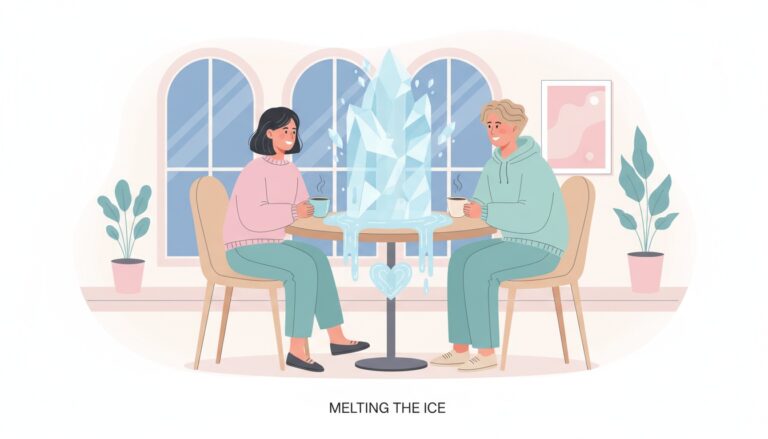
Hello, this is Daily Hangul! Have you ever felt an invisible wall between you and your Korean friend, even though you hang out every week? You laugh together, drink coffee together, but something feels stiff because every sentence ends in “-yo” or “-nida.”
Synthetic Case Study (Based on common learner experiences):
Let’s look at a recurring pattern we see with our students, let’s call this the “Sarah Scenario.” Sarah (25) made a Korean friend, Ji-min (25). Even after knowing each other for six months, Sarah kept using formal textbooks Korean (Jondaetmal). Ji-min felt that Sarah wanted to keep a distance, so Ji-min hesitated to open up about personal worries. The relationship stalled because the language level didn’t match the emotional closeness.
Why isn’t the textbook enough? Textbooks teach you how to be polite, but they rarely teach you how to be close. Today, we will learn how to break that wall safely without being rude.
At a Glance
- Goal: Switching from Polite Speech (Jondaetmal) to Casual Speech (Banmal).
- Safe Context: Same age friends, or when an older person gives you permission.
- Level: A2 (Lower Intermediate) – Essential for deep friendship.
- Key Expressions:
- 말을 놓다 (To drop formalities)
- 말 편하게 해도 돼요? (Can I speak comfortably?)
- 우리 동갑이네요! (We are the same age!)
Table of Contents
- Today’s Key Expressions Deep Dive
- Textbook vs. Real Korean
- The Politeness Thermometer (Analysis)
- Real-Life Role Play: The “Age Reveal” Moment
- Shadowing Challenge
- FAQ
- Wrap-up & Quiz
Today’s Key Expressions Deep Dive
1. 말을 놓다 (Mareul nota)
- Meaning: To drop formalities / To start speaking casually
- Lit: To put down words.
- Usage & Register:
- Used when suggesting the switch. Usually, the older person suggests this to the younger person, or same-age friends suggest it to each other.
- Tutor’s Secret Note:
- This is an idiom. You literally “put down” the burden of politeness.
- Warning: Never just start using Banmal without asking! Even if you are the same age, using Banmal immediately can be seen as aggressive or uneducated.
- Pronunciation Clinic:
- [Marel nota] -> The ‘h’ in 놓 (noh) is often silent or weak when followed by vowels, but here followed by ‘다’, it aspirates the ‘d’ sound slightly, but in casual rapid speech, it sounds like [Marel nota].
- Examples:
- 우리 이제 말 놓을까요? (Uri ije mal noeulkkayo?) – Shall we speak casually now?
- 저한테 말 놓으셔도 돼요. (Jeohante mal noeusyeodo dwaeyo.) – You can speak casually to me.
- 언제 말을 놓았어요? (Eonje mareul noasseoyo?) – When did you guys start speaking casually?
- Mini Quiz:
-
Click to see answer
Answer: 놓을까요 (Noeulkkayo)
- 우리 이제 말 ( )? – Shall we drop formalities?
-
2. 말 편하게 해도 돼요? (Mal pyeonhage haedo dwaeyo?)
- Meaning: Can I speak comfortably (casually)?
- Lit: Is it okay if I do speech comfortably?
- Usage & Register:
- This is a very polite and soft way to ask for permission to switch to Banmal.
- Tutor’s Secret Note:
- “Comfortably” (Pyeonhage) here is a code word for “Banmal.” It sounds much softer than saying “Can I use Banmal?”
- Pronunciation Clinic:
- [Pyeon-ha-ge] -> Ensure the ‘h’ is soft. Don’t stress it too hard.
- Examples:
- 말 편하게 하세요. (Mal pyeonhage haseyo.) – Please speak comfortably (to me).
- 우리 동갑이니까 말 편하게 해도 될까요? (Uri donggab-inikka mal pyeonhage haedo doelkkayo?) – Since we are the same age, can I speak casually?
- 아직 말 편하게 하기에는 좀 어색해요. (Ajik mal pyeonhage hagi-eneun jom eosaekhaeyo.) – It’s still a bit awkward to speak casually.
3. 야 / 너 (Ya / Neo)
- Meaning: Hey / You
- Usage & Register:
- Strictly Banmal only. Never use these with people older than you or strangers.
- Tutor’s Secret Note:
- In English, “You” is neutral. In Korean, “Neo” (You) can be offensive if used too early. Even in Banmal, Koreans often prefer using names (e.g., Jimin-ah) instead of “Neo.”
- Pronunciation Clinic:
- [Ya] vs [Ye] -> Make sure your mouth opens wide for ‘Ya’.
- Examples:
- 야! 오랜만이다. (Ya! Oraenmanida.) – Hey! Long time no see.
- 너는 어때? (Neoneun eottae?) – How about you?
- 지민아, 너 밥 먹었어? (Jimin-a, neo bap meogeosseo?) – Jimin, did you eat?
Textbook vs. Real Korean
| Context | Textbook Korean (Book Korean) | Real Korean (Spoken naturally) |
|---|---|---|
| Suggesting Banmal | 우리 이제 반말을 합시다. (Uri ije banmareul hapsida.) Let’s do banmal now. |
우리 말 놓을까? (Uri mal noeulkka?) Shall we drop formalities? |
| Agreeing | 네, 좋습니다. (Ne, joseumnida.) Yes, that is good. |
응, 그러자! / 좋아! (Eung, geureoja! / Joa!) Yeah, let’s do it! / Good! |
Checklist: When to Switch
* [ ] You discovered you are the same age (Don-gap).
* [ ] The other person is younger and asked you to speak comfortably.
* [ ] You have agreed explicitly to switch.
Unique Analysis: The Politeness Thermometer
How does the “distance” change with your sentence ending? Let’s look at the temperature of the relationship.
| Level | Ending | Example | Vibe | Distance |
|---|---|---|---|---|
| Level 5 (Ice) | -합니다 (-nida) | 반갑습니다. (Bangapseumnida.) | Business, News, Military | 🧊 Far |
| Level 3 (Water) | -해요 (-yo) | 반가워요. (Bangawoyo.) | Polite, Safe, Daily Life | 💧 Neutral |
| Level 1 (Fire) | -해 (-ae/ye) | 반가워! (Bangawo!) | Friends, Intimate, Family | 🔥 Close |
- Tip: Most foreigners stay at Level 3. Moving to Level 1 is the key to becoming a “real friend” in Korea, but you need the “key” (asking permission) to open that door.
Real-Life Role Play: The “Age Reveal”
Situation: You (Guest) and a new Korean acquaintance (Min-su) are at a cafe in Hongdae. You just realized you were born in the same year.
Guest: 저 98년생이에요. (Jeo gu-sip-pal-nyeon-saeng-ieyo.)
(I was born in 1998.)
Min-su: 진짜요? 저도 98년생이에요! 우리 동갑이네요. (Jinjja-yo? Jeodo gu-sip-pal-nyeon-saeng-ieyo! Uri donggab-ineyo.)
(Really? I’m born in 98 too! We are the same age.)
Guest: 와, 반가워요! 그럼 우리 말 편하게 할까요? (Wa, bangawoyo! Geureom uri mal pyeonhage halkkayo?)
(Wow, nice to meet you! Then shall we speak comfortably?)
Min-su: 오, 좋아요. 우리 말 놓아요. (O, joayo. Uri mal noayo.)
(Oh, good. Let’s drop formalities.)
Guest: 그래! 민수야, 커피 뭐 마실래? (Geurae! Minsu-ya, keopi mwo masillae?)
(Okay! Minsu, what coffee do you want to drink?)
Culture Tip: Notice how the Guest immediately switched to “Geurae!” (Okay!) and added “-ya” after the name once Min-su agreed. This immediate switch is a sign of friendliness!
Shadowing Challenge
Script (20 seconds)
Try saying this naturally, as if you just found out your friend’s age.
“우리 동갑이니까, 말 편하게 해도 돼요?”
(Uri donggab-inikka, mal pyeonhage haedo dwaeyo?)
Checklist:
* [ ] Said it slowly (checking pronunciation).
* [ ] Said it at normal speed.
* [ ] Said it with a smile (non-verbal cue is important!).
Pronunciation Point: Link “donggab-inikka” smoothly like [Dong-ga-bi-ni-kka].
FAQ (Frequently Asked Questions)
Q1: Can I suggest Banmal to someone older than me if we are close?
* Answer: Generally, no. Even if you are close, the younger person usually waits for the older person to suggest it (
Frequently Asked Questions (FAQ)
Q: What does "말을 놓다 (Mareul nota)" mean in Korean and how do you pronounce it?
A: In Korean, "말을 놓다 (Mareul nota)" is pronounced [see lesson guide] and means: To drop formalities / To start speaking casually
Q: What does "말 편하게 해도 돼요? (Mal pyeonhage haedo dwaeyo?)" mean in Korean and how do you pronounce it?
A: In Korean, "말 편하게 해도 돼요? (Mal pyeonhage haedo dwaeyo?)" is pronounced [see lesson guide] and means: Can I speak comfortably (casually)?
Q: What does "야 / 너 (Ya / Neo)" mean in Korean and how do you pronounce it?
A: In Korean, "야 / 너 (Ya / Neo)" is pronounced [see lesson guide] and means: Hey / You






