Introduction
Hello, this is Daily Hangul! 👋
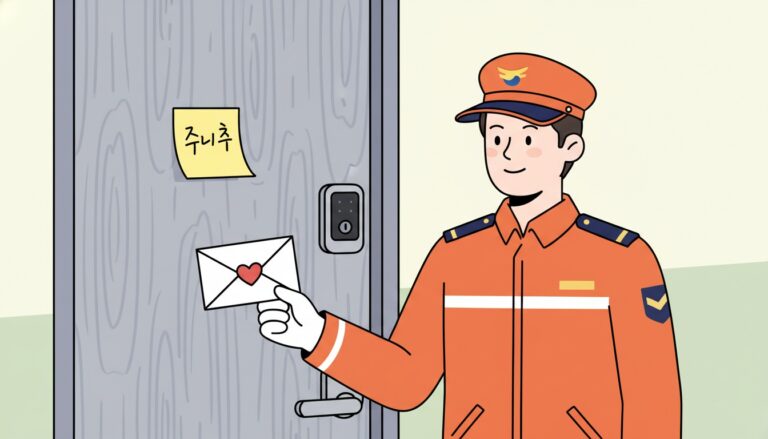
Have you ever waited at home all day for an important document (like your Alien Registration Card or a bank card), only to find a sticker on your door saying you missed the delivery? You might be thinking, “I was home! Why didn’t they just leave it at the door?”
This is a synthetic case study based on frequent questions from expats in Korea:
Many students tell me, “Teacher, the delivery person called me, but I didn’t understand, so I said ‘Okay’ and hung up. Then I got a message saying I have to go to the post office.”
This happens because of “Deunggi” (Registered Mail). Unlike regular packages (Taekbae) which are often left in front of your door, Deunggi has a strict rule: It must be received in person.
Textbooks teach you how to send a letter, but they rarely teach you the panic of missing an important government document. Today, let’s learn how to handle this situation like a local!
At a Glance
- Key Expressions: 등기 (Registered Mail), 본인 수령 (Receipt in person), 보관 기간 (Storage period).
- When to use: When receiving important documents from banks, immigration, or courts.
- Level: B1 (Intermediate) – Essential for solving daily life problems in Korea.
Table of Contents
- Today’s Deep Dive Expressions
- Textbook vs. Real Korean
- Culture Note: The “Sticky Note” on Your Door
- Real-Life Role Play: At the Post Office
- Shadowing Challenge
- FAQ
- Wrap-up & Quiz
Today’s Deep Dive Expressions
1. 등기 (Deunggi) / 등기 우편 (Deunggi Upyeon)
- Meaning: Registered mail / Certified mail
- Usage & Register:
- Used by post office workers and in official notifications.
- Often heard as “등기 왔습니다” (Deunggi has arrived).
- Tutor’s Secret Note: 🤫
- Hearing “Deunggi” implies “I need your signature.” You cannot ask them to “just leave it there.”
- Warning: If you ignore the arrival notice (sticker), the mail gets sent back to the sender, which is a huge hassle for visa documents.
- Pronunciation Clinic:
- [등기] sounds like [Deung-gi]. Make sure the ‘g’ is soft but distinct.
- Examples:
- 등기 왔습니다. (Deunggi watsseumnida.) – Registered mail is here.
- 이거 등기로 보내 주세요. (Igeo deunggi-ro bonae juseyo.) – Please send this via registered mail.
- 법원 등기예요. (Beobwon deunggi-yeyo.) – It is registered mail from the court.
- Alternatives:
- 일반 우편 (Ilban Upyeon) – Regular mail (no tracking, dropped in mailbox).
- Mini Quiz:
- “The postman said it is ______ , so I need to sign.”
-
Click for Answer
등기 (Deunggi)
2. 본인 (Bonin)
- Meaning: The person themselves / In person / Myself
- Usage & Register:
- Formal/Official context.
- Used when ID verification is required.
- Tutor’s Secret Note: 🤫
- You will hear “본인이세요?” (Are you the person in question?) a lot.
- Even if you are the spouse or roommate, some strict mail (like credit cards) specifies “본인 외 수령 불가” (No one but the person can receive).
- Pronunciation Clinic:
- [보닌] (Bo-nin). Connect the ‘n’ sound smoothly.
- Examples:
- 본인만 수령 가능해요. (Bonin-man suryeong ganeunghaeyo.) – Only the person themselves can receive it.
- 본인 확인이 필요합니다. (Bonin hwagini piryohamnida.) – Identity verification is required.
- 제가 본인입니다. (Jega bonin-imnida.) – I am that person.
- Alternatives:
- 직접 (Jikjeop) – Directly / In person (Adverb).
- Mini Quiz:
- “Can my friend pick it up? No, it must be ______.”
-
Click for Answer
본인 (Bonin)
3. 부재중 (Bujaejung)
- Meaning: Absence / Not at home / Missed call
- Usage & Register:
- Written on the delivery notice sticker or seen on phone logs.
- Tutor’s Secret Note: 🤫
- If you see “부재중 방문” (Visited while absent) on the sticker, check the redelivery date or the post office location.
- Pronunciation Clinic:
- [부재중] sounds like [Bu-jae-jung].
- Examples:
- 부재중이라서 못 받았어요. (Bujaejung-iraseo mot badasseoyo.) – I couldn’t get it because I wasn’t home.
- 부재중 전화가 와 있었어요. (Bujaejung jeonhwaga wa isseosseoyo.) – There was a missed call.
- 고객님 부재중으로 반송됩니다. (Gogaengnim bujaejung-euro bansong-doemnida.) – It is being returned due to customer absence.
- Alternatives:
- 집에 없을 때 (Jibe eopseul ttae) – When not at home (Casual).
Textbook vs. Real Korean
Context: Asking the delivery person to just leave the package.
| Type | Expression | Nuance |
|---|---|---|
| Book Korean | 문 앞에 놓아 주세요. (Mun ape noa juseyo.) | “Please place it in front of the door.” (Grammatically perfect, standard). |
| Real Korean | 문 앞에 놔주세요. (Mun ape nwajuseyo.) | Shortened version. Very common for Taekbae (parcels). |
| Real Korean (Deunggi) | 경비실에 맡겨 주세요? (Gyeongbisire matgyeo juseyo?) | “Can you leave it at the security office?” (Note: Most Deunggi cannot be left here, but people often ask to check). |
⚠️ Reality Check: For Deunggi, neither of these work if the sender requested “Bonin Suryeong” (Person-only receipt). You must say: “우체국으로 찾으러 갈게요.” (I will go to the post office to pick it up.)
Unique Analysis: The “Delivery Notice” Decoder 🏷️
When you find a sticker (우편물 도착 안내서 – Mail Arrival Notice) on your door, look for these keywords to understand your situation:
- 재배달 예정 (Jaebaedal Yejeong): “Scheduled for redelivery.” The postman will come again tomorrow. You don’t need to do anything yet.
- 우체국 보관 (Ucheguk Bogwan): “Stored at Post Office.” They tried 2-3 times, and now you must go to the post office.
- 폐문부재 (Pyemun Bujae): “Door closed, absent.” Fancy legal term for “Nobody was home.”
- 신분증 지참 (Sinbunjeung Jicham): “Bring ID.” Do not forget your ARC or Passport!
Real-Life Role Play 🎭
Scenario: You missed the delivery and are now at the post office counter to pick up your mail.
Person A: Clerk | Person B: You
A: 어서 오세요. 어떻게 오셨어요?
(Eoseo oseyo. Eotteoke osyeosseoyo?)
Welcome. How can I help you?
B: 등기 찾으러 왔어요. 집에 사람이 없어서 못 받았어요.
(Deunggi chajeureo wasseoyo. Jibe sarami eopseoseo mot badasseoyo.)
I came to pick up registered mail. I missed it because no one was home.
A: 네, 신분증하고 도착 안내서 보여 주시겠어요?
(Ne, sinbunjeunghago dochak annaeseo boyeo jusigesseoyo?)
Okay, can you show me your ID and the arrival notice?
B: 여기요. 혹시 이거 대리 수령도 되나요?
(Yeogiyo. Hoksi igeo daeri suryeongdo doenayo?)
Here. By any chance, can someone else pick this up for me?
A: 아니요, 이건 본인만 받으실 수 있는 거예요.
(Aniyo, igeon boninman badeusil su inneun geoyeyo.)
No, this one can only be received by the person themselves.
B: 아, 알겠습니다. 여기 서명하면 되나요?
(A, algesseumnida. Yeogi seomyeonghamyeon doenayo?)
Ah, I see. Do I sign here?
Shadowing Challenge 🗣️
Repeat this sentence 3 times to sound natural when explaining why you are at the post office.
“Please give me the registered mail that came yesterday.”
“어제 온 등기 우편 찾으러 왔어요.”
(Eoje on deunggi upyeon chajeureo wasseoyo.)
- [ ] Attempt 1 (Slow)
- [ ] Attempt 2 (Normal)
- [ ] Attempt 3 (Fast & Natural)
Pronunciation Tip: In 찾으러 (chajeureo), the ‘ㅈ’ moves to the next block -> [차즈러].
FAQ (Frequently Asked Questions)
Q1: Can I pick up Deunggi on the weekend?
Most Korean post offices are closed on weekends. However, some large district post offices have a “Delivery Storage” (교부) window open on Saturday mornings. You must call 1588-1300 or check the notice sticker first.
Q2: What is the difference between 택배 (Taekbae) and 등기 (Deunggi)?
* Taekbae: Usually parcels/boxes. Can be left at the door/security office.
* Deunggi: Usually documents/letters (or small important boxes). Requires a signature. Legal proof of delivery.
Wrap-up & Mission
Today we learned that Deunggi (Registered Mail) requires Bonin (You) to receive it! Don’t panic if you see a sticker on your door; just grab your ID and head to the post office before the storage period (보관 기간) ends.
🚀 Today’s Mission:
Next time you see a delivery truck or a postman, look for the logo. Is it 우체국 (Post Office) or a private company like CJ or Coupang? Spotting the difference helps you predict if you need to be home!
Tell me in the comments:
Have you ever had a package returned because you weren’t home? 😢
Final Quiz 📝
1. What does “본인 수령” mean?
a) Leave at the door
b) Receive in person
c) Return to sender
2. Which phrase means “I came to pick up registered mail”?
a) 등기 보내러 왔어요.
b) 등기 찾으러 왔어요.
c) 택배 시켰어요.
3. Fill in the blank:
“I missed the call because I was ______.”
= “______이라서 전화를 못 받았어요.”
Answers:
1. b) Receive in person
2. b) 등기 찾으러 왔어요. (Deunggi chajeureo wasseoyo.)
3. 부재중 (Bujaejung)
Frequently Asked Questions (FAQ)
Q: What does "등기 (Deunggi) / 등기 우편 (Deunggi Upyeon)" mean in Korean and how do you pronounce it?
A: In Korean, "등기 (Deunggi) / 등기 우편 (Deunggi Upyeon)" is pronounced [see lesson guide] and means: Registered mail / Certified mail
Q: What does "본인 (Bonin)" mean in Korean and how do you pronounce it?
A: In Korean, "본인 (Bonin)" is pronounced [see lesson guide] and means: The person themselves / In person / Myself
Q: What does "부재중 (Bujaejung)" mean in Korean and how do you pronounce it?
A: In Korean, "부재중 (Bujaejung)" is pronounced [see lesson guide] and means: Absence / Not at home / Missed call