

Introduction
Hello, this is Daily Hangul!
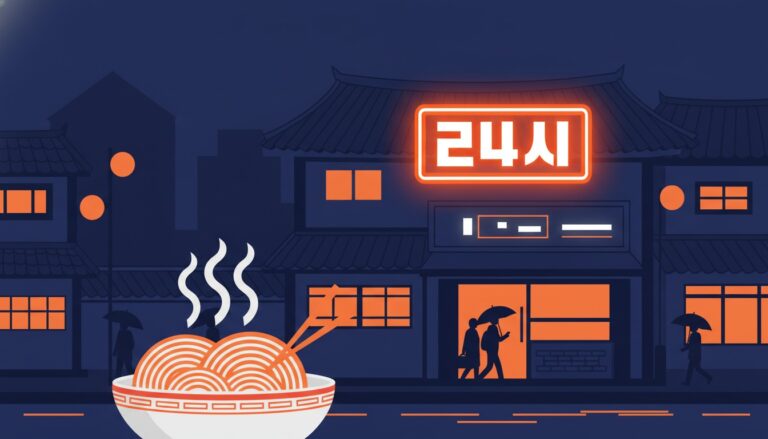
It’s 2:00 AM in Seoul. You’ve just finished exploring the nightlife in Hongdae, or perhaps you’ve just landed and checked into your hotel. Suddenly, hunger strikes. In many countries, your only option might be a convenience store. But in Korea? The city is still wide awake with the smell of ramyun and gukbap.
Composite Case Study (Sintoy)
We often hear from students like “Sarah” (a composite character representing many beginners). Sarah walked into a brightly lit restaurant at 3 AM, saw staff moving around, but stood frozen at the door for 5 minutes because she didn’t know if they were actually serving food or just cleaning up. She eventually left hungry because she was too afraid to ask, “Are you open?”
Textbooks teach you how to make a formal reservation for 7 PM. But they rarely teach you the survival phrases for a fast-paced, 24-hour restaurant where efficiency is king. Today, we will learn how to confidently walk in, sit down, and eat like a local, even at 3 AM.
Summary: At a Glance
- Today’s Key Phrases: Asking if they are open, calling the staff, and understanding “Self-Service.”
- Safe Zone: Casual 24-hour diners (Kimbap Cheonguk), Gukbap houses, Late-night fried chicken spots.
- Level: C1 Context / A1 Grammar. While the grammar is simple, knowing when and how to use these specific phrases shows you understand the unique “fast-dining” culture of Korea.
Table of Contents
- Deep Dive: 3 Essential Late-Night Phrases
- Textbook vs. Real Korean: The “Water” Situation
- Unique Analysis: The “Self” Culture Decoder
- Role Play: 2:30 AM at a Gukbap Restaurant
- Shadowing Challenge
- FAQ & Wrap-up
Deep Dive: Today’s Core Phrases
1. 지금 식사 되나요? (Jigeum siksa doenayo?)
- Meaning (English): Can I eat right now? / Are you serving food now?
- Usage & Register:
- To whom: The staff or owner when you first walk in.
- Tone: Polite (
-yoending).
- Tutor’s Secret Note:
- Even if a sign says “24H,” sometimes they have a “break time” for cleaning between 3 AM and 5 AM. This phrase is the safest way to avoid sitting down awkwardly only to be told the kitchen is closed.
- Warning: Do not just ask “Open?” (Yeoreosseoyo?). It sounds unnatural in this context because the door is obviously open. You need to ask if dining (siksa) is possible.
- Pronunciation Clinic:
- Doenayo: Pronounce the ‘doe’ like the ‘we’ in ‘wet’, not ‘doe’ a deer. [Dwe-na-yo].
- Examples:
- Travel: (Entering a quiet shop) “Jeogiyo, jigeum siksa doenayo?” (Excuse me, can I eat now?)
- Night Shift: “Sajangnim, jigeum siksa doenayo?” (Boss, are you serving food now?)
- Friends: “Ya, jigeum siksa doeneun got inneunji bwa.” (Hey, look if there’s a place serving food now.)
- Alternatives:
- More Formal: 영업 하세요? (Yeong-eop haseyo? – Are you doing business?)
- Casual: 지금 돼요? (Jigeum dwaeyo? – Is it possible now?)
- Mini Quiz:
Click to see the answer
Q. You see a staff mopping the floor at 2 AM. You ask: “Jeogiyo, ______?”
A. Jigeum siksa doenayo?
2. 여기요 / 저기요 (Yeogiyo / Jeogiyo)
- Meaning (English): Over here! / Excuse me!
- Usage & Register:
- To whom: To call a waiter/waitress to your table.
- Tone: Loud and confident.
- Tutor’s Secret Note:
- In Western culture, yelling across the room is rude. In a busy Korean 24-hour restaurant, waiting silently is the mistake. If there is no bell on the table, you must speak up. Staff are busy; they appreciate a clear call.
- Tip: Raise your hand slightly as you say it.
- Pronunciation Clinic:
- Don’t drag the end too long like “Jeogiyoooooo~” (sounds like whining). Keep it crisp: “Jeogi-yo!”
- Examples:
- Ordering: “Jeogiyo, jumunhalgeyo.” (Excuse me, I will order.)
- Requesting: “Yeogiyo, gimchi jom deo juseyo.” (Over here, please give me more kimchi.)
- Paying: “Sajangnim (Boss), gyesanhalgeyo.” (Boss, I’ll pay.)
- Alternatives:
- Polite (to older female owner): 사장님 (Sajangnim – Boss)
- Avoid: 아줌마 (Ajumma) – While common in the past, some find it slightly rude nowadays. Stick to Sajangnim or Jeogiyo.
- Mini Quiz:
Click to see the answer
Q. You have been waiting 10 minutes and no one came. You should say: ______
A. Jeogiyo! / Yeogiyo!
3. 물은 셀프입니다 (Mureun selpeu-imnida)
- Meaning (English): Water is self-service.
- Usage & Register:
- Context: Written on signs or spoken by staff.
- Tutor’s Secret Note:
- “Self” (Selpeu) is Konglish (Korean-English). If you sit and wait for water in a Gimbap shop, you will die of thirst. If you see the sign “Mureun Self,” stand up and find the water purifier.
- Mistake: Calling the staff to ask for water when there is a “Self” sign makes you look like a high-maintenance tourist.
- Pronunciation Clinic:
- Selpeu: Koreans pronounce the ‘f’ as a ‘p’ sound. Say [Sel-peu], not [Self].
- Examples:
- Signage: “Mureun selpeu” (Water is self-service)
- Staff: “Sonnim, mureun selpeu-eyo.” (Customer, water is self-service.)
- Banchan (Side dishes): “Banchando selpeu-eyo?” (Are side dishes self-service too?)
- Alternatives:
- Sign Variation: 물은 드실 만큼만 (Mureun deusil mankeumman – Take only as much water as you drink)
- Mini Quiz:
Click to see the answer
Q. The staff points to the fridge and says “Selpeu-eyo.” What do you do?
A. Get up and get it yourself.
Textbook vs. Real Korean
Scenario: You are thirsty at a casual late-night diner.
| Context | Textbook Korean (Book) | Real Korean (Street) | Situation Check |
|---|---|---|---|
| Asking for water | 물 좀 주세요. (Mul jom juseyo) |
(Check wall for sign) 물은 셀프인가요? (Mureun selpeu-ingayo?) |
In 80% of cheap/fast places, asking for water is unnecessary. check for signs first. |
| Ordering | 메뉴판 좀 주세요. (Menyupan jom juseyo) |
(Look at wall menu) 저기요! 이거 주세요. (Jeogiyo! Igeo juseyo) |
Most 24h places have menus on the wall, not in books. Point and order. |
Unique Analysis: The “Self” Culture Decoder
In Korean late-night eateries, efficiency is everything. Here is a “Level of Self-Service” thermometer to help you read the room.
| Level | What to do | Where? |
|---|---|---|
| Level 1: Full Service | Sit still. They bring everything. | BBQ places (sometimes), Fine dining. |
| Level 2: Water Self | You get water/cups from the purifier. Staff brings food. | Most casual restaurants, Gukbap houses. |
| Level 3: Semi Self | You get water + Kimchi/Radish (Banchan) yourself. | Kimbap Cheonguk, Ramen shops. |
| Level 4: Full Self | Order at Kiosk -> Pick up food -> Return tray -> Get water. | Fast food, Highway rest areas, University cafeterias. |
Tip: Look for the stainless steel container labeled 육수 (Yuksu – Broth). In many Kimbap places, warm broth is free and self-service. Don’t miss it!
Real Scenario Role Play
Setting: A 24-hour Sundubu (Soft Tofu Stew) restaurant near Gangnam Station. 3:00 AM.
Characters:
* Alex (Guest): Hungry tourist.
* Sajangnim (Owner): Busy lady organizing receipts.
(Alex opens the door. It’s quiet.)
Alex: (Hesitantly) 저기요, 지금 식사 되나요?
(Jeogiyo, jigeum siksa doenayo?)
Excuse me, can I eat right now?
Sajangnim: 네, 들어오세요. 편한 데 앉으세요.
(Ne, deureo-oseyo. Pyeonhan de anjeuseyo.)
Yes, come in. Sit wherever is comfortable.
(Alex sits down. He waits for a menu, but sees it on the wall.)
Alex: (Raises hand) 사장님, 주문이요!
(Sajangnim, jumuniyo!)
Boss, I’d like to order!
Sajangnim: 네, 뭐 드릴까요?
(Ne, mwo deurilkkayo?)
Yes, what shall I give you?
Alex: 순두부 하나 주세요. 아, 그리고 물 좀 주세요.
(Sundubu hana juseyo. Ah, geurigo mul jom juseyo.)
One Soft Tofu Stew, please. Ah, and water please.
Sajangnim: (Pointing to the purifier) 물은 셀프예요. 저쪽에 있어요.
(Mureun selpeu-eyo. Jeojjoge isseoyo.)
Water is self-service. It’s over there.
Alex: 아, 네! 감사합니다.
(Ah, ne! Gamsahamnida.)
Ah, okay! Thank you.
Cultural Tip: Did you notice Alex tried to order water? It’s a classic mistake! But the owner was polite about it. Just say “Ah, ne!” and go get it.
Shadowing Challenge
Let’s practice the most important survival phrase. Repeat this 3 times to build muscle memory.
“Excuse me, can I eat right now?”
- Slow: Jeo-gi-yo, ji-geum… sik-sa… doe-na-yo?
- Natural: Jeogiyo, jigeum siksa doenayo?
- Real Speed (Hungry Mode): Jeogiyo, jigeumsiksa doenayo?
Checklist:
* [ ] Did you pronounce ‘doe’ as [dwe]?
* [ ] Did you raise your intonation at the end?
* [ ] Did you say it loudly enough for the ‘kitchen’ to hear?
FAQ: Late Night Dining
Q1: Can I eat alone (Honbap) at these places?
A: Absolutely. 24-hour restaurants are the holy land of Honbap (Eating alone). No one will judge you. Just say “Hana-yo” (One person).
Q2: Do I need to tip?
A: No. Tipping is not part of Korean culture, even late at night. The price on the menu is final.
Q3: What if I don’t know the food names?
A: Use the magic phrase: “Igeo juseyo” (Give me this) while pointing at a picture or another table’s food.
Wrap-up & Mission
Summary:
Today we learned that in 24-hour restaurants, you must be proactive: ask if dining is possible (Jigeum siksa doenayo?), call the staff confidently (Jeogiyo!), and get your own water (Mureun Selpeu).
Your Mission:
Next time you watch a K-Drama scene in a restaurant (like Kimbap Cheonguk or a Subway), look at the water purifier. Can you spot the small sign that says 셀프 (Self)? If you find it, you’ve leveled up your Korean eyes!
Comment Question:
Have you ever waited for a waiter in a restaurant who never came? Tell us your story in the comments!
Final Quiz
1. You enter a restaurant at 4 AM. The door is open, but it looks empty. What do you say?
A. Hello! (Annyeonghaseyo!)
B. Jeogiyo, jigeum siksa doenayo? (Excuse me, can I eat now?)
C. Mul jom juseyo. (Give me water.)
Answer: B – This confirms if the kitchen is actually open.
2. You see a sign “물은 셀프” (Mureun Selpeu). What does it mean?
A. Water is expensive.
B. The water is very cold.
C. Get the water yourself.
Answer: C – It’s self-service.
3. Fill in the blank: To call a waiter, you raise your hand and say “_______!”
Answer: Jeogiyo (or Yeogiyo)
Frequently Asked Questions (FAQ)
Q: What does "육수" mean in Korean and how do you pronounce it?
A: In Korean, "육수" is pronounced [Yuksu - Broth] and means: . In many Kimbap places, warm broth is free and self-service. Don't miss it!
Q: What does "셀프" mean in Korean and how do you pronounce it?
A: In Korean, "셀프" is pronounced [Self] and means: ? If you find it, you've leveled up your Korean eyes!







