

Introduction
Hello, this is Daily Hangul! 👋
Have you ever tried to explain your diet plan to a Korean friend, only to have them confused about whether you already lost weight or are planning to lose weight?
[Synthetic Case]
Based on patterns observed in many of our intermediate (B2) learners, a common mistake occurs when translating “I am losing weight.” Many students say “살을 뺐어요 (I lost weight – past tense)” when they actually mean “살을 빼고 있어요 (I am currently losing weight).” Small grammar differences can completely change the timeline of your story!
In Korea, “Diet” (다이어트) isn’t just about food; it’s a lifestyle topic often discussed in January or before summer. Today, we will move beyond the textbook and learn the natural way to talk about meal plans, workout routines, and that universal struggle of giving up.
Summary at a Glance
- Today’s Expressions:
- 살을 빼다 (To lose weight intentionally)
- 식단 조절을 하다 (To control one’s diet)
- 작심삼일 (Giving up after 3 days – Idiom)
- Safe Zone: Perfect for conversations with friends, personal trainers, or colleagues during lunch.
- Level (B2): At this level, you move from simple descriptions (“I exercise”) to explaining process, intention, and failure.
Table of Contents
- Today’s Core Expressions Deep Dive
- Textbook vs. Real Korean
- Exclusive Analysis: The Polite Refusal Thermometer
- Real-Life Role Play: Refusing Late Night Snacks
- Shadowing Challenge
- FAQ
- Wrap-up & Quiz
Today’s Core Expressions Deep Dive
1. 살을 빼다 (Sal-eul ppaeda)
- Meaning: To lose weight (Active)
- Literal: To subtract/remove flesh.
- Usage & Register:
- Casual: 살 빼고 있어 (Sal ppaego isseo)
- Polite: 살을 빼고 있어요 (Sal-eul ppaego isseoyo)
- Tutor’s Secret Note:
Be careful! There is a huge difference between 살을 빼다 (Active: I am exercising/starving to lose weight) and 살이 빠지다 (Passive: I lost weight unintentionally, maybe due to stress or illness). If you want to brag about your effort, use 빼다. - Pronunciation Clinic:
- [살을]: Connects as [사를] (Sa-reul).
- [빼]: This is a tense sound (Double consonant ㅃ). Tense your lips before releasing air.
- Examples:
- (Self-talk) 이번 달에는 꼭 살을 뺄 거야. (I will definitely lose weight this month.)
- Ibeon dareneun kkok sareul ppael geoya.
- (To a trainer) 건강하게 살을 빼고 싶어요. (I want to lose weight healthily.)
- Geonganghage sareul ppaego sipeoyo.
- (Result) 운동해서 5킬로 살을 뺐어요. (I exercised and lost 5kg.)
- Undonghaeseo o-killo sareul ppaesseoyo.
- (Self-talk) 이번 달에는 꼭 살을 뺄 거야. (I will definitely lose weight this month.)
- Alternatives:
- More Formal: 체중을 감량하다 (Chejung-eul gamnyanghada – To reduce body weight)
- Slang/Common: 다이어트 중이다 (Daieoteu jung-ida – I am in the middle of a diet)
- Mini Quiz:
- I am currently losing weight.
- 저는 지금 살을 ____ 있어요.
Click for Answer
빼고 (ppaego)
2. 식단 조절을 하다 (Sikdan jojeor-eul hada)
- Meaning: To control one’s diet / To meal prep
- Usage & Register:
- Used when explaining why you can’t eat spicy or salty food.
- Tutor’s Secret Note:
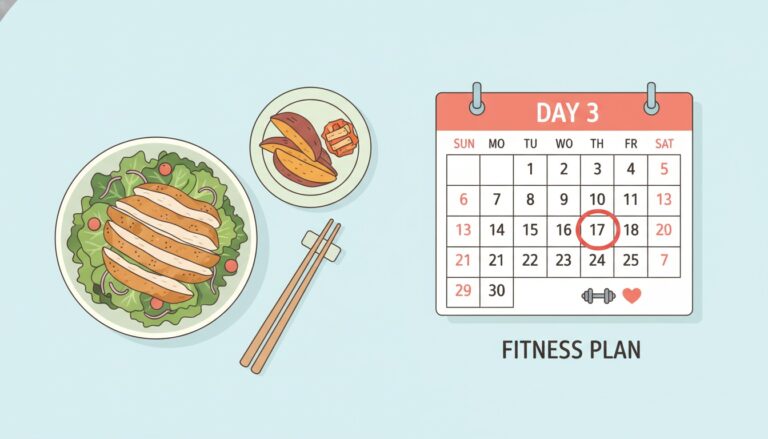
In Korea, “Chicken Breast” (닭가슴살 – Dak-gaseum-sal) is the symbol of diet food. If you say you are doing Sikdan (short for Sikdan jojeol), Koreans will automatically assume you are eating chicken breast, sweet potatoes, and cherry tomatoes. - Pronunciation:
- [식단]: Pronounced as [식딴] (Sik-ttan) due to tensification rule.
- Examples:
- (Lunch time) 저 요즘 식단 조절 중이라 샐러드 먹을게요. (I’m controlling my diet these days, so I’ll have a salad.)
- Jeo yojeum sikdan jojeol jung-ira saelleodeu meogeulgeyo.
- (To a friend) 식단 조절이 운동보다 더 힘들어. (Controlling diet is harder than exercising.)
- Sikdan jojeori undongboda deo himdeureo.
- (Planner) 내일부터 식단 들어갑니다. (I’m starting my diet meal plan from tomorrow.)
- Naeilbuteo sikdan deureogamnida.
- (Lunch time) 저 요즘 식단 조절 중이라 샐러드 먹을게요. (I’m controlling my diet these days, so I’ll have a salad.)
3. 작심삼일 (Jak-sim-sam-il)
- Meaning: Giving up after 3 days (A resolution that doesn’t last)
- Literal: Made up mind (lasts) three days.
- Usage & Register:
- A very common idiom used when confessing you failed your diet or study plan.
- Tutor’s Secret Note:
This isn’t just negative. Koreans use it jokingly to show humility. “Ah, it was Jaksim-samil again!” You can also say “My Jaksim-samil happens every 3 days” (meaning you restart constantly). - Examples:
- (Confession) 헬스장 등록했는데 또 작심삼일이었어. (I signed up for the gym, but I quit after 3 days again.)
- Helseujang deungnokhaenneunde tto jaksimsamirieosseo.
- (Advice) 이번 다이어트는 작심삼일로 끝내지 마. (Don’t let this diet end in 3 days.)
- Ibeon daieoteuneun jaksimsamillo kkeunnaeji ma.
- (Humor) 작심삼일도 10번 하면 한 달이다. (Even 3 days of effort repeated 10 times makes a month.)
- Jaksimsamildo yeol-beon hamyeon han darida.
- (Confession) 헬스장 등록했는데 또 작심삼일이었어. (I signed up for the gym, but I quit after 3 days again.)
Textbook vs. Real Korean
| Situation | Textbook Korean (Book) | Real Korean (Street/Casual) | Note |
|---|---|---|---|
| Starting a diet | 체중 감량을 시작했습니다. (Chejung gamnyang-eul sijakhaetsseumnida) |
나 다이어트 1일차야. (Na daieoteu irilchaya) |
“1일차” (Day 1) is very trendy on social media. |
| Going to the gym | 체육관에 갑니다. (Cheyukgwan-e gamnida) |
헬스장 가. (Helseujang ga) |
“Gym” is almost always 헬스장 (Health-jang). |
| Cheat Day | 오늘은 마음껏 먹는 날이에요. (Oneureun maeumkkeot meongneun narieyo) |
오늘 입 터졌어. (Oneul ip teojyeosseo) |
Ip teojyeosseo literally means “My mouth burst open” (ate uncontrollably). |
Exclusive Analysis: The “No Thank You” Thermometer
When you are on a diet, refusing food is the hardest part. Here is how to refuse based on “Social Distance.”
Level 1: Close Friend (Casual)
“나 살 빼야 돼. 너 혼자 먹어.”
(Na sal ppaeya dwae. Neo honja meogeo.)
“I gotta lose weight. You eat alone.”
Level 3: Colleague (Polite)
“아, 제가 요즘 식단 관리 중이라서요. 죄송해요!”
(Ah, jega yojeum sikdan gwalli jung-iraseoyo. Joesonghaeyo!)
“Ah, I am managing my diet these days. Sorry!”
Level 5: Boss/Elder (Respectful + Excuse)
“신경 써 주셔서 감사합니다. 그런데 제가 건강 검진 때문에 조절을 좀 하고 있습니다.”
(Singyeong sseo jusyeoseo gamsahamnida. Geureonde jega geongang geomjin ttaemune jojeoreul jom hago itsseumnida.)
“Thank you for caring. However, I am controlling (my intake) a bit due to a health check-up.” (Using “Health Check-up” is the ultimate undeniable excuse!)
Real-Life Role Play
Situation: Friday night at a Han River park. Friend A is trying to tempt Friend B (who is on a diet) with delivery food.
A: 날씨 진짜 좋다. 우리 치킨 시킬까? 맥주랑?
(Nalssi jinjja jota. Uri chikin sikilkka? Maekjurang?)
(The weather is so good. Shall we order chicken? With beer?)
B: 아… 진짜 먹고 싶은데. 나 어제부터 식단 조절 시작했잖아.
(Ah… jinjja meokgo sipeunde. Na eojebuteo sikdan jojeol sijakaetjana.)
(Ah… I really want to eat it. But you know I started controlling my diet yesterday.)
A: 에이, 딱 하루인데 뭐 어때? 오늘 그냥 치팅 데이 해!
(Ei, ttak haruinde mwo eottae? Oneul geunyang chiting dei hae!)
(Hey, it’s just one day, what’s the big deal? Just make today a cheat day!)
B: 안 돼. 저번에도 그랬다가 작심삼일 됐단 말이야.
(An dwae. Jeobeonedo geuraetdaga jaksimsamil dwaetdan mariya.)
(No. Last time I did that, and I gave up after 3 days.)
A: 알았어. 그럼 나만 먹는다?
(Arasseo. Geureom naman meongneunda?)
(Okay. Then I’m eating alone?)
B: (Sigh) …닭가슴살 샐러드 파는 곳 있는지 찾아볼게.
(…Dakgaseumsal saelleodeu paneun got inneunji chajabolge.)
(…I’ll look if there’s a place selling chicken breast salad.)
💡 Culture Tip: In Korea, saying “No” to food sharing can feel cold (Jeong culture). Explaining why (e.g., “I promised my trainer”) makes it much smoother.
Shadowing Challenge 🗣️
Script (New Year’s Resolution context):
“올해 목표는 건강하게 살을 빼는 거예요. 굶지 않고 운동하면서 천천히 뺄 거예요.”
Romanization:
Olhae mokpyoneun geonganghage sareul ppaeneun geoyeyo. Gumji anko undonghamyeonseo cheoncheonhi ppael geoyeyo.
Meaning:
“My goal this year is to lose weight healthily. I won’t starve; I will lose it slowly while exercising.”
Checklist:
* [ ] Read aloud slowly (Focus on pronunciation of ‘굶지’ [gum-ji])
* [ ] Read at normal speed
* [ ] Read with emotion (Determined tone!)
Pronunciation Point: ‘굶지’ (Starve + not) is pronounced [굼찌]. The ㄹ (l) is silent!
FAQ
Q1: Can I just say “Diet” (다이어트) for everything?
Yes! In Korean, “Doing diet” (다이어트하다) includes both exercising and eating less. It is the most common verb.
Example: 저 요즘 다이어트해요. (I am on a diet these days.)
Q2: How do I say “I gained weight”?
Use the expression “Flesh rose/attached” (살이 쪘어요).
Example: 연휴 동안 살이 너무 쪘어요. (I gained too much weight during the holidays.)
Wrap-up & Next Step
Today we learned how to discuss our fitness goals. Remember, saying you are “doing Sikdan” sounds much more professional than just saying “not eating.”
Today’s Mission:
Next time you refuse a snack, try saying: “미안해요, 저 요즘 식단 조절 중이에요.”
What is your biggest obstacle in dieting? Delicious food or laziness? Let me know in the comments!
Final Quiz
1. Which word means “Gym” in casual Korean?
A) 체육관 (Cheyukgwan)
B) 헬스장 (Helseujang)
C) 운동장 (Undongjang)
2. How do you describe a plan that failed after a few days?
A) 일석이조 (Ilseok-ijo)
B) 작심삼일 (Jaksim-samil)
C) 함흥차사 (Hamheung-chasa)
3. Fill in the blank: “I want to ____ weight.” (Active)
살을 [ _____ ] 싶어요.
⬇️ Scroll down for Answers
- B) 헬스장 (Most common term for a fitness center)
- B) 작심삼일
- 빼고 (Ppaego) – 살을 빼고 싶어요.
Frequently Asked Questions (FAQ)
Q: What does "살을 빼다 (Sal-eul ppaeda)" mean in Korean and how do you pronounce it?
A: In Korean, "살을 빼다 (Sal-eul ppaeda)" is pronounced [see lesson guide] and means: To lose weight (Active)
Q: What does "식단 조절을 하다 (Sikdan jojeor-eul hada)" mean in Korean and how do you pronounce it?
A: In Korean, "식단 조절을 하다 (Sikdan jojeor-eul hada)" is pronounced [see lesson guide] and means: To control one's diet / To meal prep
Q: What does "작심삼일 (Jak-sim-sam-il)" mean in Korean and how do you pronounce it?
A: In Korean, "작심삼일 (Jak-sim-sam-il)" is pronounced [see lesson guide] and means: Giving up after 3 days (A resolution that doesn't last)







