

Introduction
Hello, this is Daily Hangul!
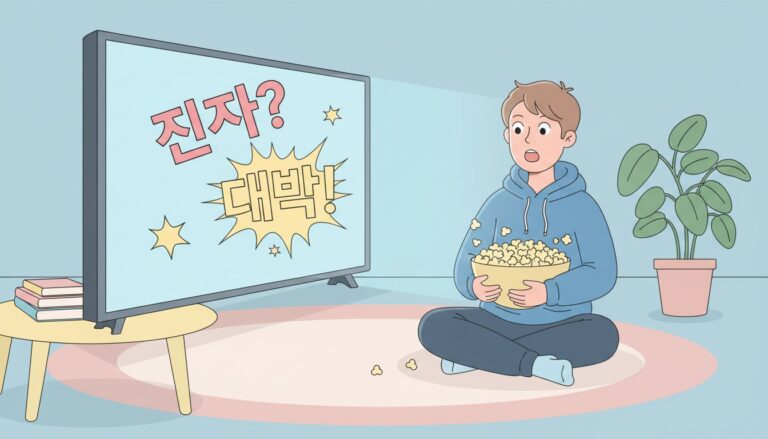
Have you ever stared at the screen while watching your favorite K-Drama, waiting for the subtitles to load, only to realize the characters have already said something shocking? The music swells, the camera zooms in, and the main character gasps.
Since no specific user story was submitted for this topic, I’ve compiled a “Synthetic Case” based on patterns from many of my students.
“Teacher, why do they say ‘Jinjja’ twenty times in one episode? Sometimes it sounds angry, sometimes happy. I’m confused!” — (Common question from Level 1 learners)
Textbooks teach you grammar, but K-Dramas teach you feelings. In dramas, characters don’t speak like news anchors. They mumble, scream, and use words that carry heavy emotional weight. Today, we will learn the specific words that signal a Plot Twist.
Summary at a Glance
- Today’s Expressions: 진짜 (Jinjja), 설마 (Seolma), 대박 (Daebak)
- Safe Usage: Mostly casual (Friends/Self-talk). Use caution with superiors.
- Level A1: These are high-frequency words. Knowing them helps you catch the mood before reading the translation.
Table of Contents
- Today’s Core Expressions: Deep Dive
- Textbook vs. Real Korean
- Analysis: The Tone Thermometer
- Real Life Scenario: Role Play
- Shadowing Challenge
- FAQ
- Wrap-up & Quiz
Today’s Core Expressions: Deep Dive
1. 진짜 (Jinjja / Real)
- Meaning: Really? / Real / Seriously
- Literal: Real / Truth
- Context: Used to question the truth or emphasize an emotion.
- Usage & Register:
- To whom: Friends (Pan-mal) or mixed with ‘-yo’ for polite situations.
- Style: Very common in spoken language.
- Tutor’s Secret Note:
- Koreans use this as a filler word, a question, and an exclamation. If you say it with a sigh (Ha… jinjja…), it implies frustration or annoyance, like “Unbelievable…”
- Warning: Do not overuse this in a formal business presentation. It sounds too emotional.
- Pronunciation Clinic:
- Be careful with the ‘jj’ (ㅉ). It is a tense sound. Don’t say “Jin-ja” (soft). Say “Jin-JJA” (with tension in your throat).
- Examples:
- Drama: 사랑해, 진짜야. (Saranghae, jinjja-ya.) – “I love you, I mean it.”
- Reaction: 아, 진짜? (Ah, jinjja?) – “Oh, really?”
- Frustration: 아, 진짜 왜 그래? (Ah, jinjja wae geurae?) – “Ah, seriously, why are you being like this?”
- Alternatives:
- More Formal: 정말 (Jeongmal)
- More Casual: 찐 (Jjin – Slang)
- Mini Quiz:
- A: I won the lottery! / B: ______? (Really?)
-
Click to see answer
진짜 (Jinjja)
2. 설마 (Seolma / Surely not)
- Meaning: No way… / Don’t tell me… / It can’t be…
- Context: Used when you suspect something bad or surprising is true, but you hope it isn’t.
- Usage & Register:
- To whom: Mostly self-talk or to close friends.
- Tutor’s Secret Note:
- This is the “Plot Twist Indicator.” When a character says Seolma…, 99% of the time, their suspicion is correct. It creates suspense.
- Pronunciation Clinic:
- The ‘L’ (ㄹ) flows into the ‘M’. Pronounce it smoothly: [Seol-ma].
- Examples:
- Suspicion: 설마… 기억 안 나? (Seolma… gieok an na?) – “Don’t tell me… you don’t remember?”
- Disbelief: 설마 그럴 리가 없어. (Seolma geureol liga eopseo.) – “No way, that can’t be true.”
- Shock: 설마가 사람 잡는다. (Seolmaga saram jamneunda.) – Proverb: “‘Surely not’ catches people (The unexpected happens).”
- Alternatives:
- Phrase: 말도 안 돼 (Maldo an dwae – That makes no sense)
- Mini Quiz:
- (Seeing a ghost) ______, you are alive?
-
Click to see answer
설마 (Seolma)
3. 대박 (Daebak / Jackpot)
- Meaning: Awesome / Crazy / Big hit
- Literal: Big Gourd (historically meaning ‘Jackpot’)
- Context: Used for anything shocking, good OR bad.
- Usage & Register:
- To whom: Friends. Avoid with the CEO.
- Tutor’s Secret Note:
- In recent dramas, it’s often used dryly. Instead of “Wow! Daebak!”, characters might whisper “…Daebak.” when they are speechless from shock.
- Pronunciation Clinic:
- [Dae-bak]. The ‘k’ (ㄱ) at the end is a stop sound. Do not release a puff of air. It is not “Daebak-u”. It stops tight.
- Examples:
- Good News: 우와, 대박이다! (Uwa, daebagida!) – “Wow, that’s awesome!”
- Shocking News: 그 둘이 사귄대? 대박. (Geu duri sagwindae? Daebak.) – “They are dating? That’s crazy.”
- Situation: 이거 완전 대박 사건이야. (Igeo wanjeon daebak sageoniya.) – “This is a huge incident.”
- Alternatives:
- Slang: 헐 (Heol – OMG)
- Formal: 대단합니다 (Daedan-hamnida – That is great/impressive)
- Mini Quiz:
- (Your friend bought a luxury car) Wow, ______!
-
Click to see answer
대박 (Daebak)
Textbook vs. Real Korean
Situation: You just found out your friend is the lost heir to a company (classic drama trope!).
| Type | Expression | Nuance |
|---|---|---|
| Book Korean | 정말입니까? 믿을 수 없습니다. (Jeongmal-imnikka? Mideul su eopseumnida.) |
Sounds like a robot or a courtroom lawyer. Very stiff. |
| Real Korean | 대박… 진짜요? 말도 안 돼. (Daebak… Jinjja-yo? Maldo an dwae.) |
Natural reaction. Shows genuine shock and emotion. |
Checklist:
* Meeting in a boardroom? → Use Book Korean.
* Drinking soju with a friend? → Use Real Korean.
Analysis: The Tone Thermometer 🌡️
In Korean, the tone changes the meaning entirely. Let’s look at “진짜 (Jinjja)”.
| Level | Tone/Intonation | Meaning | Situation |
|---|---|---|---|
| 1 | ↗ Rising High | “Really?!” | Surprised by good news. |
| 2 | → Flat | “Seriously.” | Confirming a fact. “It’s really hot.” |
| 3 | ↘ Falling Low | “Oh, really…” | Disappointment or sarcasm. |
| 4 | ↖ Sharp/Short | “Seriously?!” | Annoyance. (e.g., Someone stepped on your foot). |
| 5 | Elongated (Jin~jja) | “Come on…” | Whining or pleading. |
Real Life Scenario: Role Play
Setting: A cafe in Seoul. Two friends are gossiping about a mutual friend.
Characters:
* Min-ji: Knowing the secret.
* Alex: The foreign friend (Reaction master).
(Dialogue)
Min-ji: 야, 너 들었어? 지수 다시 전남친 만난대.
(Ya, neo deureosseo? Ji-su dasi jeon-namchin mannandae.)
“Hey, did you hear? Ji-su is seeing her ex-boyfriend again.”
Alex: 설마… 그 나쁜 남자?
(Seolma… geu nappeun namja?)
“Don’t tell me… that bad guy?”
Min-ji: 응, 맞아. 어제 같이 있는 거 봤어.
(Eung, maja. Eoje gachi inneun geo bwasseo.)
“Yeah, that’s right. I saw them together yesterday.”
Alex: 와… 대박. 진짜 이해가 안 가네.
(Wa… daebak. Jinjja ihaega an gane.)
“Wow… crazy. I really don’t understand.”
💡 Culture Tip:
When reacting to gossip in Korea, active listening (Back-channeling) is crucial. Using words like Jinjja?, Heol, and Daebak shows you are engaged. Silence can be considered rude or uninterested.
Shadowing & Speaking Challenge
Let’s practice the “Shocked Reaction.” Repeat this 3 times.
Script:
“설마… 진짜? 와, 대박이다.”
(Seolma… Jinjja? Wa, daebagida.)
(No way… Really? Wow, that’s crazy.)
- [ ] Attempt 1 (Slowly checking pronunciation)
- [ ] Attempt 2 (Focus on intonation – Rising tone for Jinjja?)
- [ ] Attempt 3 (Drama Actor Mode – Full Emotion!)
🗣️ Pronunciation Point: Remember to stop the sound at the ‘k’ in Dae-bak. Don’t let the air out!
FAQ (Frequently Asked Questions)
Q1: Can I use “Daebak” to my boss or teacher?
A: Generally, no. It is slang. To a superior, if something is amazing, say “정말 대단합니다” (Jeongmal daedan-hamnida). However, if you have a very close relationship, a quiet “…wow, daebak” might slip out, but be careful!
Q2: What is the difference between ‘Jinjja’ and ‘Jeongmal’?
A: They are 90% interchangeable. ‘Jeongmal’ (정말) feels slightly more formal/written, while ‘Jinjja’ (진짜) is more spoken/colloquial. In a drama, you will hear ‘Jinjja’ much more often in arguments or casual chats.
Wrap-up & Action Item
Today we learned the “Drama Trio”: Jinjja (Really), Seolma (No way), and Daebak (Crazy).
Today’s Mission:
Watch 10 minutes of any K-Drama on Netflix or YouTube. Count how many times you hear “Jinjja”. If you hear it, pause and mimic the actor’s tone exactly!
Tell me in the comments:
Which K-Drama are you watching right now? I need recommendations!
Final Quiz
1. Which word suggests a strong suspicion or fear that something is true? (e.g., “Don’t tell me…”)
A) 대박 (Daebak)
B) 설마 (Seolma)
C) 안녕 (Annyeong)
2. How should you pronounce the ‘jj’ in ‘Jinjja’?
A) Soft and airy
B) Tense and strong
C) Like a ‘z’ sound
3. Fill in the blank: “Wow, I won! This is ______!”
(Hint: Jackpot/Awesome)
⬇️ Click to see the answers
1. B (Seolma)
2. B (Tense and strong)
3. 대박 (Daebak)
Frequently Asked Questions (FAQ)
Q: What does "진짜 (Jinjja / Real)" mean in Korean and how do you pronounce it?
A: In Korean, "진짜 (Jinjja / Real)" is pronounced [see lesson guide] and means: Really? / Real / Seriously
Q: What does "설마 (Seolma / Surely not)" mean in Korean and how do you pronounce it?
A: In Korean, "설마 (Seolma / Surely not)" is pronounced [see lesson guide] and means: No way... / Don't tell me... / It can't be...
Q: What does "대박 (Daebak / Jackpot)" mean in Korean and how do you pronounce it?
A: In Korean, "대박 (Daebak / Jackpot)" is pronounced [see lesson guide] and means: Awesome / Crazy / Big hit







