

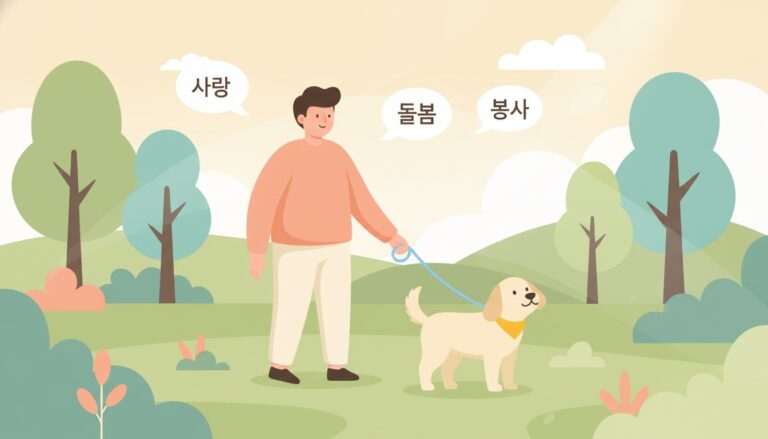
Warm Hearts, Wagging Tails: Essential Korean Phrases for Dog Shelter Volunteering
Introduction
Hello, I’m Daily Hangul! 👋
Have you ever thought about doing something meaningful while living in or traveling to Korea? Many Korean learners are now looking beyond K-Pop concerts and cafes, seeking connection through volunteering (jawanbongsa, 자원봉사).
Today, we are heading to a place filled with unconditional love: The Dog Shelter (Yugigyeon Bohoso, 유기견 보호소).
📝 Note on Experience: Since I cannot personally visit every shelter in Korea, the examples below are a synthetic compilation based on common questions and mistakes reported by foreign volunteers in Korea. This ensures you get the most universal and practical advice!
Why isn’t a textbook enough? Because in a shelter, you don’t just say “The dog is cute.” You need to understand urgent instructions like “Don’t let him pull!” or “He bites!” instantly. Let’s learn the real language of care.
📋 Summary at a Glance
- Today’s Expressions:
- 산책시키다 (To walk a dog)
- 치우다 (To clean up/remove)
- 겁이 많다 (To be timid/scared)
- Safe Zone: Use these with shelter staff and fellow volunteers.
- Level (B2): These involve causative forms and emotional descriptions essential for safety.
📑 Table of Contents
- Today’s Core Expressions Deep Dive
- Textbook vs. Real Korean
- Unique Analysis: The “Pet vs. Staff” Switch
- Real-Life Role Play: Getting Assigned a Dog
- Shadowing Challenge
- FAQ
- Wrap-up & Quiz
💡 Today’s Core Expressions Deep Dive
1. 산책시키다 (San-chaek-si-ki-da)
- Meaning: To walk (a dog) / Literally: To make someone take a walk
- Usage: To staff/Other volunteers (Polite)
Tutor’s Secret Note 🤫
Many beginners make the mistake of saying “강아지랑 산책해요 (I take a walk with the dog).” While grammatically correct, strictly speaking, you are performing the duty of walking the dog. The verb 시키다 (to make/let do) emphasizes the action of leading the dog.
* Warning: Don’t just say “걷다 (geot-da – to walk).” That sounds like you are just walking on two legs next to a dog.
Pronunciation Clinic 🗣️
* [산책씨키다]: The ‘s’ in ‘si’ often sounds slightly tensed.
Examples:
1. 제가 이 아이 산책시켜도 될까요?
(Je-ga i a-i san-chaek-si-kyeo-do doel-kka-yo?)
May I take this dog for a walk?
2. 산책시킬 때 줄을 꽉 잡으세요.
(San-chaek-si-kil ttae jul-eul kkwak ja-beu-se-yo.)
Please hold the leash tight when walking the dog.
3. 오후에는 대형견을 산책시켜야 해요.
(O-hu-e-neun dae-hyeong-gyeon-eul san-chaek-si-kyeo-ya hae-yo.)
We need to walk the large dogs in the afternoon.
Alternatives:
* 산책 다녀오다 (San-chaek da-nyeo-o-da): “To go out for a walk and come back” (More casual).
* 배변 산책하다 (Bae-byeon san-chaek-ha-da): “To go for a potty walk” (Specific).
🧠 Mini Quiz (Click to see)
Q. Fill in the blank: “Can I ____ this dog?”
제가 이 강아지 (_______) 될까요?
Answer: 산책시켜도 (san-chaek-si-kyeo-do)
2. 치우다 (Chi-u-da)
- Meaning: To clean up / To remove / To tidy
- Usage: Essential when dealing with dog waste (poop/pee).
Tutor’s Secret Note 🤫
Volunteering is 80% cleaning! You will hear this word constantly. It implies removing the mess completely. When you see poop, don’t say “clean” (청소하다 – cheong-so-ha-da), say “치우다” (remove it).
Pronunciation Clinic 🗣️
* [치우다]: Pronounce ‘u’ clearly. Don’t slur it into ‘chwuda’.
Examples:
1. 배변은 바로 치워 주세요.
(Bae-byeon-eun ba-ro chi-wo ju-se-yo.)
Please clean up the excrement immediately.
2. 견사 청소하고 똥도 다 치웠어요.
(Gyeon-sa cheong-so-ha-go ttong-do da chi-wo-sseo-yo.)
I cleaned the kennel and cleared away all the poop.
3. 이 담요 좀 치워 주시겠어요?
(I dam-yo jom chi-wo ju-si-ge-sseo-yo?)
Could you please move/remove this blanket?
Alternatives:
* 정리하다 (Jeong-ni-ha-da): To organize (Use for tools/leashes, not poop).
* 처리하다 (Cheo-ri-ha-da): To handle/dispose of (More formal).
🧠 Mini Quiz (Click to see)
Q. Fill in the blank: “I cleaned up the poop.”
똥을 (_______).
Answer: 치웠어요 (chi-wo-sseo-yo)
3. 겁이 많다 (Geob-i man-ta)
- Meaning: To be timid / To have a lot of fear
- Usage: Describing rescue dogs who are afraid of humans.
Tutor’s Secret Note 🤫
Shelter dogs often have trauma. Staff will warn you saying “This kid has a lot of fear.” Understanding this prevents accidents. It’s softer and more empathetic than saying “He is scary (무서워요).”
Pronunciation Clinic 🗣️
* [거비 만타]: The ‘h’ (ㅎ) in 많(man) is silent, and the ‘t’ becomes aspirated due to the ‘h’ effect in conjugation, but here ‘man-ta’ is the base. Linking sound: Geob-i -> [Geo-bi].
Examples:
1. 이 아이는 겁이 많아서 천천히 다가가야 해요.
(I a-i-neun geob-i ma-na-seo cheon-cheon-hi da-ga-ga-ya hae-yo.)
This child (dog) is timid, so you must approach slowly.
2. 겁이 많지만 물지는 않아요.
(Geob-i man-chi-man mul-ji-neun a-na-yo.)
He is timid, but he doesn’t bite.
3. 남자한테 겁이 많은 편이에요.
(Nam-ja-han-te geob-i ma-neun pyeon-i-e-yo.)
He tends to be scared of men.
Alternatives:
* 소심하다 (So-sim-ha-da): To be shy/timid (Personality trait).
* 예민하다 (Ye-min-ha-da): To be sensitive/on edge.
🧠 Mini Quiz (Click to see)
Q. Fill in the blank: “This dog is very timid.”
이 강아지는 (_______) 많아요.
Answer: 겁이 (geob-i)
🆚 Textbook vs. Real Korean
Context: Referring to the dogs
| Type | Expression | Context | Nuance |
|---|---|---|---|
| Book Korean 📘 | 개 (Gae) / 강아지 (Gang-a-ji) | General / Dictionary | “Gae” can sound too blunt or objective. “Gang-a-ji” is fine but generic. |
| Real Korean 🦊 | 아이 (A-i) / 친구 (Chin-gu) | Shelter / Animal Lovers | Literally “Child” or “Friend.” Shows affection and respect for the life. |
⚠️ Situation Checklist:
* Filling out a form: Use 견 (Gyeon – Dog) or 개 (Gae).
* Talking to Staff: Use 아이 (A-i) (e.g., “Is this child sick?” – I a-i a-pa-yo?)
* Talking to the Dog: Use Baby talk (e.g., “Aigo, pretty baby!” – Aigo yeppeura!).
🔍 Unique Analysis: The “Tone Thermometer”
How should you change your voice tone in a shelter?
| Target Listener | Tone/Endings | Example Sentence |
|---|---|---|
| Shelter Manager | Formal & Polite (~Ha-yo / ~Hab-ni-da) |
“Where should I put this trash?” (I sseu-re-gi eo-di-e beo-ri-na-yo?) |
| Fellow Volunteer | Polite but Friendly (~Ha-yo) |
“Shall we go for a walk together?” (Ga-chi san-chaek-hal-kka-yo?) |
| The Dog | High Pitch & Casual (Ban-mal / Sounds) |
“Did you poop? Good job!” (Eung-ga ha-sseo? A-i, jal-haet-da!) |
Tip: Even if you don’t speak fluent Korean, raising your pitch when talking to the dog is a universal language of kindness! 🎵
🎭 Real-Life Role Play
Situation: Arriving at the shelter and getting your first assignment.
Location: A shelter in the countryside of Gyeonggi-do.
Staff: 봉사 오셨어요? 이쪽으로 오세요. 앞치마 입으시고요.
(Bong-sa o-syeo-sseo-yo? I-jjog-eu-ro o-se-yo. Ap-chi-ma i-beu-si-go-yo.)
Did you come to volunteer? Come this way. Please put on an apron..
You: 네, 안녕하세요. 오늘 어떤 일 하면 될까요?
(Ne, an-nyeong-ha-se-yo. O-neul eo-tteon il ha-myeon doel-kka-yo?)
Hello. What work should I do today?
Staff: 오늘은 산책 봉사가 급해요. 저기 ‘바둑이’ 데리고 나가시면 돼요.
(O-neul-eun san-chaek bong-sa-ga geup-hae-yo. Jeo-gi ‘Baduk-i’ de-ri-go na-ga-si-myeon dwae-yo.)
We urgently need walking volunteers today. You can take ‘Baduki’ over there out.
You: 아, 저 아이인가요? 혹시 주의할 점 있나요?
(Ah, jeo a-i-in-ga-yo? Hok-si ju-ui-hal jeom in-na-yo?)
Ah, is it that child (dog)? Is there anything I should be careful about?
Staff: 네, 겁이 많아서 큰 소리 내면 안 돼요. 그리고 똥은 꼭 치워 주시고요.
(Ne, geob-i ma-na-seo keun so-ri nae-myeon an dwae-yo. Geu-ri-go ttong-eun kkok chi-wo ju-si-go-yo.)
Yes, he is very timid, so don’t make loud noises. And please make sure to clean up the poop.
You: 네, 알겠습니다! 조심해서 다녀올게요.
(Ne, al-ge-sseum-ni-da! Jo-sim-hae-seo da-nyeo-ol-ge-yo.)
Okay, understood! We will be back safely.
🗣️ Shadowing Challenge
Let’s practice the most important safety phrase. Repeat this 3 times!
“This child is a bit timid, so please approach slowly.”
이 아이는 겁이 좀 많아서, 천천히 다가와 주세요.
(I a-i-neun geob-i jom ma-na-seo, cheon-cheon-hi da-ga-wa ju-se-yo.)
- [ ] Attempt 1 (Read slowly)
- [ ] Attempt 2 (Natural speed)
- [ ] Attempt 3 (With emotion/concern)
✨ Pronunciation Point:
Make sure to link the words 겁이 (Geob-i) smoothly as [거비].
🙋♀️ FAQ (Frequently Asked Questions)
Q1: Is it rude to call a dog “개 (Gae)”?
It’s not rude, but it sounds very dry and detached. In a shelter where volunteers love animals, using 아이 (Child) or calling them by name shows you care. Using “개” sounds like you are talking about livestock.
Q2: How do I ask for a poop bag?
Simple! Ask for a “Bae-byeon bong-tu” (Excrement bag).
* “배변 봉투 좀 더 주세요.” (Bae-byeon bong-tu jom deo ju-se-yo – Please give me more poop bags.)
🎓 Wrap-up & Mission
Volunteering in Korea is a fantastic way to learn “warm” language while making a difference. Today we learned how to offer a walk (산책시키다), handle the mess (치우다), and respect a dog’s fear (겁이 많다).
🔥 Today’s Mission:
Next time you see a cute dog on the street in Korea, instead of just staring, think in your head: “저 아이는 겁이 많을까?” (Is that child timid?)
💬 Comment below:
Are you a dog person or a cat person? Tell me in Korean! (강아지파 vs 고양이파)
📝 Final Quiz
- Which verb is best used when you take a dog for a walk as a duty?
a) 산책하다 (San-chaek-ha-da)
b) 산책시키다 (San-chaek-si-ki-da)
c) 걷다 (Geot-da) -
How do you say “Please clean up the poop”?
a) 똥 먹어 주세요 (Ttong meo-geo ju-se-yo)
b) 똥 치워 주세요 (Ttong chi-wo ju-se-yo)
c) 똥 싸 주세요 (Ttong ssa ju-se-yo) -
Fill in the blank for “Timid”:
“He has a lot of fear.”
= (_______) 많아요.
Check Answers (Scroll down) ⬇️
1. b) 산책시키다 (Causative form)
2. b) 똥 치워 주세요
3. 겁이 (Geob-i)
Frequently Asked Questions (FAQ)
Q: What does "산책시키다 (San-chaek-si-ki-da)" mean in Korean and how do you pronounce it?
A: In Korean, "산책시키다 (San-chaek-si-ki-da)" is pronounced [see lesson guide] and means: To walk (a dog) / Literally: To make someone take a walk
Q: What does "치우다 (Chi-u-da)" mean in Korean and how do you pronounce it?
A: In Korean, "치우다 (Chi-u-da)" is pronounced [see lesson guide] and means: To clean up / To remove / To tidy
Q: What does "겁이 많다 (Geob-i man-ta)" mean in Korean and how do you pronounce it?
A: In Korean, "겁이 많다 (Geob-i man-ta)" is pronounced [see lesson guide] and means: To be timid / To have a lot of fear







