

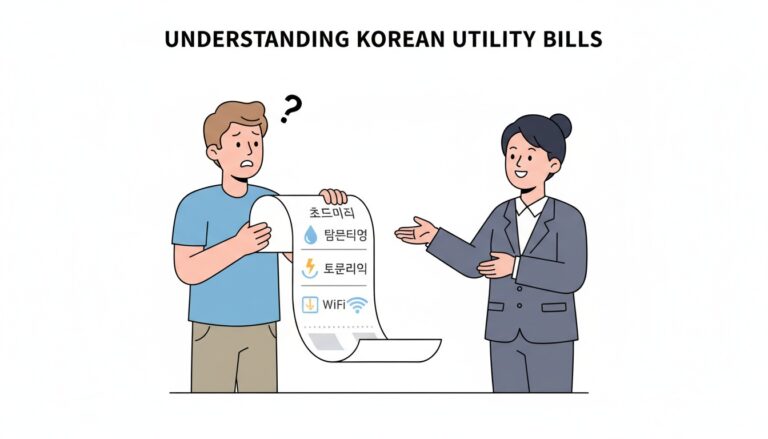
Renting in Korea: The “Gwallibi” Trap! How to Ask What’s Included in Your Maintenance Fee
Introduction
Hello, this is Daily Hangul!
Have you ever found the perfect room in Seoul with surprisingly low rent, only to be shocked when the monthly bill arrives? You are not alone.
Since I cannot share everyone’s personal financial details, I have compiled a “Synthetic Case Study” based on stories from many of our subscribers. Let’s look at “Mark’s” situation. Mark found a studio (Officetel) for 600,000 KRW/month. He thought it was a steal. But at the end of the month, he received a bill for 150,000 KRW more. Why? He didn’t ask about Gwallibi (Maintenance Fee).
Textbooks often teach you how to ask for the price (Eolmayeyo?), but they rarely teach you the survival skill of asking, “Does this fee include electricity, or is that extra?”
In Korea, rent is just the beginning. Today, we will learn how to clarify exactly what you are paying for so you don’t get surprised.
At a Glance: Today’s Summary
- Target Situation: Talking to a real estate agent (Budongsan) or landlord.
- Key Expressions:
- 관리비 얼마예요? (How much is the maintenance fee?)
- ~ 포함돼요? (Is ~ included?)
- 공과금은 별도인가요? (Are utilities separate?)
- Difficulty Level (B1): Essential for adult survival in Korea. You need these exact phrases to protect your wallet.
Table of Contents
- Today’s Deep Dive: Key Expressions
- Textbook vs. Real Korean
- Unique Analysis: The “Bill Breakdown” Table
- Real Life Role Play: At the Real Estate Agency
- Shadowing Challenge
- FAQ
- Final Quiz
Today’s Deep Dive: Key Expressions
1. 관리비 얼마예요? (How much is the maintenance fee?)
- Pronunciation: [Gwallibi eolmayeyo?]
- Meaning: How much is the maintenance fee?
- Usage & Register:
- To whom: Real Estate Agent (Sajangnim) or Landlord.
- Tone: Polite (Haeyo-che) is standard.
- Tutor’s Secret Note:
- Even if the app says “50,000 won,” always ask again. Sometimes the app is outdated. If you don’t ask, they might assume you know it’s expensive.
- Pronunciation Clinic:
- 관 (Gwan) + 리 (Ri) sounds like [Gwal-li] due to the liquidization rule (ㄴ+ㄹ -> ㄹㄹ). It flows smoothly.
- Examples:
- 월세는 50만 원이고, 관리비는 얼마예요?
- [Wol-se-neun 50-man-won-i-go, gwal-li-bi-neun eol-ma-ye-yo?]
- (The rent is 500,000 won, and how much is the maintenance fee?)
- 관리비가 생각보다 비싸네요.
- [Gwal-li-bi-ga saeng-gak-bo-da bi-ssa-ne-yo.]
- (The maintenance fee is more expensive than I thought.)
- 관리비 고정이에요?
- [Gwal-li-bi go-jeong-i-e-yo?]
- (Is the maintenance fee fixed?)
- 월세는 50만 원이고, 관리비는 얼마예요?
2. [Item] + 포함돼요? (Is [Item] included?)
- Pronunciation: [~ poham-dwaeyo?]
- Meaning: Is [Item] included?
- Usage & Register:
- Use this to check specific utilities like internet or water.
- Tutor’s Secret Note:
- Warning: If they say “Yes,” ask exactly what. Sometimes “included” just means the building cleaning fee, not your electricity.
- Pronunciation Clinic:
- 포함 (Poham): Make sure the ‘H’ is soft but audible.
- 돼요 (Dwaeyo): Pronounce it quickly like ‘Day-yo’ but with a ‘w’ sound -> [Dwae-yo].
- Examples:
- 관리비에 인터넷 포함돼요?
- [Gwal-li-bi-e in-teo-net po-ham-dwae-yo?]
- (Is the internet included in the maintenance fee?)
- 수도세도 포함돼요?
- [Su-do-se-do po-ham-dwae-yo?]
- (Is the water bill included too?)
- 가스랑 전기는 포함 안 되죠?
- [Ga-seu-rang jeon-gi-neun po-ham an dwe-jyo?]
- (Gas and electricity aren’t included, right?)
- 관리비에 인터넷 포함돼요?
3. 공과금은 별도인가요? (Are utilities separate?)
- Pronunciation: [Gong-gwa-geum-eun byeol-do-in-ga-yo?]
- Meaning: Are utility bills separate (extra)?
- Usage & Register:
- This is a slightly more formal/professional way to clarify costs.
- Tutor’s Secret Note:
- Keyword: 별도 (Byeoldo) means “separate” or “excluded.” If you see this word, prepare to pay extra.
- Examples:
- 월세에 공과금은 별도인가요?
- [Wol-se-e gong-gwa-geum-eun byeol-do-in-ga-yo?]
- (Are utilities separate from the monthly rent?)
- 모든 공과금 별도입니다.
- [Mo-deun gong-gwa-geum byeol-do-im-ni-da.]
- (All utilities are separate.)
- 전기세는 별도로 내셔야 해요.
- [Jeon-gi-se-neun byeol-do-ro nae-syeo-ya hae-yo.]
- (You have to pay the electricity bill separately.)
- 월세에 공과금은 별도인가요?
Mini Quiz:
Fill in the blank: “Is the internet included?”
인터넷 ______?Click to see answer
포함돼요 (poham-dwaeyo)
Textbook vs. Real Korean
Textbooks often teach full sentences that sound a bit robotic in a fast-paced real estate office. Here is how to sound natural.
| Context | Textbook Korean (Too Formal/Stiff) | Real Korean (Natural & Efficient) |
|---|---|---|
| Asking about items | 관리비에 무엇이 포함되어 있습니까? (What is included in the fee?) | 관리비에 뭐 뭐 들어가요? (What goes into the fee?) |
| Asking about electricity | 전기 요금은 따로 냅니까? (Do I pay electric fees separately?) | 전기세는 별도죠? (Electricity is extra, right?) |
| Clarifying total | 총 얼마를 지불해야 합니까? (How much total must I pay?) | 다 합쳐서 얼마예요? (How much is it all together?) |
Quick Tip: Using “뭐 뭐 (Mwo mwo)” (what and what) sounds very native when listing things.
Unique Analysis: The “Bill Breakdown” Table
In Korea, Gwallibi (Building Fee) and Gonggwageum (Usage Utilities) are often confused. Use this table to understand what you are paying.
The “Is it Included?” Probability Chart
| Item (Korean) | Item (English) | Usually Included in Gwallibi? | Note |
|---|---|---|---|
| 인터넷 (In-teo-net) | Internet | High (for Studios/Officetels) | Often slow shared wifi. Check speed! |
| 수도세 (Su-do-se) | Water Bill | Medium | Often fixed (e.g., 10,000 won/month). |
| 전기세 (Jeon-gi-se) | Electricity | Very Low | You pay for what you use. |
| 가스비 (Ga-seu-bi) | Gas (Heating) | Extremely Low | Warning: Korean floor heating (Ondol) can be expensive in winter. |
| 청소비 (Cheong-so-bi) | Cleaning Fee | Always | Usually for hallway/stairs, not your room. |
Use this sentence:
“가스비랑 전기세는 제가 따로 내는 거죠?”
([Ga-seu-bi-rang jeon-gi-se-neun je-ga tta-ro nae-neun geo-jyo?])
= Gas and electricity are paid by me separately, right?
Real Life Role Play: At the Real Estate Agency
Situation: You are looking at a nice studio near Gangnam. The rent seems cheap, but you are suspicious.
Place: Real Estate Agency (부동산 – Budongsan)
Agent (Sajangnim): 이 방 어때요? 월세 60만 원이에요. 싸죠?
(How is this room? Rent is 600,000 won. Cheap, right?)
You: 네, 방은 좋은데… 혹시 관리비는 얼마예요?
([Ne, bang-eun jo-eun-de… hok-si gwal-li-bi-neun eol-ma-ye-yo?])
(Yes, the room is good but… by any chance, how much is the maintenance fee?)
Agent: 아, 관리비는 10만 원이에요.
(Ah, the maintenance fee is 100,000 won.)
You: 10만 원이요? 거기에 뭐 뭐 포함돼요?
([Sip-man-won-i-yo? Geo-gi-e mwo mwo po-ham-dwae-yo?])
(100,000 won? What exactly is included in that?)
Agent: 인터넷이랑 수도세 포함이고, 가스랑 전기는 별도예요.
(Internet and water are included, gas and electricity are separate.)
You: 아, 공과금은 별도군요. 알겠습니다.
([Ah, gong-gwa-geum-eun byeol-do-gun-yo. Al-get-seum-ni-da])
(Ah, so utilities are separate. I understand.)
💡 Culture Tip:
In Korea, listing rent as “500/50” means 5 million won deposit / 500,000 won monthly rent. Gwallibi is almost never included in that “50” number. Always add +5~15 man-won mentally.
Shadowing Challenge
Let’s practice speaking naturally. Repeat this sentence 3 times to get the rhythm right.
Script:
“월세는 싼데, 공과금은 별도인가요?”
([Wol-se-neun ssan-de, gong-gwa-geum-eun byeol-do-in-ga-yo?])
(The rent is cheap, but are utilities separate?)
Checklist:
* [ ] Did you pronounce 공과금 (Gong-gwa-geum) clearly? (The ‘Gwa’ sound is key)
* [ ] Did you raise the tone slightly at the end for the question?
* [ ] Did you say it within 3 seconds?
FAQ (Frequently Asked Questions)
Q1: Can I negotiate the maintenance fee (Gwallibi)?
* Answer: Usually, no. In modern buildings (Officetels/Apartments), it is a fixed system. However, in older “Villa” (빌라) buildings where the landlord sets the price arbitrarily, you might be able to ask for a small discount if you promise a longer lease, but don’t count on it.
Q2: What happens if I don’t pay Gwallibi?
* Answer: It is treated the same as not paying rent. Your water or electricity might be cut off, and it will be deducted from your deposit (Bojeung-geum).
Q3: Is “Internet Included” actually good internet?
* Answer: Not always. It is often shared building Wi-Fi. If you are a gamer or work from home, ask: “개인 인터넷 설치해도 돼요?” ([Gae-in in-teo-net seol-chi-hae-do dwae-yo?] – Can I install my own internet?)
Conclusion & Action Item
Don’t let a “cheap rent” sign fool you! The real price is Rent + Gwallibi + Utilities.
Today’s Mission:
If you live in Korea, check your latest bill or contract. Look for the word “관리비 (Gwallibi)” and see what items are listed under it. If you are still looking for a house, practice asking “Is electricity separate?” in front of a mirror today.
Tell me in the comments:
Have you ever been surprised by a bill in Korea? What was it for? (I once paid 200,000 won for gas in winter…)
Final Quiz
- Which word means “included”?
A) 별도 (Byeoldo)
B) 포함 (Poham)
C) 월세 (Wolse) -
Which utility is almost NEVER included in the maintenance fee?
A) Cleaning fee (Cheong-so-bi)
B) Internet (In-teo-net)
C) Gas/Heating (Ga-seu-bi) -
Fill in the blank:
“Electricity is extra/separate.”
전기세는 ______예요. (Hint: Starts with ㅂ)
Click to reveal answers
1. B) 포함 (Poham)
2. C) Gas/Heating (Ga-seu-bi) – especially floor heating!
3. 별도 (Byeoldo)
Frequently Asked Questions (FAQ)
Q: What does "관리비 얼마예요? (How much is the maintenance fee?)" mean in Korean and how do you pronounce it?
A: In Korean, "관리비 얼마예요? (How much is the maintenance fee?)" is pronounced [Gwallibi eolmayeyo?] and means: How much is the maintenance fee?
Q: What does "[Item] + 포함돼요? (Is [Item] included?)" mean in Korean and how do you pronounce it?
A: In Korean, "[Item] + 포함돼요? (Is [Item] included?)" is pronounced [~ poham-dwaeyo?] and means: Is [Item] included?
Q: What does "공과금은 별도인가요? (Are utilities separate?)" mean in Korean and how do you pronounce it?
A: In Korean, "공과금은 별도인가요? (Are utilities separate?)" is pronounced [Gong-gwa-geum-eun byeol-do-in-ga-yo?] and means: Are utility bills separate (extra)?







