

Introduction
Hello, this is Daily Hangul!
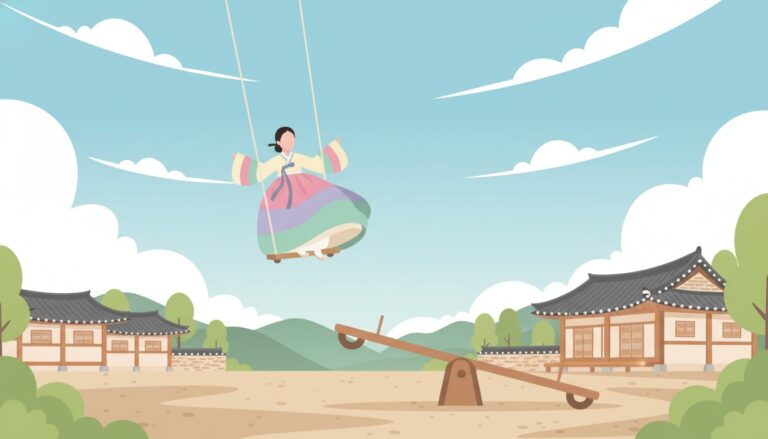
Have you ever watched a Korean historical drama (Sageuk) and seen women in beautiful Hanbok jumping on a wooden board or flying high on a swing? It looks elegant, but trust me, it’s an extreme sport!
Composite Case (Based on student inquiries):
Many of my students visiting the Korean Folk Village in Yongin often send me videos asking, “Teacher, how do I say ‘Push me higher’ or ‘I’m losing my balance’ in Korean? I wanted to try the swing, but I couldn’t communicate with the staff!”
Today, we are not just learning about games. We are using Neolttwigi (See-saw jumping) and Geunetagi (Swinging) to master essential verbs related to motion, balance, and thrills. These words are useful not just in games, but in daily life and even business settings!
At a Glance: Today’s Summary
- Key Expressions: 3 essential phrases for describing physical actions and thrills.
- Safe Zone: Casual to Polite (Perfect for outdoor activities or describing hobbies).
- Level (C1): While the games are traditional, the vocabulary (balance, risky, push) is high-level and versatile.
Table of Contents
- Today’s Key Expressions Deep Dive
- Textbook vs. Real Korean
- Unique Analysis: The “Scary” Thermometer
- Real-Life Role Play: At the Folk Village
- Shadowing Challenge
- FAQ
- Wrap-up & Quiz
Today’s Key Expressions Deep Dive
1. 중심을 잡다 (Jungsim-eul japda)
Meaning
- Literal: To catch the center.
- Meaning: To keep one’s balance / To focus.
Usage & Register
- Who: Anyone (Instructor, friend, self-talk).
- Style:
잡아요(Jabayo – Polite),잡아(Jaba – Casual).
Tutor’s Secret Note
In Neolttwigi, if you don’t keep your balance, you fly off! But Koreans also use this metaphorically. If your life feels chaotic or a project is messy, we say, “Let’s find our center (balance).”
* Warning: Don’t confuse it with “사람을 잡다” (to annoy/harass someone effectively).
Pronunciation Clinic
- Yeoneum (Linking):
잡아요sounds like [자바요 (Jabayo)].
Examples
- Neolttwigi: 중심을 잘 잡아야 해요. (Jungsim-eul jal jabaya haeyo.)
- You have to balance well.
- Yoga Class: 한 발로 중심을 잡으세요. (Han ballo jungsim-eul jabuseyo.)
- Keep your balance on one foot.
- Life Advice: 흔들리지 말고 중심을 잡으세요. (Heundeulliji malgo jungsim-eul jabuseyo.)
- Don’t be shaken; hold your ground (stay focused).
Alternatives
- Formal: 균형을 유지하다 (Gyunhyeong-eul yujihada – Maintain equilibrium)
- Casual: 안 넘어지다 (An neomeojida – Not fall down)
Mini Quiz
Click to see the quiz
Fill in the blank: The boat is shaking! Keep your balance!
배가 흔들려요! ______ 잡으세요!
Answer: 중심을 (Jungsim-eul)
2. 밀어주세요 (Mireojuseyo)
Meaning
- Literal: Please push (for me).
- Meaning: Push me / Give me a boost.
Usage & Register
- Who: To a friend pushing your swing, or asking a favor.
- Style:
밀어줘(Mireojwo – Casual),밀어주세요(Mireojuseyo – Polite).
Tutor’s Secret Note
When playing Geunetagi, you need someone to push you. However, in a business context, if you ask a boss “밀어주세요,” it can mean “Please support/endorse me for a promotion.”
Pronunciation Clinic
- Review: The ‘ㄹ’ moves to the next block. [미러주세요 (Mireojuseyo)].
Examples
- Swing: 더 세게 밀어주세요! (Deo sege mireojuseyo!)
- Push me harder!
- Door: 당기지 말고 밀어주세요. (Danggiji malgo mireojuseyo.)
- Don’t pull, please push.
- Support: 이번 프로젝트 좀 밀어주세요. (Ibeon peurojekteu jom mireojuseyo.)
- Please support (push) this project.
Alternatives
- Casual: 쳐줘 (Cheojwo – Hit/Push slightly)
- Formal: 지원하다 (Jiwonhada – Support/Assist)
Mini Quiz
Click to see the quiz
Fill in the blank: Can you push the swing?
그네 좀 ______?
Answer: 밀어줄래요? (Mireojullaeyo?) or 밀어주세요? (Mireojuseyo?)
3. 아슬아슬해요 (Aseul-aseulhaeyo)
Meaning
- Meaning: It’s risky / breathtaking / a close call / thrilling.
Usage & Register
- Who: Describing a situation or feeling.
- Style:
아슬아슬해(Casual),아슬아슬합니다(Formal).
Tutor’s Secret Note
This is a fantastic onomatopoeic mimetic word. It describes that feeling when something is just about to fall or fail but hasn’t yet. Watching a high jump in Neolttwigi is exactly this feeling.
Pronunciation Clinic
- Flow: Say it rhythmically. [A-seul-A-seul].
Examples
- Watching Neolttwigi: 와, 방금 진짜 아슬아슬했어! (Wa, banggeum jinjja aseul-aseulhaesseo!)
- Wow, that was really a close call (risky)!
- Time: 시간이 아슬아슬해요. (Sigani aseul-aseulhaeyo.)
- We are cutting it close on time.
- Clothes: 치마 길이가 아슬아슬해요. (Chima giriga aseul-aseulhaeyo.)
- The skirt length is daringly short.
Alternatives
- More intense: 위험해요 (Wiheomhaeyo – It’s dangerous)
- More fun: 짜릿해요 (Jjarithaeyo – It’s thrilling/electric)
Mini Quiz
Click to see the quiz
Fill in the blank: We arrived just in time (it was a close call).
도착 시간이 정말 _______.
Answer: 아슬아슬했어요 (Aseul-aseulhaesseoyo)
Textbook vs. Real Korean
| Context | Book Korean (Standard) | Real Korean (Vivid & Emotional) |
|---|---|---|
| Trying a game | 저는 그네를 타요. (I ride a swing.) |
한번 도전해 볼래! (I wanna give it a try! / Challenge!) |
| Feeling fear | 무서워요. (I am scared.) |
간 떨어질 뻔했어! (I almost dropped my liver! = Scared to death) |
| Moving high | 높이 올라갑니다. (It goes up high.) |
하늘을 나는 기분이야. (Feels like I’m flying in the sky.) |
Checklist:
* Use Book Korean when explaining the rules to a beginner.
* Use Real Korean when you are actually playing and screaming with friends.
Unique Analysis: The “Scary” Thermometer
When playing heights-based games like Neolttwigi, how you express fear changes the vibe.
| Level | Expression (Korean/Romanization) | Nuance |
|---|---|---|
| 1 (Cute) | 무서워~ (Museowo~) | “Eek, scary!” (Whining/laughing) |
| 3 (Standard) | 좀 무섭네요. (Jom museomneyo.) | “It’s a bit scary.” (Polite honesty) |
| 5 (Real Fear) | 장난 아니야. (Jangnan aniya.) | “This is not a joke.” (Serious face) |
| Max (Panic) | 나 내려갈래! (Na naeryeogallae!) | “I want to get down!” (Game over) |
Real-Life Role Play: At the Korean Folk Village
Situation: You and your Korean friend, Minji, are in front of a giant traditional swing (Geune).
You: 저거 너무 높아 보이는데… 아슬아슬해요.
(Jeogeo neomu nopa boineunde… aseul-aseulhaeyo.)
(That looks too high… It looks risky/scary.)
Minji: 에이, 괜찮아. 내가 뒤에서 밀어줄게.
(Ei, gwaenchana. Naega dwieseo mireojulge.)
(Ey, it’s okay. I’ll push you from behind.)
You: 살살 밀어주세요. 저 중심 잡기 힘들어요.
(Salsal mireojuseyo. Jeo jungsim japgi himdeureoyo.)
(Push gently, please. It’s hard for me to keep balance.)
Minji: (Pushes hard) 꽉 잡아! 하늘까지 가자!
(Kkwak jaba! Haneulkaji gaja!)
(Hold on tight! Let’s go to the sky!)
You: 으악! 잠깐만요! 간 떨어질 뻔했어요!
(Euak! Jamkkanmanyo! Gan tteoreojil ppeonhaesseoyo!)
(Argh! Wait! I almost dropped my liver!)
Culture Tip: Traditional swings (Geune) are standing swings, not sitting ones! This makes balancing much harder than Western playground swings.
Shadowing Challenge
Imagine you are on the swing, feeling the wind. Repeat this 3 times.
“바람이 시원해요. 더 높이 밀어주세요!”
(Barami siwonhaeyo. Deo nopi mireojuseyo!)
(The wind is cool. Push me higher!)
- [ ] Attempt 1 (Slow)
- [ ] Attempt 2 (Natural Speed)
- [ ] Attempt 3 (With Emotion!)
Pronunciation Point: Be careful with ‘높이’. It is pronounced [노피 (Nopi)], not [Nop-i].
Frequently Asked Questions (FAQ)
Q1: Can I use “밀어주세요” (Push me) in a crowded subway?
Yes! If people are blocking the door, you can say “좀 밀어주세요” (Please push in a bit) to make space, but usually, “좀 지나갈게요” (Passing through) is more polite.
Q2: Is “Neolttwigi” different from a See-saw?
Yes. A Western see-saw is for sitting. Neolttwigi is for standing and jumping. That’s why we use the verb 뛰다 (ttwida – to jump/run), not just 타다 (tada – to ride).
Conclusion & Action Item
Today we learned how to survive Korean traditional games with 중심을 잡다 (balance), 밀어주세요 (push), and 아슬아슬하다 (thrilling).
Today’s Mission:
Next time you are physically active (gym, yoga, or hiking), try saying “중심을 잡아야 해” (I need to balance) to yourself!
Question for you:
Have you ever tried a standing swing? Tell me in the comments if you are brave enough to try!
Final Quiz
- Which word describes a “risky but thrilling” feeling?
a) 지루해요 (Jiruhaeyo)
b) 아슬아슬해요 (Aseul-aseulhaeyo)
c) 편안해요 (Pyeonanhaeyo) -
How do you say “Push me” politely?
a) 밀어 (Mireo)
b) 당겨주세요 (Danggyeojuseyo)
c) 밀어주세요 (Mireojuseyo) -
Fill in the blank: Keep your balance!
“______을 잡으세요!”
Answers: 1. (b), 2. (c), 3. 중심 (Jungsim)
Frequently Asked Questions (FAQ)
Q: What does "중심을 잡다 (Jungsim-eul japda) Meaning" mean in Korean and how do you pronounce it?
A: In Korean, "중심을 잡다 (Jungsim-eul japda) Meaning" is pronounced [see lesson guide] and means: To keep one's balance / To focus.
Q: What does "밀어주세요 (Mireojuseyo) Meaning" mean in Korean and how do you pronounce it?
A: In Korean, "밀어주세요 (Mireojuseyo) Meaning" is pronounced [see lesson guide] and means: Push me / Give me a boost.
Q: What does "아슬아슬해요 (Aseul-aseulhaeyo) Meaning" mean in Korean and how do you pronounce it?
A: In Korean, "아슬아슬해요 (Aseul-aseulhaeyo) Meaning" is pronounced [see lesson guide] and means: It’s risky / breathtaking / a close call / thrilling.






