

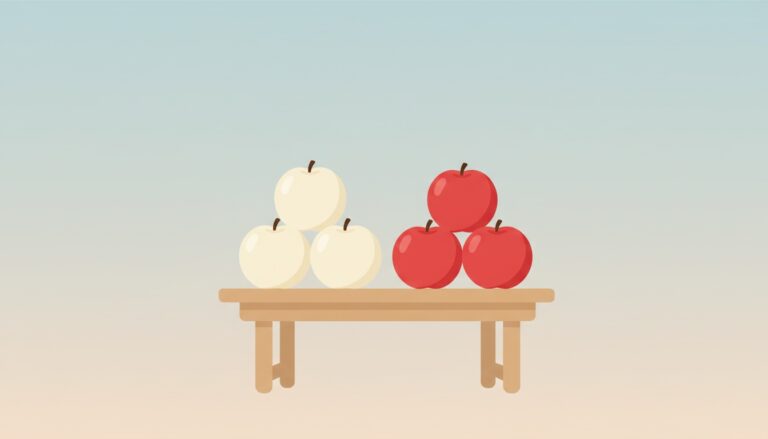
Surving Seollal: Why Is “Red” East and “White” West?
Introduction
Hello, this is Daily Hangul!
Imagine this: You are invited to a Korean friend’s or in-law’s house for Seollal (Lunar New Year). You want to help set the table, so you confidently pick up a red apple and place it on the left side. Suddenly, the room goes quiet. An elder relative gently moves the apple to the right side.
“Why does the location of a fruit matter?” you might wonder.
Note: Since specific individual experiences vary widely, the following is a synthesized case based on common questions from international students experiencing their first traditional Korean holiday.
Textbooks often list the names of the holidays, but they rarely explain the intense “placement logic” (Hong-dong-baek-seo) or the nervous tension during the preparation. Today, we will decode the Charyesang (Ancestral Rites Table) so you can impress Koreans with your cultural knowledge instead of freezing in front of a pile of pears.
Summary at a Glance
- Today’s Key Expressions: Charye, Hong-dong-baek-seo, Eumbok
- When to use: During Seollal (Lunar New Year) or Chuseok (Korean Thanksgiving).
- Level (C1): Understanding these terms shows you respect the deep culture, not just the language.
Table of Contents
- Today’s Key Expressions Deep Dive
- Textbook vs. Real Korean: The “Mealkit” Revolution
- Cultural Insight: The Stress Thermometer
- Real-Life Scenario: Helping in the Kitchen
- Shadowing Challenge
- FAQ
Today’s Key Expressions Deep Dive
1. 차례 (Charye / Cha-rye)
- Meaning (English/Korean): Ancestral Rites (specifically for holidays) / 명절에 지내는 제사
- Usage & Register: Used when talking about the morning ceremony on Seollal or Chuseok.
- Tutor’s Secret Note:
- Don’t confuse this with Jesa (제사). Jesa is usually for the anniversary of a death. Charye is a festival for ancestors on holidays.
- Warning: Never say “Partying” for Charye. It is a solemn (but happy) respectful event.
- Pronunciation Clinic: [Cha-rye] often sounds like [Cha-re] in fast speech. Don’t stress the ‘y’ too much.
- Examples:
- 설날 아침에는 차례를 지내요. (Seollal achim-eneun charye-reul jinaeyo.)
- We perform ancestral rites on the morning of Seollal.
- 이번 차례는 누가 준비해요? (Ibeon charye-neun nuga junbihaeyo?)
- Who is preparing the rites this time?
- 차례상에는 맛있는 음식이 많아요. (Charyesang-eneun masinneun eumsig-i manayo.)
- There is a lot of delicious food on the rites table.
- 설날 아침에는 차례를 지내요. (Seollal achim-eneun charye-reul jinaeyo.)
- Alternatives:
- 제사 (Jesa): General term for ancestral rites.
- 예배 (Yebae): Worship (used by Christian families instead of Charye).
Mini Quiz (Click to see answer)
Fill in the blank: On Seollal morning, the whole family gathers to perform ______.
Answer: 차례 (Charye)
2. 홍동백서 (Hong-dong-baek-seo)
- Meaning (English/Korean): Red East, White West / 붉은 과일은 동쪽, 흰 과일은 서쪽
- Usage & Register: A four-character idiom (Sajeoseong-eo) used as a rule for setting the table.
- Tutor’s Secret Note:
- This is the “Golden Rule.” If you mutter this while holding an apple, Koreans will be shocked by your knowledge.
- East (Dong) is usually the right side of the table (from the ancestor’s perspective), and West (Seo) is the left.
- Pronunciation Clinic: Pronounce each syllable clearly. [Hong-Dong-Baek-Seo]. Beware of the ‘eo’ sound in Seo.
- Examples:
- 사과는 홍동백서에 따라 동쪽에 놓으세요. (Sagwa-neun hong-dong-baek-seo-e ttara dongjjog-e noeuseyo.)
- Place the apple on the East side according to ‘Red East, White West’.
- 홍동백서가 무슨 뜻이에요? (Hong-dong-baek-seo-ga museun tteus-ieyo?)
- What does ‘Hong-dong-baek-seo’ mean?
- 요즘은 홍동백서를 안 지키는 집도 있어요. (Yojeum-eun hong-dong-baek-seo-reul an jikineun jip-do isseoyo.)
- These days, some households don’t follow ‘Hong-dong-baek-seo’.
- 사과는 홍동백서에 따라 동쪽에 놓으세요. (Sagwa-neun hong-dong-baek-seo-e ttara dongjjog-e noeuseyo.)
3. 음복 (Eumbok / Eum-bok)
- Meaning (English/Korean): Partaking of sacrificial food and drink / 제사 음식을 나누어 먹음
- Usage & Register: Formal term for eating the food after the ceremony is finished.
- Tutor’s Secret Note:
- Koreans believe that eating this food brings the blessings of the ancestors.
- Culture Tip: Even if you aren’t hungry, try a little bit. It’s polite.
- Pronunciation Clinic: [Eum-bok]. The ‘m’ and ‘b’ sounds flow together.
- Examples:
- 차례가 끝나고 다 같이 음복을 했어요. (Charye-ga kkeunnago da gachi eumbok-eul haesseoyo.)
- After the rites, we all shared the blessed food.
- 음복 술 한 잔 받으세요. (Eumbok sul han jan badeuseyo.)
- Please accept a glass of the blessed ritual wine.
- 음복을 해야 복을 받아요. (Eumbok-eul haeya bok-eul badayo.)
- You must partake in the ritual food to receive blessings.
- 차례가 끝나고 다 같이 음복을 했어요. (Charye-ga kkeunnago da gachi eumbok-eul haesseoyo.)
Textbook vs. Real Korean
Context: Setting the Table
| Type | Expression/Situation | Nuance |
|---|---|---|
| Book Korean | “정성을 다해 음식을 준비하겠습니다.” (Jeongseong-eul dahae eumsig-eul junbihagetseumnida.) I will prepare the food with all my heart. |
Very formal, dramatic, like a historical drama. |
| Book Korean | “조율이시, 어동육서…” (Joyurisi, Eodongyukseo…) (Reciting complex rules for dates, chestnuts, fish, meat placement) |
Strict traditionalist. Rare for younger generations to memorize all. |
| Real Korean | “요즘은 간소화해서 하는 집이 많아.” (Yojeum-eun gansohwahaeseo haneun jib-i mana.) Many houses simplify it these days. |
The reality. Less food, less stress. |
| Real Korean | “전은 그냥 시장에서 사자.” (Jeon-eun geunyang sijang-eseo saja.) Let’s just buy the pancakes at the market. |
Pragmatic. “Market-made” or “Mealkits” are saving Seollal. |
Situation Checklist:
* Grandparents’ house (Strict): Follow “Hong-dong-baek-seo” rules.
* Young couple’s house: “Whatever looks good and tastes good.”
Cultural Analysis: The Holiday Stress Thermometer
How stressful is this phrase to a Korean daughter-in-law?
| Phrase | Meaning (Literal) | Real Nuance (The “Sigh” Factor) | Stress Level |
|---|---|---|---|
| “이번 설에 내려오니?” (Ibeon Seollal-e naeryeooni?) |
Are you coming down (home) this Seollal? | “The traffic will be 5 hours, but you must come.” | 🔥🔥🔥 |
| “음식은 간단하게 하자.” (Eumsig-eun gandanhage haja.) |
Let’s prepare food simply. | Trap Alert! “Simple” still means 5 kinds of Jeon and Galbi-jjim. | 🔥🔥🔥🔥🔥 |
| “올해는 외식하자.” (Olhae-neun oesikhaja.) |
Let’s eat out this year. | The most beautiful sentence in the Korean language. | ❄️ (Peace) |
Real-Life Scenario: Role Play
Situation: Sarah (foreigner) is trying to help her Korean mother-in-law (Eomeoni) set the Charye table on Seollal morning.
Sarah: 어머니, 이 사과는 어디에 놓을까요?
(Eomeoni, i sagwa-neun eodie noeulkkayo?)
Mother, where should I put this apple?
Eomeoni: 아, 그건 동쪽에 놓으면 돼. 홍동백서라고 하거든.
(A, geugeon dongjjog-e noeumyeon dwae. Hong-dong-baek-seo-rago hageodeun.)
Ah, you can put that on the East side. It’s called “Red East, White West.”
Sarah: 붉은색은 동쪽이군요! 그럼 배는 서쪽에 둘까요?
(Bulgeunsaek-eun dongjjog-igunyo! Geureom bae-neun seojjog-e dulkkayo?)
Red is East! Then shall I put the pear on the West?
Eomeoni: 맞아! 우리 며느리 한국 사람 다 됐네!
(Maja! Uri myeoneuri Hanguk saram da dwaenne!)
Correct! My daughter-in-law has become fully Korean!
Sarah: 다 차리고 나서 음복도 같이 해요?
(Da charigo naseo eumbok-do gachi haeyo?)
Do we do Eumbok together after setting it up?
Eomeoni: 그럼~ 조상님 덕을 나눠 먹어야지.
(Geureom~ Josangnim deog-eul nanwo meogeoyaji.)
Of course~ We must share the ancestors’ virtue.
💡 Culture Tip: calling parents-in-law “Abeonim/Eomeoni” (Father/Mother) is standard. Asking for instructions first is better than guessing the placement!
Shadowing & Speaking Challenge
Script (Repeat 3 times):
“새해 복 많이 받으시고, 올 한 해도 건강하세요.”
(Saehae bok mani badeusigo, ol han haedo geonganghaseyo.)
(Meaning: Happy New Year, and please stay healthy all year long.)
- [ ] Attempt 1 (Slow)
- [ ] Attempt 2 (Natural Speed)
- [ ] Attempt 3 (Emotionally – with a bow)
Pronunciation Point:
* 많이 (mani): The ‘h’ (ㅎ) is silent. It sounds like [ma-ni].
* 올 한 (ol han): Link the ‘l’ sound naturally. [O-ran] is incorrect, keep the ‘l’ clear or slightly linked.
Frequently Asked Questions (FAQ)
Q1: Can I eat the food on the table during the ceremony?
* Answer: Absolutely not! You must wait until the rite is finished (bowing, burning incense). Eating afterwards is called 음복 (Eumbok).
* Ex: 제사 끝날 때까지 기다리세요. (Jesa kkeunnal ttaekkaji gidariseyo. – Wait until the rite ends.)
Q2: Do Christian Koreans perform Charye?
* Answer: Usually, no. Instead of the traditional table and bowing to ancestors, they gather for a family worship service called 가정 예배 (Gajeong Yebae) and pray.
Wrap-up & Action Item
Today we learned that a Korean table isn’t just about food—it’s about direction (East/West) and respect.
Today’s Mission:
Search for an image of “Charyesang” on Google or Instagram. Try to identify which side has the red fruits (East) and which has the white fruits (West).
Tell me in the comments:
Does your country have a tradition of offering food to ancestors? How is it different from Korea?
Final Quiz
Click to reveal the quiz!
- What is the rule that says “Red fruits go East, White fruits go West”?
a) Eodongyukseo
b) Hong-dong-baek-seo
c) Jwah-u-chung-dol -
What do you call eating the ritual food after the ceremony?
a) Charye
b) Sebae
c) Eumbok -
Fill in the blank: “During Seollal, we perform ______ for our ancestors.”
(Hint: C__r__)
Answers: 1. (b), 2. (c), 3. Charye
Frequently Asked Questions (FAQ)
Q: What does "제사" mean in Korean and how do you pronounce it?
A: In Korean, "제사" is pronounced [Jesa] and means: General term for ancestral rites.
Q: What does "예배" mean in Korean and how do you pronounce it?
A: In Korean, "예배" is pronounced [Yebae] and means: Worship (used by Christian families instead of Charye).
Q: What does "많이" mean in Korean and how do you pronounce it?
A: In Korean, "많이" is pronounced [mani] and means: The 'h' (ㅎ) is silent. It sounds like [ma-ni].
Q: What does "올 한" mean in Korean and how do you pronounce it?
A: In Korean, "올 한" is pronounced [ol han] and means: Link the 'l' sound naturally. [O-ran] is incorrect, keep the 'l' clear or slightly linked.







