

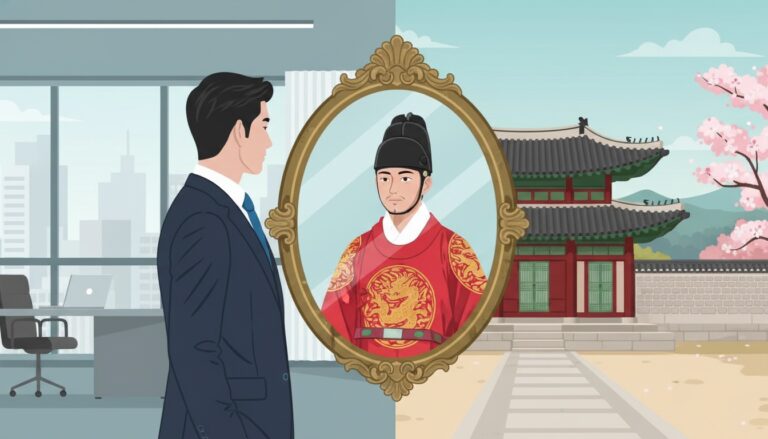
Don’t Call Your Boss “Your Majesty”! Understanding Sageuk (Historical Drama) vs. Real Korean
Introduction
Hello, this is Daily Hangul!
Are you a fan of Kingdom, The Red Sleeve, or Mr. Queen? Historical dramas, known as Sageuk (사극), are a fantastic way to enjoy Korean culture. However, they can be a minefield for Korean learners.
Here is a “Synthetic Case” based on mistakes commonly made by K-drama fans:
One of our learners, let’s call him Mark, was so immersed in a historical drama that when his Korean boss bought him lunch, he loudly said, “Seong-eun-i mang-geuk-ha-om-ni-da!” (Your grace is immeasurable!). The restaurant went silent. His boss laughed, but Mark turned bright red when he realized he sounded like a Joseon Dynasty eunuch talking to a King.
Textbooks rarely explain that the language used in the Joseon Dynasty is not the language used in 2024 Seoul. Today, we will decode the difference so you can enjoy dramas without accidentally role-playing a court official at Starbucks.
At a Glance: Today’s Summary
- Key Focus: Distinguishing between Archaic (Old) Korean and Modern Korean.
- Safe Zone: These expressions are for understanding dramas, not for speaking to friends or colleagues.
- Level: B2 (Intermediate) – Understanding distinct speech registers helps you grasp the nuance of hierarchy.
Table of Contents
- Today’s Key Expressions Deep Dive
- Textbook vs. Real Korean
- Unique Analysis: The Time Travel Translator
- Real-Life Role Play: At the Palace Ticket Office
- Shadowing Challenge
- FAQ
- Wrap-up & Quiz
Today’s Key Expressions Deep Dive
1. 성은이 망극하옵니다 (Seong-eun-i mang-geuk-ha-om-ni-da)
- Meaning: “Your grace is immeasurable” (Thank you, Your Majesty).
- Usage & Register:
- Context: Exclusively used by subjects to the King/Queen in the Joseon Dynasty.
- Tone: Extreme humility and loyalty.
- Tutor’s Secret Note:
- If you use this in real life, people will think you are joking or doing a skit. It is never used seriously in modern society.
- Warning: Do not say this to your father-in-law or boss unless you want to be the office clown.
- Pronunciation Clinic:
- Liaison: [seong-eu-ni] connects smoothly.
- Ending: The suffix
~ha-om-ni-dais the archaic marker of extreme politeness.
- Examples:
- (Drama) 성은이 망극하옵니다, 전하.
- Seong-eun-i mang-geuk-ha-om-ni-da, Jeonha.
- (Your grace is immeasurable, Your Majesty.)
- (Reality – BAD) 성은이 망극하옵니다, 부장님.
- Seong-eun-i mang-geuk-ha-om-ni-da, Bujangnim.
- (Your grace is immeasurable, Department Head. -> Awkward!)
- (Modern Equivalent) 정말 감사합니다.
- Jeongmal gamsa-hamnida.
- (Thank you very much.)
- (Drama) 성은이 망극하옵니다, 전하.
- Alternatives:
- Modern Formal: 감사합니다 (Gamsa-hamnida)
- Modern Casual: 고마워 (Gomawo)
- Mini Quiz:
- The modern version of “Seong-eun-i mang-geuk-ha-om-ni-da” is: [ ] 합니다.
-
Click to see answer
감사 (Gamsa)
2. 통촉하여 주시옵소서 (Tong-chok-ha-yeo ju-si-op-so-seo)
- Meaning: “Please heed my words / Please consider my plea carefully.”
- Usage & Register:
- Context: Used when a minister begs the King to change a decision or punish someone.
- Tone: Desperate, formal pleading.
- Tutor’s Secret Note:
- You hear this when officials are bowing with their heads on the ground. In modern Korean, using
~op-so-seosounds like a prayer or a theatrical play.
- You hear this when officials are bowing with their heads on the ground. In modern Korean, using
- Pronunciation Clinic:
- Tense Sound:
Tongis aspirated (strong T). - Rhythm: It has a rhythmic pleading tone: Tong-chok-ha-yeo / ju-si-op / so-seo.
- Tense Sound:
- Examples:
- (Drama) 전하, 통촉하여 주시옵소서!
- Jeonha, tong-chok-ha-yeo ju-si-op-so-seo!
- (Your Majesty, please heed my plea!)
- (Reality – BAD) 사장님, 제 월급 인상을 통촉하여 주시옵소서.
- Sajang-nim, je wolgeup insang-eul tong-chok-ha-yeo ju-si-op-so-seo.
- (Boss, I beg thee to consider my salary raise. -> Too dramatic)
- (Modern Equivalent) 한번만 다시 생각해주세요.
- Hanbeon-man dasi saenggak-hae-juseyo.
- (Please reconsider it just once.)
- (Drama) 전하, 통촉하여 주시옵소서!
- Alternatives:
- Modern Formal: 부탁드립니다 (Butak-deurimnida – I request of you)
- Modern Casual: 제발 (Jebal – Please)
- Mini Quiz:
- Instead of this long phrase, modern Koreans simply say [ ] when asking for a favor firmly.
-
Click to see answer
부탁드립니다 (Butak-deurimnida)
3. 송구하옵니다 (Song-gu-ha-om-ni-da)
- Meaning: “I am extremely ashamed/sorry.”
- Usage & Register:
- Context: Apologizing to a superior for a grave mistake.
- Tone: Heavy, serious, shrinking.
- Tutor’s Secret Note:
- Interestingly, 송구합니다 (Song-gu-hamnida) is actually still used in very formal modern contexts (like political apologies or official statements). However, the
~ha-om-ni-daending makes it sound like 500 years ago.
- Interestingly, 송구합니다 (Song-gu-hamnida) is actually still used in very formal modern contexts (like political apologies or official statements). However, the
- Pronunciation Clinic:
- Silent H: The
hin ha-om-ni-da often becomes soft or silent in fast speech.
- Silent H: The
- Examples:
- (Drama) 죽을 죄를 지었사옵니다. 송구하옵니다.
- Jugeul joe-reul jieot-sa-om-ni-da. Song-gu-ha-om-ni-da.
- (I have committed a deadly sin. I am ashamed.)
- (Modern Formal) 늦어서 정말 죄송합니다.
- Neujeoseo jeongmal joesong-hamnida.
- (I am truly sorry for being late.)
- (Modern Business) 불편을 드려 송구합니다.
- Bulpyeon-eul deuryeo song-gu-hamnida.
- (I apologize for the inconvenience – Very formal/Written)
- (Drama) 죽을 죄를 지었사옵니다. 송구하옵니다.
- Alternatives:
- Modern Formal: 죄송합니다 (Joesong-hamnida)
- Modern Casual: 미안해 (Mian-hae)
- Mini Quiz:
- The most common modern word for “I am sorry” is [ ]합니다.
-
Click to see answer
죄송 (Joesong)
Textbook vs. Reality Korean
Let’s compare what you see in history books/dramas vs. what you hear on the streets of Seoul.
Context Comparison: Addressing Someone Higher Up
| Type | Expression | Nuance | When to use? |
|---|---|---|---|
| Book / Drama | 전하 (Jeonha) / 마마 (Mama) | Your Majesty / Your Highness | Only in Sageuk dramas or role-play cafes. |
| Book / Drama | ~하옵소서 (~ha-op-so-seo) | Please do [verb] | Never in real life. |
| Real Korean | 사장님 (Sajang-nim) / 대표님 (Daepyo-nim) | Boss / CEO | Everyday business settings. |
| Real Korean | ~해주세요 (~hae-juseyo) | Please do [verb] | Standard polite request. |
Unique Analysis: The Time Travel Translator
How does the “temperature” and “distance” of language change from 1800 to 2024?
🕰️ The Ending Particle Shift
| 1800s (Sageuk Style) | Meaning | 2024 (Modern Style) | Vibe Check |
|---|---|---|---|
| ~하옵니다 (~ha-om-ni-da) | I do / It is | ~합니다 (~hamnida) | From “Your humble servant speaks” to “Professional reporting.” |
| ~이옵니다 (~i-om-ni-da) | It is | ~입니다 (~imnida) | “It is truly so, Sire” became “It is.” |
| ~하거라 (~ha-geora) | Do it! (Command) | ~해라 / ~해 (~haera / ~hae) | From “Authoritative command to inferior” to “Casual/Stern instruction.” |
| 여봐라! (Yeo-bwa-ra!) | Look here! (Calling guard) | 저기요! (Jeogiyo!) | From “Guards!” to “Excuse me (at a restaurant)!” |
Key Takeaway: Modern Korean values efficiency and polite distance (
-yo/-nida), whereas Sageuk Korean emphasizes extreme hierarchy and loyalty.
Real-Life Scenario: Role Play
Situation: You are renting a Hanbok (traditional clothes) near Gyeongbokgung Palace. The staff is adjusting your outfit. (Don’t be the tourist who speaks like a King!)
Characters:
* Staff: Friendly rental shop employee.
* You: An excited tourist.
Dialogue:
- Staff: 손님, 한복 사이즈가 딱 맞으시네요!
- (Sonnim, Hanbok saijeu-ga ttak majeusi-neyo!)
- Customer, the Hanbok size fits you perfectly!
- You: 아, 정말요? 감사합니다! (Not Seong-eun-i mang-geuk-ha-om-ni-da)
- (A, jeongmal-yo? Gamsa-hamnida!)
- Oh, really? Thank you!
- Staff: 머리 장식도 해드릴까요? 무료예요.
- (Meori jangsik-do hae-deurilkkayo? Muryo-yeyo.)
- Shall I do a hair ornament for you? It’s free.
- You: 네, 부탁드립니다. 예쁜 걸로 해주세요.
- (Ne, butak-deurimnida. Yeppeun geollo hae-juseyo.)
- Yes, please. Please choose a pretty one.
- Staff: (Finishing up) 자, 다 됐습니다. 즐거운 시간 보내세요!
- (Ja, da dwaet-seumnida. Jeulgeoun sigan bonaeseyo!)
- Okay, all done. Have a wonderful time!
- You: 네, 수고하세요!
- (Ne, sugo-haseyo!)
- Yes, keep up the good work! (Standard goodbye)
Culture Tip: Even if you are wearing a King’s robe, you are still a customer. Use polite language (John-daet-mal) to the staff. Playing the “King” role is only for photos!
Shadowing & Speaking Challenge
Let’s practice the difference between Drama Tone and Reality Tone. Repeat 3 times!
Script 1: The Drama Tone (For Fun)
“내 너를 영원히 지킬 것이니라.”
(Nae neoreul yeong-wonhi jikil geo-si-ni-ra.)
“I shall protect thee for eternity.” (Very dramatic, deep voice)
Script 2: The Reality Tone (To use)
“내가 평생 지켜줄게.”
(Naega pyeongsaeng jikyeo-julge.)
“I’ll protect/stay by you for my whole life.” (Romantic, modern)
Checklist:
* [ ] Did you notice the ending change from ~ni-ra to ~julge?
* [ ] Did you repeat the Modern version naturally?
* [ ] Did you pronounce “Pyeongsaeng” (Lifetime) correctly?
FAQ (Frequently Asked Questions)
Q1: Can I use Sageuk phrases as a joke?
Yes! But only with close friends who know you like K-dramas. If you say “Tong-chok-ha-yeo ju-si-op-so-seo” when asking a friend for a snack, it’s funny. If you say it to a police officer, it’s weird.
Q2: Why do historical dramas use such difficult words?
Because the social hierarchy was much stricter. The language reflects the Confucian caste system of the Joseon Dynasty. Modern Korean has become more democratic and simplified.
Q3: Is “Mama” (마마) related to “Mom”?
No! “Mama” is an honorific title for royalty (His/Her Majesty). “Mom” in Korean is Eomma (엄마). Don’t confuse them, or you might accidentally call your mother “Your Majesty” (though she might like that!).
Wrap-up & Action Items
Today we learned that Historical Korean (Sageuk) is a specific dialect of the past and shouldn’t be mixed with modern daily conversation.
Today’s Mission:
1. Watch a scene from a historical drama (e.g., Kingdom, Moon Lovers).
2. Listen for the ending “~ha-om-ni-da” or “~so-seo.”
3. Translate that sentence into modern Korean in your head (e.g., replace with “~hamnida” or “~juseyo”).
Question for you:
What is your favorite historical K-drama line that sounds cool but you know you can’t use? Share it in the comments!
Final Quiz
1. Which phrase is appropriate to say to a convenience store clerk?
a) Seong-eun-i mang-geuk-ha-om-ni-da.
b) Gamsa-hamnida.
c) Tong-chok-ha-yeo ju-si-op-so-seo.
2. “Jeonha” (전하) means:
a) Your Majesty (King)
b) Teacher
c) Department Manager
3. Fill in the blank:
To say “I am sorry” in a modern, formal situation, you say “Jeongmal [ ]-hamnida.”
Answers:
1. b) Gamsa-hamnida
2. a) Your Majesty (King)
3. Joesong (죄송)
Frequently Asked Questions (FAQ)
Q: What does "성은이 망극하옵니다 (Seong-eun-i mang-geuk-ha-om-ni-da)" mean in Korean and how do you pronounce it?
A: In Korean, "성은이 망극하옵니다 (Seong-eun-i mang-geuk-ha-om-ni-da)" is pronounced [see lesson guide] and means: "Your grace is immeasurable" (Thank you, Your Majesty).
Q: What does "통촉하여 주시옵소서 (Tong-chok-ha-yeo ju-si-op-so-seo)" mean in Korean and how do you pronounce it?
A: In Korean, "통촉하여 주시옵소서 (Tong-chok-ha-yeo ju-si-op-so-seo)" is pronounced [see lesson guide] and means: "Please heed my words / Please consider my plea carefully."
Q: What does "송구하옵니다 (Song-gu-ha-om-ni-da)" mean in Korean and how do you pronounce it?
A: In Korean, "송구하옵니다 (Song-gu-ha-om-ni-da)" is pronounced [see lesson guide] and means: "I am extremely ashamed/sorry."







