

Introduction
Hello, this is Daily Hangul!
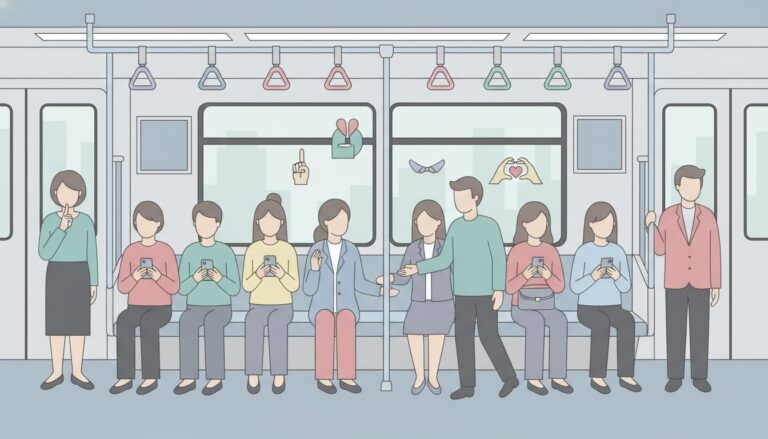
Imagine this: You are on a packed Seoul subway during rush hour. It’s strangely quiet despite the crowd. Suddenly, your phone rings loudly, and everyone’s eyes turn to you. You panic, answer, and say, “Hello? I’m on the train!” loudly. The stares get colder.
While we haven’t met personally, this is a “Composite Case” based on stories from many of our beginner students. In Western cultures, talking on public transport is often normal. In Korea, silence is golden.
Textbooks teach you grammar, but they often miss the “Nunchi” (눈치 – the art of sensing the atmosphere) required in public spaces. Today, we will learn not just the words, but the survival etiquette to travel through Korea without becoming “that rude tourist.”
Summary at a Glance
- Today’s Expressions: Jamsiman-yo (Excuse me), Naeril-geyo (I’m getting off), Joesong-hamnida (I’m sorry).
- Safe Zone: Use these in subways, buses, elevators, and crowded streets.
- Level (A2): Essential for survival. Knowing these prevents physical bumps and awkward stares.
Table of Contents
- Today’s Core Expressions Deep Dive
- Textbook vs. Real Korean
- Analysis: The Noise Volume Thermometer
- Real-Life Role Play: Rush Hour Survival
- Shadowing Challenge
- FAQ
Today’s Core Expressions Deep Dive
1. 잠시만요 / 지나갈게요 (Excuse me / I’m passing through)
- Pronunciation: Jamsiman-yo / Jinagal-geyo
- Meaning:
- Jamsiman-yo: Literally “Just a moment,” used as “Excuse me.”
- Jinagal-geyo: “I will pass through.”
- Usage & Register:
- Who: To strangers blocking your way.
- Tone: Polite Haeyo-che (Polite informal). Firm but soft.
- Tutor’s Secret Note:
- Nuance: Sil-lye-ham-ni-da (Excuse me) is too formal for a crowded bus. Jamsiman-yo implies “I need a second of your space.” If you just push without saying this, you are considered very rude.
- Warning: Do not shout it aggressively. A slightly rising intonation works best.
- Pronunciation Clinic:
- In Jinagal-geyo, the ‘k’ sound in ‘ge’ often sounds softer, almost like a hard ‘g’.
- Examples:
- Subway: 잠시만요, 내릴게요. (Jamsiman-yo, naeril-geyo.) – Excuse me, I’m getting off.
- Crowd: 죄송합니다, 지나갈게요. (Joesong-hamnida, jinagal-geyo.) – Sorry, I’m passing through.
- Elevator: 잠시만요! (Jamsiman-yo!) – Hold on (the door)!
- Alternatives:
- More Casual (Friends): Jamsiman (Wait a sec).
- More Formal: Sil-lye-ha-gess-seum-ni-da (I will excuse myself – rarely used in transit).
- Mini Quiz:
Click to see the answer
Q: You need to get off the bus, but someone is blocking the door. You say: “______!”
A: 잠시만요 (Jamsiman-yo) or 비켜주세요 (Bikyeo-juseyo – slightly more direct/rude if not careful, stick to Jamsimanyo!)
2. 여기요 (Over here / Excuse me)
- Pronunciation: Yeogi-yo
- Meaning: “Here” (Used to call attention).
- Usage & Register:
- Who: To a bus driver if they miss your stop, or a server in a restaurant.
- Tone: Loud and clear.
- Tutor’s Secret Note:
- Nuance: In a quiet library or subway, don’t use this. But on a bus, if the driver doesn’t open the door, shout this immediately!
- Examples:
- Bus: 기사님, 여기요! 문 열어 주세요. (Gisa-nim, yeogi-yo! Mun yeoreo juseyo.) – Driver, here! Please open the door.
- Lost Item: 저기요, 지갑 떨어뜨리셨어요. (Jeogi-yo, jigap tteoreotteu-ri-syeoss-eoyo.) – Excuse me (over there), you dropped your wallet.
- Restaurant: 여기요, 물 좀 주세요. (Yeogi-yo, mul jom juseyo.) – Over here, please give me some water.
3. 통화 어렵습니다 (It’s difficult to talk right now)
- Pronunciation: Tonghwa eoryeop-seum-nida
- Meaning: “Talking on the phone is difficult.”
- Usage & Register:
- Who: To the person calling you when you are on public transport.
- Tone: Whispered, quick.
- Tutor’s Secret Note:
- Culture Tip: It is considered bad manners to have a full conversation on the subway/bus. If you answer, whisper this phrase and hang up immediately.
- Examples:
- Bus: 지금 버스라 통화 어려워요. (Jigeum beoseu-ra tonghwa eoryeowo-yo.) – I’m on the bus so it’s hard to talk.
- Subway: 지하철입니다. 나중에 걸게요. (Jihacheol-imnida. Najunge geol-geyo.) – I’m on the subway. I’ll call you later.
- Meeting: 회의 중이라 통화 안 돼요. (Hoe-ui jung-ira tonghwa an dwaeyo.) – I’m in a meeting so I can’t talk.
Textbook vs. Real Korean
| Feature | Textbook Korean (The Theory) | Real Korean (The Reality) |
|---|---|---|
| Context | Standard Grammar | Survival Speed |
| Expression 1 | 실례합니다 (Sil-lye-ham-ni-da) “Excuse me.” |
잠시만요 (Jamsiman-yo) “Just a moment (Let me through).” |
| Expression 2 | 하차하겠습니다 (Hacha-ha-gess-seum-ni-da) “I will disembark.” |
내릴게요 (Naeril-geyo) “I’m getting off!” |
| Situation Check | Used in formal speeches or very polite introductions. | Used when you have 3 seconds before the subway doors close. |
Analysis: The Noise Volume Thermometer
How loud can you be? Here is a “Volume Temperature” guide for Korean public transport.
| Level | Action | Acceptance Level | Korean Reaction |
|---|---|---|---|
| 1 (Cool) | Sleeping / Reading | ✅ Perfect | “A model citizen.” |
| 2 (Warm) | KakaoTalk Messaging | ✅ Fine | (No reaction) |
| 3 (Hot) | Whispering to a friend | ⚠️ Caution | People might glance if it goes on too long. |
| 4 (Boiling) | Talking on Phone | ❌ Rude | People will stare or make “Tsk” sounds. |
| 5 (Exploding) | Video Call / Speakerphone | 🚫 Very Rude | Someone might scold you: “아, 조용히 좀 합시다!” (Hey, let’s be quiet!) |
Real-Life Role Play: Rush Hour Survival
Situation: Inside a packed Subway Line 2 at Gangnam Station (6:00 PM). You need to get off, but a wall of people is blocking the door.
You (Tourist): (Thinking: Oh no, the door is opening!) 저기… 익스큐즈 미? (Jeogi… Excuse me?)
Local Commuter: (Wearing headphones, doesn’t hear you)
You: (Remembering Daily Hangul) 잠시만요! 내릴게요! (Jamsiman-yo! Naeril-geyo!)
Local Commuter: (Startled, moves aside) 아, 네. (Ah, ne.)
You: (Squeezing through) 감사합니다. (Gamsa-hamnida.)
Someone stepped on: 아! (Ah!)
You: 죄송합니다! (Joesong-hamnida!)
💡 Culture Tip: In Korea, physical contact (bumping shoulders) is inevitable during rush hour. You don’t always need to apologize for minor bumps, but if you step on a foot or push hard, Joesong-hamnida is a must.
Shadowing Challenge
Let’s practice for the subway! Repeat this 3 times.
Script:
“잠시만요, 지나갈게요. 내립니다!”
(Jamsiman-yo, jinagal-geyo. Naerimnida!)
Meaning: “Excuse me, passing through. I’m getting off!”
- [ ] Attempt 1: Slowly, focusing on pronunciation.
- [ ] Attempt 2: Normal speed.
- [ ] Attempt 3: Rush hour speed (Fast & Urgent!)
Pronunciation Point: Connect Naerim-nida smoothly. It sounds like [Nae-rim-ni-da], not [Nae-rib-ni-da].
Frequently Asked Questions (FAQ)
Q1: Can I eat or drink on the bus/subway?
A: No. Especially on buses, take-out cups with straws are legally banned from being carried on if not in a carrier. Subways don’t strictly ban carrying, but eating is very rude.
* Example: 커피 가지고 타시면 안 돼요. (Keopi gajigo tasimyeon an dwaeyo. – You can’t board with coffee.)
Q2: What are the pink seats on the subway?
A: Those are strictly for pregnant women. Even if the train is full and the seat is empty, do not sit there. It is a strong cultural rule.
Q3: Is it okay to cross my legs?
A: In a crowded train, crossing legs (Manspreading or leg crossing) is frowned upon because your shoe sole might dirty someone’s pants. Keep legs straight.
Conclusion & Action Item
Today’s Takeaway: In Korean public transport, silence is respect, and Jamsiman-yo is your magic key to part the crowd.
Today’s Mission:
Next time you are on public transport (or even an elevator), try to spot the Noyakjaseok (Priority Seats) and the Pink Seats. Make a mental note: “I will never sit there!”
Tell us in the comments:
Have you ever gotten stuck on a train because you couldn’t say “Excuse me”? Share your story!
⬇️ Final Quiz (Click to test yourself!)
- What is the best phrase to use when moving through a crowd?
- A) 사랑합니다 (Sarang-hamnida)
- B) 잠시만요 (Jamsiman-yo)
- C) 안녕히 계세요 (Annyeong-hi gyeseyo)
- D) 여보세요 (Yeoboseyo)
- True or False: It is polite to talk loudly on the phone if it is an important business call.
- A) True
- B) False
- Fill in the blank:
“I am getting off!” = ________게요! (Naeril-geyo!)
Answers: 1. (B), 2. (B – whisper and hang up!), 3. 내릴 (Naeril)
Frequently Asked Questions (FAQ)
Q: What does "잠시만요 / 지나갈게요 (Excuse me / I'm passing through)" mean in Korean and how do you pronounce it?
A: In Korean, "잠시만요 / 지나갈게요 (Excuse me / I'm passing through)" is pronounced [Jamsiman-yo / Jinagal-geyo] and means: Jamsiman-yo: Literally "Just a moment," used as "Excuse me."
Q: What does "여기요 (Over here / Excuse me)" mean in Korean and how do you pronounce it?
A: In Korean, "여기요 (Over here / Excuse me)" is pronounced [Yeogi-yo] and means: "Here" (Used to call attention).
Q: What does "통화 어렵습니다 (It's difficult to talk right now)" mean in Korean and how do you pronounce it?
A: In Korean, "통화 어렵습니다 (It's difficult to talk right now)" is pronounced [Tonghwa eoryeop-seum-nida] and means: "Talking on the phone is difficult."







