

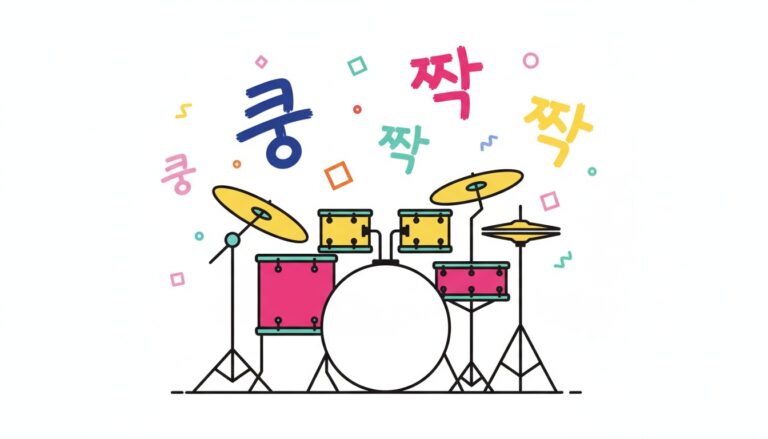
Introduction
Hello, this is Daily Hangul!
Have you ever found yourself tapping your foot to a K-Pop song or maybe even joined a hobby band in Korea? Music is a universal language, but the way we describe sounds is unique to every culture.
Imagine you are in a band practice room in Hongdae. The leader turns to you and says, “Here, give me a ‘Kung-Jjak’ feel.” If you freeze because you’re looking for a word in the dictionary, you might miss the beat!
Note on Case Study: The following is a synthetic case based on patterns observed in multiple intermediate learners.
Many foreign learners try to describe drum beats using English onomatopoeia like “Boom-Bap” or technical terms like “Kick-Snare.” While correct, it often creates a slight delay in communication with native Korean bandmates who instinctively use Korean sound symbolism. Today, we will bridge that gap so you can feel the rhythm like a local.
Textbooks teach you the noun “drum” (드럼), but they rarely teach you how to speak the drum. Let’s get into the groove!
At a Glance: Today’s Rhythm
- Key Expressions: 쿵 (Kung), 짝 (Jjak), 박자를 타다 (To ride the rhythm)
- Safe Zone: Casual jamming, hobby clubs (Dongari), singing rooms (Karaoke), and music discussions.
- Difficulty: B1~C1 (Essential for niche communication; simple words but deep nuance).
Table of Contents
- Today’s Key Expressions Deep Dive
- Textbook vs. Real Korean
- Analysis: The Sound of Korean Drums
- Real-Life Scenario: Hongdae Band Practice
- Shadowing Challenge
- FAQ
- Wrap-up & Mission
Today’s Key Expressions Deep Dive
1. 쿵 (Kung) / 짝 (Jjak)
- Meaning (English): Thump / Clap (Kick drum / Snare drum)
- Usage & Register:
- To whom: Band members, friends, music teachers.
- Recommended Tone: Casual speech (Panmal) or Polite informal (Haeyo-che) depending on the relationship.
- Tutor’s Secret Note:
- Real Vibe: Koreans use these sounds to vocalize a beat. “Kung” is the heavy bass (Kick), and “Jjak” is the sharp snare. It’s much faster to say “Kung-Jjak” than “Kick-and-Snare.”
- Warning: Don’t use “Kung” for a high-pitched sound. It implies weight and heaviness.
- Pronunciation Clinic:
- Kung: Pronounce the ‘K’ strongly (aspiration) but keep the vowel short. It’s not ‘Kooong’.
- Jjak: This is a tensed sound (Double J). It must be sharp and short, like a high-five.
- Examples:
- Band Practice: 베이스 드럼을 더 쿵! 하고 세게 밟아봐요. (Beiseu deureomeul deo kung! hago sege balbabwayo.) – Step on the bass drum harder, like “Kung!”
- Listening to Music: 이 노래는 쿵짝 리듬이 너무 신나요. (I noraeneun kungjjak rideumi neomu sinnayo.) – The “boom-clap” rhythm of this song is so exciting.
- Describing a Heartbeat: 심장이 쿵 했어요. (Simjangi kung haesseoyo.) – My heart went “thump” (meaning: I was surprised/fluttered).
- Alternatives:
- 치 (Chi): Used for High-hats or lighter sounds (Kung-Chi-Ta-Chi).
- 두둥 (Dudung): Used for a drum roll or a more dramatic bass sound.
- Mini Quiz:
-
Click to reveal: Fill in the blank (Sound of a snare drum)
Answer: 짝 (Jjak)
-
2. 박자를 타다 (Bakja-reul tada)
- Meaning (English): To ride the rhythm / To groove / To keep time
- Usage & Register:
- To whom: Anyone enjoying music.
- Recommended Tone: 해요체 (Haeyo-che).
- Tutor’s Secret Note:
- Real Vibe: It literally means “to ride the beat.” It describes someone who is physically moving along with the music or has a good sense of rhythm.
- Warning: Confusing this with “박자를 놓치다” (to miss the beat). “Tada” is positive; “Nochida” is a mistake.
- Pronunciation Clinic:
- Bakja: The ‘k’ in Bak acts as a stop sound. It flows into ‘ja’ making it sound slightly tense (Bak-jja).
- Examples:
- Compliment: 와, 그 친구는 박자를 진짜 잘 타네! (Wa, geu chinguneun bakjareul jinjja jal tane!) – Wow, that friend really rides the beat well!
- Instruction: 몸으로 박자를 타면서 연주해 보세요. (Momeuro bakjareul tamyeonseo yeonjuhae boseyo.) – Try playing while moving your body to the rhythm.
- Observation: 사람들이 음악에 맞춰 박자를 타고 있어요. (Saramdeuri eumage matchwo bakjareul tago isseoyo.) – People are grooving to the music.
- Alternatives:
- 그루브를 타다 (Geurubeu-reul tada): To ride the groove (Konglish, very common).
- 박자를 맞추다 (Bakja-reul matchuda): To keep time (more technical/precise).
- Mini Quiz:
-
Click to reveal: What verb do you use for “riding” the beat?
Answer: 타다 (Tada)
-
3. 비트를 쪼개다 (Biteu-reul jjogaeda)
- Meaning (English): To split the beat (subdivide the rhythm)
- Usage & Register:
- To whom: Musicians, producers, enthusiastic listeners.
- Recommended Tone: Often used in exclamation or analysis.
- Tutor’s Secret Note:
- Real Vibe: Used when a drummer plays complex fills or a rapper raps very fast with intricate timing. It implies high skill.
- Pronunciation Clinic:
- Jjogaeda: The ‘jj’ is a tensed sound. Start with your tongue tight against the roof of your mouth.
- Examples:
- Admiration: 와, 드럼 비트 쪼개는 것 좀 봐! (Wa, deureom biteu jjogaeneun geot jom bwa!) – Wow, look at how he’s splitting the drum beat!
- Instruction: 여기서는 박자를 더 잘게 쪼개 주세요. (Yeogiseoneun bakjareul deo jalge jjogae juseyo.) – Please subdivide the beat more finely here.
- Review: 리듬을 쪼개서 부르니까 훨씬 느낌이 사네요. (Rideumeul jjogaeseo bureunikka hwolssin neukkimi saneyo.) – Since you split the rhythm while singing, the vibe is much better.
- Alternatives:
- 엇박 (Eot-bak): Off-beat / Syncopation.
- Mini Quiz:
-
Click to reveal: How do you say “to split” in this context?
Answer: 쪼개다 (Jjogaeda)
-
Textbook vs. Real Korean
Context: You are talking about your hobby to a Korean friend.
| Type | Expression (Korean/Romanization) | Nuance |
|---|---|---|
| Book Korean | 저는 드럼을 연주할 수 있습니다. (Jeoneun deureomeul yeonjuhal su isseumnida.) |
“I am capable of performing the drum.” (Very formal, sounds like a concert pianist interview.) |
| Book Korean | 드럼을 배우고 싶어요. (Deureomeul baeugo sipeoyo.) |
“I want to learn drums.” (Standard, polite, perfectly fine but safe.) |
| Real Korean | 저 드럼 좀 쳐요. (Jeo deureom jom chyeoyo.) |
“I hit the drums a bit.” (Natural way to say you play drums as a hobby.) |
| Real Korean | 합주 한번 할까요? (Hapju hanbeon halkkayo?) |
“Shall we jam together?” (‘Hapju’ is the standard term for ensemble/band practice.) |
When to use what?
* “연주하다” (Perform): Use only on stage or in formal profiles.
* “치다” (Hit/Play): Use for drums, guitar, piano in casual conversation.
Unique Analysis: The Sound of Korean Drums
How does English “Beatboxing” translate to Korean “Mouth Drums”? Here is the “Sound Translation Map” so you can describe beats vocally.
| Sound Source | English Sound | Korean Sound (Mouth Drum) | Feeling |
|---|---|---|---|
| Kick Drum (Bass) | Boom / Thump | 쿵 (Kung) | Heavy, Grounded, Center |
| Snare Drum | Clap / Pow / Bap | 짝 (Jjak) / 탁 (Tak) | Sharp, Slapping, Cutting |
| High Hat (Closed) | Tik / Tsk | 치 (Chi) / 츠 (Tseu) | Metallic, Fast, Keeping time |
| High Hat (Open) | Tshhh | 취 (Chwi) | Airy, Sustained |
Example Beat Conversion:
* English: Boom-Tsk-Pow-Tsk
* Korean: 쿵-치-따-치 (Kung-Chi-Tta-Chi)
Real-Life Scenario: Role Play
Setting: A basement practice studio near Hongdae. 8:00 PM on a Friday. You are the drummer.
Characters:
* Min-su (Leader/Guitar): Passionate, uses slang.
* You (Drummer): Foreigner, intermediate Korean.
(Scene Start)
Min-su: 자, 이번 곡은 좀 신나게 가보자. 드럼이 리드해 줘.
(Ja, ibeon gogeun jom sinnage gaboja. Deureomi rideuhae jwo.)
Okay, let’s make this song exciting. Drums, you lead.
You: 알겠어. 비트는 어느 정도로 할까? 좀 빠르게?
(Algesseo. Biteuneun eoneu jeongdoro halkka? Jom ppareuge?)
Got it. How should the beat be? A bit fast?
Min-su: 응, 처음엔 쿵-쿵-짝 느낌으로 무겁게 가다가, 후렴에서 터뜨리자.
(Eung, cheoeumen Kung-Kung-Jjak neukkimeuro mugeopge gadaga, huryeomeseo teotteurija.)
Yeah, start heavy with a “Kung-Kung-Jjak” feel, then explode at the chorus.
You: 오케이. 그럼 후렴에서는 박자를 좀 쪼개서 쳐볼게.
(Oke. Geureom huryeomeseoneun bakjareul jom jjogaeseo chyeobolge.)
Okay. Then for the chorus, I’ll try splitting the beat a bit.
Min-su: 오! 좋아. 완벽해. 원, 투, 쓰리, 포!
(O! Joa. Wanbyeokhae. Won, tu, sseuri, po!)
Oh! Nice. Perfect. One, two, three, four!
(Scene End)
💡 Culture Tip: In Korean hobby bands (Jikjangin Band or Dongari), it’s common to drop honorifics if everyone agrees to be friends (called Ya-ja time or just becoming Mal-no-ki), but usually, you start with polite Yo endings until the leader says otherwise.
Shadowing & Speaking Challenge
Let’s practice the sentence that makes you sound like a pro musician. Listen to the rhythm of the sentence itself!
Script:
“처음에는 단순하게 가다가, 나중에 비트를 쪼개서 칠게요.”
(Cheoeumeneun dansunhage gadaga, najunge biteureul jjogaeseo chilgeyo.)
(I’ll keep it simple at first, and then I’ll split the beat later.)
Your Checklist:
* [ ] Read aloud slowly, focusing on “Jjo-gae-seo” (double J).
* [ ] Read at normal speed, imagining you are holding drumsticks.
* [ ] Say it without looking at the text.
Pronunciation Point: carefully pronounce ‘Jjo’ (쪼) with tension to differentiate it from ‘Jo’ (조 – to tune/group).
FAQ (Frequently Asked Questions)
Q1: Can I use “Kung” and “Jjak” for other instruments?
A: Yes! For piano, “Kung” can be the left-hand bass chord, and “Jjak” the right-hand melody chord. It’s a universal language for “Strong beat” vs “Weak beat.”
Q2: Is it rude to say “드럼 쳐요” (I hit drums)?
A: Not at all. For percussion, piano, and guitar, the verb 치다 (Chida) is the most natural word for “play.” 연주하다 sounds too formal for a hobby.
* Example: 저 기타 쳐요. (I play guitar.) / 저 피아노 쳐요. (I play piano.)
Conclusion & Action Item
Today we learned how to feel the Korean rhythm with Kung (쿵), Jjak (짝), and how to split the beat (비트 쪼개기).
Today’s Mission:
Find a K-Pop song you like. Listen to the drums. Try to vocalize the beat using “Kung,” “Chi,” and “Tak” for 10 seconds. If you can say it, you can play it!
Question for you:
What is your favorite instrument to 치다 (play)? Tell me in the comments!
Final Quiz
- Which sound represents the heavy bass drum?
A) 짝 (Jjak)
B) 쿵 (Kung)
C) 치 (Chi)
D) 챙 (Chaeng) -
How do you naturally say “I play the drums” to a friend?
A) 드럼을 연주해. (Deureomeul yeonjuhae)
B) 드럼을 때려. (Deureomeul ttaeryeo)
C) 드럼을 쳐. (Deureomeul chyeo)
D) 드럼을 밟아. (Deureomeul balba) -
Fill in the blank: “To ride the rhythm” is 박자를
_ _ _ _ .
Answers:
1. B) 쿵 (Kung)
2. C) 드럼을 쳐. (Deureomeul chyeo) – ‘때려’ means to beat up/hit aggressively!
3. 타다 (Tada) or 타요 (Tayo)
Frequently Asked Questions (FAQ)
Q: What does "치" mean in Korean and how do you pronounce it?
A: In Korean, "치" is pronounced [Chi] and means: Used for High-hats or lighter sounds (Kung-Chi-Ta-Chi).
Q: What does "두둥" mean in Korean and how do you pronounce it?
A: In Korean, "두둥" is pronounced [Dudung] and means: Used for a drum roll or a more dramatic bass sound.
Q: What does "그루브를 타다" mean in Korean and how do you pronounce it?
A: In Korean, "그루브를 타다" is pronounced [Geurubeu-reul tada] and means: To ride the groove (Konglish, very common).
Q: What does "박자를 맞추다" mean in Korean and how do you pronounce it?
A: In Korean, "박자를 맞추다" is pronounced [Bakja-reul matchuda] and means: To keep time (more technical/precise).







