

Introduction
Hello, this is Daily Hangul!
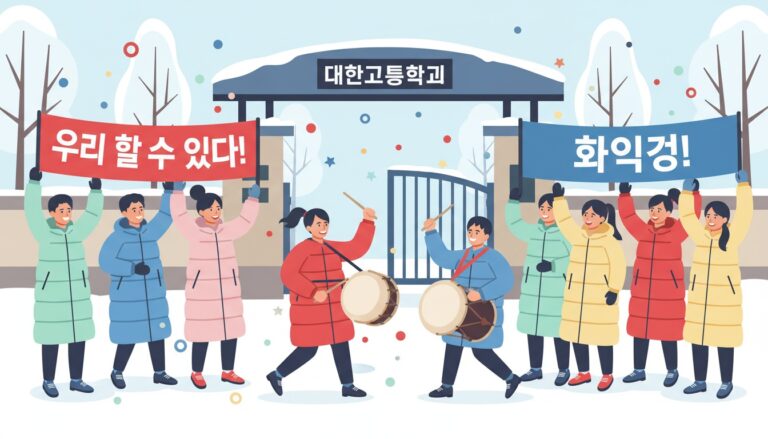
Imagine you are walking past a Korean high school on a freezing November morning. Suddenly, you hear loud drums, shouting, and see students bowing at 90 degrees while holding banners. Is it a protest? A K-pop concert?
Synthetic Case: Many foreign residents in Korea report waking up early on the third Thursday of November due to this noise. They often think something serious has happened. But actually, they are witnessing the Suneung (수능) cheering culture. It is the day of the College Scholastic Ability Test (CSAT), the most critical exam in a Korean student’s life. Juniors gather at dawn to cheer for their seniors to enter the exam hall with energy.
Textbooks teach you how to say “Good luck,” but they don’t teach you the raw energy and specific slang used on this intense day. Today, we will learn the real “cheering squad” Korean.
Summary at a Glance
- Today’s Expressions: Suneung Daebak, Jal jjik-eo, Hwaiting.
- When to use: Safe to use with friends or students taking big exams.
- Level (B1): Essential for understanding Korean school culture and news in November.
Table of Contents
- Today’s Deep Dive: Core Expressions
- Textbook vs. Real Korean
- Culture Note: The Gift Taboos
- Real Life Scenario: The School Gate
- Shadowing Challenge
- FAQ & Wrap-up
Today’s Core Expressions Deep Dive
1. 수능 대박 (Suneung Daebak)
- Meaning: (Hit the) Suneung Jackpot / Huge Success on the Exam
- Usage & Register:
- To whom: Students taking the exam (friends, family, juniors to seniors).
- Tone: Casual to polite (add ‘naseyo’ for polite).
- Tutor’s Secret Note: “Daebak” originally meant a “big gourd” (wealth) but now means “Jackpot” or “Awesome.” On exam day, everyone wishes for a “jackpot” score—even higher than expected.
- Pronunciation Clinic:
- [Suneung]: The ‘eu’ (으) sound is tricky. It’s not ‘soo-noong’. Smile while saying ‘u’.
- [Daebak]: The ‘k’ at the end is a distinct stop sound, not a released ‘kuh’.
- Examples:
- Friend: 수능 대박 나! (Suneung daebak na!) – Hit the jackpot on the Suneung!
- Banner: 선배님, 수능 대박 기원합니다! (Seonbaenim, suneung daebak giwonhamnida!) – Seniors, we wish you a Suneung jackpot!
- Text: 긴장하지 말고 대박 터뜨리자. (Ginjanghaji malgo daebak teotteurija.) – Don’t be nervous, let’s hit the jackpot.
- Alternatives:
- 시험 잘 봐 (Siheom jal bwa) – Take the exam well (Casual standard).
- 합격하세요 (Hapgyeokhaseyo) – Please pass (Polite).
- Mini Quiz:
- To make “Suneung Daebak” polite to a stranger’s child, add ______ at the end.
Click for Answer
naseyo (나세요)
- To make “Suneung Daebak” polite to a stranger’s child, add ______ at the end.
2. 잘 찍어 (Jal jjik-eo)
- Meaning: Guess well (literally: Stick/Spear/Stamp well)
- Usage & Register:
- To whom: Close friends or juniors to seniors (joking/supportive way).
- Tone: Casual (Haeyo-che: Jal jjik-eoseyo).
- Tutor’s Secret Note: This sounds strange in English. Why tell someone to “guess”? In Korea, it’s a realistic wish. If you don’t know the answer, may the “God of Guessing” guide your pencil! You will often see images of forks (to stab/pick the answer) on gifts.
- Warning: Do not say this to someone who prepared perfectly and hates luck. It’s meant to be lighthearted.
- Pronunciation Clinic:
- [Jjik]: This is a tense sound (Double J, ㅉ). Tense your throat and spit the sound out sharply.
- Examples:
- Joke: 모르는 건 잘 찍어! (Moreuneun geon jal jjik-eo!) – If you don’t know it, guess well!
- Cheering: 찍는 대로 다 정답이길! (Jjikneun daero da jeongdabigil!) – May everything you guess be the correct answer!
- Gift: 정답만 콕콕 찍어. (Jeongdamman kokkok jjik-eo.) – Pick (stab) only the correct answers.
- Alternatives:
- 실수하지 마 (Silsuhaji ma) – Don’t make mistakes.
3. 찰떡같이 붙어라 (Chaltteokgachi buteora)
- Meaning: Stick like sticky rice cake (Pass the exam).
- Usage & Register:
- To whom: Anyone taking an exam.
- Tone: Encouraging idiom.
- Tutor’s Secret Note: In Korean, passing an exam is expressed with the verb 붙다 (butda), which means “to stick/adhere.” Failing is 떨어지다 (tteoreojida), which means “to fall/drop.” Therefore, sticky foods like Tteok (rice cake) or Yeot (taffy) are symbols of passing.
- Pronunciation Clinic:
- [Chaltteok]: Double consonants ‘tt’ (ㄸ). Very sharp.
- Examples:
- Cheer: 찰떡같이 붙으세요! (Chaltteokgachi buteuseyo!) – Stick (pass) like a rice cake!
- Gift Note: 대학에 딱 붙어라. (Daehage ttak buteora.) – Stick right onto that university.
- Mom to Son: 우리 아들, 원하는 곳에 붙을 거야. (Uri adeul, wonhaneun gose buteul geoya.) – My son, you will stick (get in) where you want.
Textbook vs. Real Korean
| Context | Book Korean (Safe & Standard) | Real Korean (Street & Alive) |
|---|---|---|
| Saying Good Luck | 시험 잘 보세요. (Siheom jal boseyo.) “Take the exam well.” |
수능 대박 나세요! (Suneung daebak naseyo!) “Hit the exam jackpot!” |
| Encouragement | 최선을 다하세요. (Choeseoneul dahaseyo.) “Do your best.” |
쫄지 마! 화이팅! (Jjolji ma! Hwaiting!) “Don’t be scared! Fighting!” |
Checklist:
* Use Book Korean: With professors, formal acquaintances, or in written emails.
* Use Real Korean: At the school gate cheering, text messages to friends, or social media comments.
Cultural Analysis: The “Taboo” Translator
Why do Koreans give forks and toilet paper before exams, but never seaweed soup?
| Item | Meaning | Verdict |
|---|---|---|
| Sticky Rice Cake (Tteok) | To stick (붙다) to the university. | ✅ Highly Recommended |
| Fork (Poke) | To pick/stab (찍다) the right answer. | ✅ Fun & Popular |
| Toilet Paper | To unravel/solve (풀다) problems well (like unrolling paper). | ✅ Fun & Popular |
| Seaweed Soup (Miyeok-guk) | Seaweed is slippery. You might slip/fall (떨어지다). | ❌ FORBIDDEN |
| Bread (Ppang) | Slang for Zero (0) score. | ❌ Avoid if possible |
Real Life Scenario: Role Play
Situation: Outside a high school in Seoul. 6:50 AM. Freezing cold. Juniors are handing out hot packs and tea to seniors entering the gate.
Characters:
* Junior (Min-ji): Enthusiastic student volunteer.
* Senior (Hyun-woo): Nervous test-taker.
Min-ji: 선배님! 여기 따뜻한 차 드세요.
(Seonbaenim! Yeogi ttatteuthan cha deuseyo.)
Meaning: Senior! Please have some hot tea here.
Hyun-woo: 고마워. 아, 진짜 너무 떨린다.
(Gomawo. Ah, jinjja neomu tteollinda.)
Meaning: Thanks. Ah, I’m seriously so nervous.
Min-ji: 긴장하지 마세요! 준비한 만큼 잘 보실 거예요.
(Ginjanghaji maseyo! Junbihan mankeum jal bosil geoyeyo.)
Meaning: Don’t be nervous! You will do as well as you prepared.
Hyun-woo: 그래, 모르는 건 잘 찍고 올게.
(Geurae, moreuneun geon jal jjikgo olge.)
Meaning: Okay, I’ll guess the unknown ones well and come back.
Min-ji: 네! 수능 대박 나세요! 화이팅!
(Ne! Suneung daebak naseyo! Hwaiting!)
Meaning: Yes! Hit the jackpot! Fighting!
Culture Tip: Even if you are close, juniors typically use polite language (Honorifics) to seniors, especially on such a solemn day.
Shadowing Challenge
Scenario: Imagine you are in the cheering squad line. Shout this energetically!
Script:
“선배님! 긴장 풀고, 대박 나세요! 우리가 응원합니다!”
(Seonbaenim! Ginjang pulgo, daebak naseyo! Uriga eungwonhamnida!)
Meaning: Senior! Relax (loosen tension), and hit the jackpot! We are cheering for you!
Practice Checklist:
* [ ] Listen to the intonation (Rise on ‘Seonbaenim’, punchy on ‘Daebak’).
* [ ] Repeat slowly 3 times.
* [ ] Shout it out loud once (with emotion!).
FAQ (Frequently Asked Questions)
Q1: Can I say “Hwaiting” (Fighting) to an older person or a boss taking a test?
Yes, “Hwaiting” (or Paiting) has become a universal term of encouragement in Korea. However, if you want to be extremely formal, use “geonseungeul bimnida” (I wish you victory/success), but that sounds like a historical drama. “Jal boseyo” (Do well) is safest for superiors.
Q2: Why do police cars transport students on this day?
If a student is late for the exam (which starts strictly at 8:40 AM), they can call 112. Police cars and motorcycles will rush them to the exam center. It shows how important this test is to the entire nation.
Wrap-up & Mission
Today we learned how to survive the noise and energy of Suneung day. Remember, it’s about wishing for “sticking” (passing) and “hitting the jackpot.”
Today’s Mission:
If you see a friend studying for any test (even a driving test), send them this text:
“긴장하지 말고 시험 대박 나! 🍀” (Ginjanghaji malgo siheom daebak na!)
Tell me in the comments:
What is the “Good Luck” food in your country? Do you eat seaweed soup?
Final Quiz
- Which food should you avoid giving to a test-taker?
A) Chocolate
B) Sticky Rice Cake (Tteok)
C) Seaweed Soup
D) Fork -
What does “Jal jjik-eo” mean literally?
A) Take a good photo
B) Stab/Pick well (Guess well)
C) Sleep well
D) Eat well -
[Fill in the blank] “Stick” to the university like glue: ______ 같이 붙어라!
(Hint: A chewy rice snack)
Answers:
1. C (Seaweed is slippery = failing)
2. B
3. 찰떡 (Chaltteok)
Frequently Asked Questions (FAQ)
Q: What does "수능 대박 (Suneung Daebak)" mean in Korean and how do you pronounce it?
A: In Korean, "수능 대박 (Suneung Daebak)" is pronounced [see lesson guide] and means: (Hit the) Suneung Jackpot / Huge Success on the Exam
Q: What does "잘 찍어 (Jal jjik-eo)" mean in Korean and how do you pronounce it?
A: In Korean, "잘 찍어 (Jal jjik-eo)" is pronounced [see lesson guide] and means: Guess well (literally: Stick/Spear/Stamp well)
Q: What does "찰떡같이 붙어라 (Chaltteokgachi buteora)" mean in Korean and how do you pronounce it?
A: In Korean, "찰떡같이 붙어라 (Chaltteokgachi buteora)" is pronounced [see lesson guide] and means: Stick like sticky rice cake (Pass the exam).







