

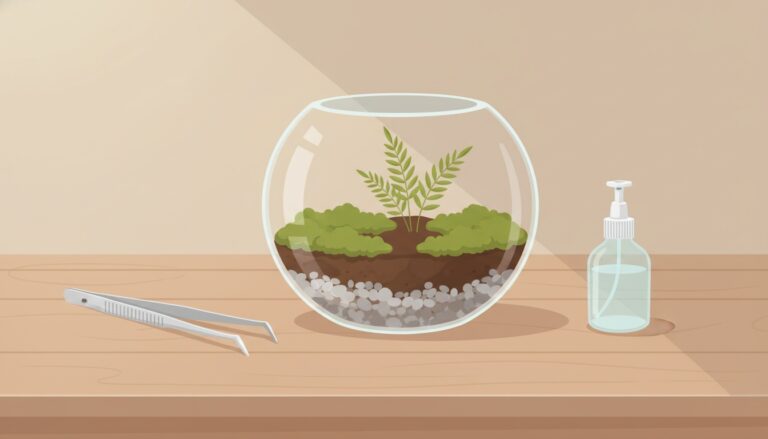
Make Your Own Tiny Forest! Korean Verbs for DIY Terrariums
Introduction
Hello, Daily Hangul! Welcome back.
Are you interested in “Planterior” (Plant + Interior)? Lately, making a “Terrarium” (a mini garden inside a glass bottle) has become a huge trend in Korea as a healing hobby.
However, simply knowing the word “Flower” (Kkot) isn’t enough to survive a DIY workshop.
📝 Synthetic Case Study (Based on common learner patterns)
Many foreign learners, when attending a Korean gardening class, often get stuck on specific action verbs. For example, instead of saying “Pack the soil firmly” (Heuk-eul dajiseyo), they might just say “Push the soil” (Heuk-eul mireoseyo), which sounds like you are moving the pile of dirt away rather than stabilizing the plant.
Today, we will learn the C1-level action verbs you need to create your own tiny forest while impressing your Korean instructor!
Summary at a Glance
- Today’s Expressions: 깔다 (Kkalda), 다지다 (Dajida), 틈 (Teum)
- Safety Level: Perfect for One-day classes, hobby clubs, and flower shops.
- Difficulty: C1 (Advanced) – These are specific action verbs that distinguish a native speaker from a beginner.
Table of Contents
- Today’s Key Expressions Deep Dive
- Textbook vs. Real Korean
- Original Analysis: The Nuance of Touch
- Real-Life Role Play: One-day Class
- Shadowing Challenge
- FAQ
- Final Quiz
Today’s Key Expressions Deep Dive
1. 깔다 (Kkalda)
- Meaning: To spread / To lay down (a foundation)
- Usage & Register: Used when placing a flat layer of something (mat, blanket, gravel, money).
- Tutor’s Secret Note:
This is essential for the first step of a terrarium: the drainage layer. If you say “Put stones” (Doleul noayo), it sounds too simple. Kkalda implies spreading them evenly to cover the surface.- ⚠️ Warning: Don’t use this for upright objects like trees. You can’t kkalda a tree; you plant (simda) it.
- Pronunciation Clinic: [Kkal-da] – The ‘ㄲ’ is a tense sound. Tense your throat slightly, like the ‘k’ in “Sky.”
- Examples:
- (Hobby) 바닥에 자갈을 먼저 깔아주세요.
Badag-e jagal-eul meonjeo kkara-juseyo.
(Please lay the gravel on the bottom first.) - (Daily) 손님이 오니까 식탁보를 깔았어요.
Sonnim-i onikka siktakbo-reul kkarasseoyo.
(Guests are coming, so I spread the tablecloth.) - (Idiom) 그 사람은 배경이 좋아. (Meaning: He has a rich/powerful background backing him.)
- (Hobby) 바닥에 자갈을 먼저 깔아주세요.
- Alternatives:
- 놓다 (Nota – Casual ‘put’)
- 포설하다 (Poseol-hada – Very formal construction term)
- Mini Quiz:
Click to see answer
Floor mats should be _____ (laid down). -> 깔아야 (kkaraya)
2. 다지다 (Dajida)
- Meaning: To pack down / To firm up / To mince (cooking)
- Usage & Register: Used when pressing soil to remove air pockets, or mincing garlic.
- Tutor’s Secret Note:
In gardening, if you don’t do this, the plant falls over. It implies “making something solid.” Koreans also use this for “strengthening resolve” (Gago-reul dajida). - Pronunciation Clinic: [Da-ji-da] – Pronounce clearly. Don’t drag the vowels.
- Examples:
- (Gardening) 흙을 손가락으로 살살 다져주세요.
Heuk-eul songarak-euro salsal dajyeo-juseyo.
(Please gently pack the soil down with your fingers.) - (Cooking) 마늘을 다져서 넣으세요.
Maneul-eul dajyeoseo neoeuseyo.
(Mince the garlic and put it in.) - (Abstract) 우리는 우정을 다졌어요.
Uri-neun ujeong-eul dajyeosseoyo.
(We strengthened/cemented our friendship.)
- (Gardening) 흙을 손가락으로 살살 다져주세요.
- Alternatives:
- 누르다 (Nureuda – Just ‘press’)
- 단단하게 하다 (Dandanhage hada – To make hard)
- Mini Quiz:
Click to see answer
Pack the soil so the plant doesn’t wobble. -> 흙을 다져 주세요. (Dajyeo)
3. 틈 (Teum)
- Meaning: Gap / Crack / Space between
- Usage & Register: Used for physical spaces between stones or plants, or metaphorical “time/opportunity.”
- Tutor’s Secret Note:
In Terrariums, beauty comes from the teum. But in relationships, if you give no teum (space/break), people get tired! - Pronunciation Clinic: [Teum] – It is one syllable. The ‘eu’ sound is like the ‘oo’ in “Book” but with lips stretched horizontally.
- Examples:
- (Gardening) 돌 사이 틈에 이끼를 채워보세요.
Dol sai teum-e ikki-reul chaewoboseyo.
(Try filling the gaps between the stones with moss.) - (Daily) 바빠서 쉴 틈이 없어요.
Bappaseo swil teum-i eopseoyo.
(I’m so busy I have no time/gap to rest.) - (Construction) 문 틈으로 바람이 들어와요.
Mun teum-euro baram-i deureowayo.
(Wind is coming in through the crack in the door.)
- (Gardening) 돌 사이 틈에 이끼를 채워보세요.
- Alternatives:
- 공간 (Gonggan – Space/Room)
- 사이 (Sai – Between)
- Mini Quiz:
Click to see answer
There is no _____ (gap) between the rocks. -> 틈 (Teum)
Textbook vs. Real Korean
| Context | Book Korean (Textbook) | Real Korean (Hobby Class) |
|---|---|---|
| Planting | 나무를 심으세요. (Namureul simeuseyo) |
Frequently Asked Questions (FAQ)
Q: What does "깔다 (Kkalda)" mean in Korean and how do you pronounce it?
A: In Korean, "깔다 (Kkalda)" is pronounced [see lesson guide] and means: To spread / To lay down (a foundation)
Q: What does "다지다 (Dajida)" mean in Korean and how do you pronounce it?
A: In Korean, "다지다 (Dajida)" is pronounced [Clinic: [Da-ji-da] and means: To pack down / To firm up / To mince (cooking)
Q: What does "틈 (Teum)" mean in Korean and how do you pronounce it?
A: In Korean, "틈 (Teum)" is pronounced [Clinic: [Teum] and means: Gap / Crack / Space between







