

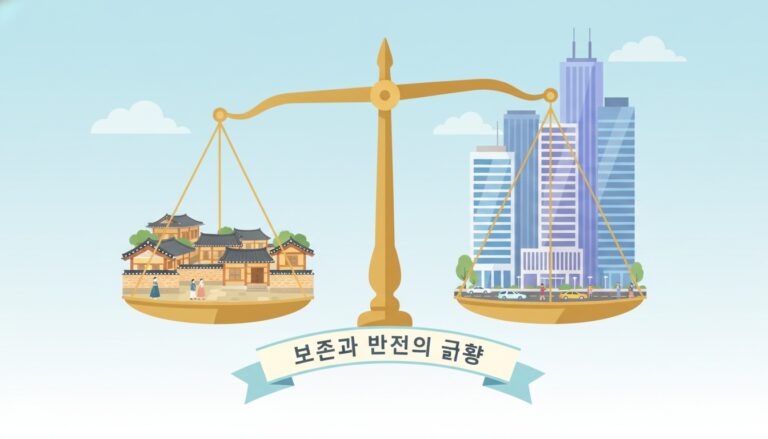
Hanok vs. Coffee Shops: How to Discuss Tradition and Money in Korean
Introduction
Hello, this is Daily Hangul!
Have you ever walked through Bukchon Hanok Village in Seoul? It’s beautiful, isn’t it? But you might have noticed signs saying “Please be quiet, people live here” right next to bustling trendy cafes.
Synthetic Case: Many of our advanced learners often ask, “How do I express my opinion on this? I want to say it’s a pity that residents are leaving, but I also love the cafes.” One learner tried to say, “The house is broken by money,” which sounded a bit awkward. They wanted to discuss urban planning conflicts, not just describe a building.
Textbooks teach you “House” (집) and “Expensive” (비싸다), but they rarely teach you how to discuss the sophisticated conflict between Preservation (보존) and Development (개발). Today, we will learn the C2-level vocabulary needed to discuss this “hot potato” issue with elegance and nuance.
Summary at a Glance
- Key Expressions: 보존하다 (To preserve), 상업화 (Commercialization), 공존 (Coexistence), 타협점 (Compromise point).
- Safe Zone: Formal debates, university discussions, or serious conversations with Korean friends about society.
- Level: C2 (Advanced). These words will make you sound like an educated intellectual, not just a tourist.
Table of Contents
- Deep Dive: Today’s Core Expressions
- Textbook vs. Real Korean: The “Win-Win” Concept
- Unique Analysis: The “Opinion Softener” Logic
- Real-Life Scenario: A Public Hearing Role Play
- Shadowing Challenge
- FAQ
- Final Quiz
Deep Dive: Today’s Core Expressions
1. 보존하다 (Bo-jon-ha-da)
- Meaning: To preserve / To conserve (focus on keeping the original state)
- Usage & Register:
- Context: Formal discussions, news, academic settings.
- Tone: Hapnida-che (Formal) or Haeyo-che (Polite) are recommended.
- Tutor’s Secret Note:
- Koreans use this when they feel something has “historical value” or “cultural spirit.” If you use this for just keeping leftovers in the fridge, it sounds funny (use 보관하다 for that).
- Warning: Don’t confuse with 보호하다 (to protect). Boho is for people/animals; Bojon is for buildings/conditions.
- Pronunciation Clinic:
- Be careful with the ‘jon’ (존). It is not ‘jun’. Keep your lips round.
- Examples:
- Historic Site: 한옥 마을을 보존해야 합니다. (Hanok ma-eul-eul bo-jon-hae-ya ham-ni-da.) – We must preserve the Hanok village.
- Debate: 개발보다는 보존이 우선입니다. (Gae-bal-bo-da-neun bo-jon-i u-seon-im-ni-da.) – Preservation is a priority over development.
- Culture: 전통 문화를 보존하려는 노력이 필요해요. (Jeon-tong mun-hwa-reul bo-jon-ha-ryeo-neun no-ryeok-i pi-ryo-hae-yo.) – Efforts to preserve traditional culture are needed.
- Alternatives:
- 지키다 (Ji-ki-da): Casual, “to keep/guard.”
- 유지하다 (Yu-ji-ha-da): Neutral, “to maintain.”
- Mini Quiz:
-
역사적인 건물을 ( ) 것은 중요합니다. (Click to see)
Answer: 보존하는 (bo-jon-ha-neun)
-
2. 상업화 (Sang-eop-hwa)
- Meaning: Commercialization
- Usage & Register:
- Used critically to describe when a place loses its charm to make money.
- Tutor’s Secret Note:
- This word often carries a negative nuance in this context. It implies “too much” business.
- Pronunciation Clinic:
- [상어퐈] (Sang-eo-pwa). The ㅂ (p) in 업 (eop) slides over to 화 (hwa), sounding like a mix.
- Examples:
- Complaint: 이 지역이 너무 상업화되었어요. (I ji-yeok-i neo-mu sang-eop-hwa-doe-eoss-eo-yo.) – This area has become too commercialized.
- News: 상업화로 인해 주민들이 떠나고 있습니다. (Sang-eop-hwa-ro in-hae ju-min-deul-i tteo-na-go iss-seum-ni-da.) – Residents are leaving due to commercialization.
- Discussion: 지나친 상업화를 막아야 해요. (Ji-na-chin sang-eop-hwa-reul ma-ga-ya hae-yo.) – We must prevent excessive commercialization.
- Alternatives:
- 관광지화 (Gwan-gwang-ji-hwa): Becoming a tourist trap/spot.
3. 공존 (Gong-jon)
- Meaning: Coexistence
- Usage & Register:
- The “Magic Word” for wrapping up a debate. It shows you seek harmony.
- Tutor’s Secret Note:
- If you use this word, Koreans will think you are very wise. It suggests finding a way for old and new to live together.
- Pronunciation Clinic:
- [공존]. Ensure the ‘ng’ (ㅇ) is clear in the first syllable.
- Examples:
- Goal: 전통과 현대의 공존을 모색해야 합니다. (Jeon-tong-gwa hyeon-dae-ui gong-jon-eul mo-saek-hae-ya ham-ni-da.) – We must seek the coexistence of tradition and modernity.
- Possibility: 관광객과 주민이 공존할 수 있을까요? (Gwan-gwang-gaek-gwa ju-min-i gong-jon-hal su iss-eul-kka-yo?) – Can tourists and residents coexist?
- Result: 아름다운 공존이 필요합니다. (A-reum-da-un gong-jon-i pi-ryo-ham-ni-da.) – Beautiful coexistence is necessary.
Textbook vs. Real Korean: The “Win-Win” Concept
| Feature | Textbook Korean (Book Korean) | Real Korean (Street/News Korean) |
|---|---|---|
| Concept | Focus on Grammar | Focus on “Social Concepts” |
| Expression 1 | 서로 돕는 것이 좋습니다. (Seo-ro dop-neun geos-i jo-sseum-ni-da.) It is good to help each other. |
상생해야 합니다. (Sang-saeng-hae-ya ham-ni-da.) We need ‘mutual survival/win-win’. |
| Expression 2 | 문제가 많습니다. (Mun-je-ga man-seum-ni-da.) There are many problems. |
젠트리피케이션이 심각해요. (Jen-teu-ri-pi-kei-syeon-i sim-gak-hae-yo.) Gentrification is serious. |
Tutor’s Tip: In urban planning news, you will hear 상생 (Sang-saeng) constantly. It is the key philosophy in Korean conflict resolution—living well together.
Unique Analysis: The “Tone Thermometer”
How strongly are you disagreeing with the development plan? Use the right ending.
- Level 1 (Soft Suggestion):
- “~하는 게 어떨까요?” (~ha-neun ge eo-tteol-kka-yo?) – How about doing…?
- Level 3 (Firm Opinion):
- “~해야 한다고 생각합니다.” (~hae-ya han-da-go saeng-gak-ham-ni-da.) – I think we must…
- Level 5 (Strong Opposition):
- “~은 절대 안 됩니다.” (~eun jeol-dae an doem-ni-da.) – …is absolutely not allowed.
Scenario: A developer wants to tear down a Hanok.
* Level 1: “보존하는 게 어떨까요?” (Why don’t we preserve it?)
* Level 5: “철거는 절대 안 됩니다!” (Demolition is absolutely not allowed!)
Real-Life Scenario: Role Play
Situation: A public hearing at a district office regarding Bukchon development.
Characters:
* Soo-jin (Resident): Wants to stop noise and damage.
* Min-ho (Developer): Wants to build a modern cafe complex.
Soo-jin: 이곳은 주민들이 사는 공간입니다. 무분별한 상업화는 반대해요.
(I-got-eun ju-min-deul-i sa-neun gong-gan-im-ni-da. Mu-bun-byeol-han sang-eop-hwa-neun ban-dae-hae-yo.)
This is a living space for residents. I oppose thoughtless commercialization.
Min-ho: 하지만 지역 경제를 위해서는 변화가 필요합니다. 낡은 건물은 고쳐야죠.
(Ha-ji-man ji-yeok gyeong-je-reul wi-hae-seo-neun byeon-hwa-ga pi-ryo-ham-ni-da. Nal-geun geon-mul-eun go-chyeo-ya-jyo.)
But for the local economy, change is needed. Old buildings need fixing.
Soo-jin: 고치는 건 좋지만, 보존이 우선되어야 합니다. 우리의 정체성이니까요.
(Go-chi-neun geon jo-chi-man, bo-jon-i u-seon-doe-eo-ya ham-ni-da. U-ri-ui jeong-che-seong-i-ni-kka-yo.)
Fixing is fine, but preservation must come first. Because it is our identity.
Min-ho: 그럼, 현대적인 시설과 한옥이 공존할 수 있는 방법을 찾아봅시다.
(Geu-reom, hyeon-dae-jeok-in si-seol-gwa han-ok-i gong-jon-hal su iss-neun bang-beop-eul cha-ja-bops-si-da.)
Then, let’s find a way for modern facilities and Hanok to coexist.
Culture Tip: In serious meetings, even if you are angry, you must maintain polite endings (Has하십시오-che or Haeyo-che). Getting emotional and using Banmal (casual speech) loses the argument immediately.
Shadowing Challenge
Script (25 seconds):
“개발도 중요하지만, 한번 사라진 역사는 되돌릴 수 없습니다. 우리는 상생의 길을 찾아야 해요.”
(Gae-bal-do jung-yo-ha-ji-man, han-beon sa-ra-jin yeok-sa-neun doe-dol-lil su eops-seum-ni-da. U-ri-neun sang-saeng-ui gil-eul cha-ja-ya hae-yo.)
“Development is important, but history, once gone, cannot be turned back. We must find a path of mutual survival.”
Checklist:
* [ ] Spoke aloud 3 times?
* [ ] Did you emphasize “되돌릴 수 없습니다” (cannot be turned back)?
* [ ] Did you pause after “중요하지만” (important, but)?
FAQ
Q1: Can I use “보존하다” for saving a file on my computer?
* No! For computer files, use 저장하다 (Jeo-jang-ha-da). 보존하다 is for history, environment, or conditions.
* Example: 파일을 저장했어요. (Pa-il-eul jeo-jang-haess-eo-yo.)
Q2: How do I say “NIMBY” (Not In My Back Yard) in Korean?
* Koreans also use the acronym 님비 (Nim-bi) or say 지역 이기주의 (Ji-yeok i-gi-ju-ui – Regional selfishness).
* Example: 그것은 님비 현상이에요. (Geu-geot-eun Nim-bi hyeon-sang-i-e-yo.)
Closing & Action Item
Today we learned how to be a diplomat between the past and the future using words like 보존 (Preservation) and 공존 (Coexistence).
Today’s Mission:
Next time you visit a Hanok village or a historical site in Korea, look for a banner or sign regarding construction. Try to read if it says “보존” (Preserve) or “개발” (Develop).
Comment Question:
Do you prefer a traditional Hanok stay or a modern hotel? Tell us why using “공존” or “보존”!
Final Quiz
- Which word is best for “keeping a historical building safe”?
a) 저장하다
b) 보존하다
c) 예약하다 -
What is the Korean word for “Commercialization”?
a) 산업화
b) 상업화
c) 민주화 -
Fill in the blank: “전통과 현대의 ( )이 필요합니다.” (Coexistence)
Answers: 1. (b), 2. (b), 3. 공존 (Gong-jon)
Frequently Asked Questions (FAQ)
Q: What does "보존하다 (Bo-jon-ha-da)" mean in Korean and how do you pronounce it?
A: In Korean, "보존하다 (Bo-jon-ha-da)" is pronounced [see lesson guide] and means: To preserve / To conserve (focus on keeping the original state)
Q: What does "상업화 (Sang-eop-hwa)" mean in Korean and how do you pronounce it?
A: In Korean, "상업화 (Sang-eop-hwa)" is pronounced [see lesson guide] and means: Commercialization
Q: What does "공존 (Gong-jon)" mean in Korean and how do you pronounce it?
A: In Korean, "공존 (Gong-jon)" is pronounced [see lesson guide] and means: Coexistence







