

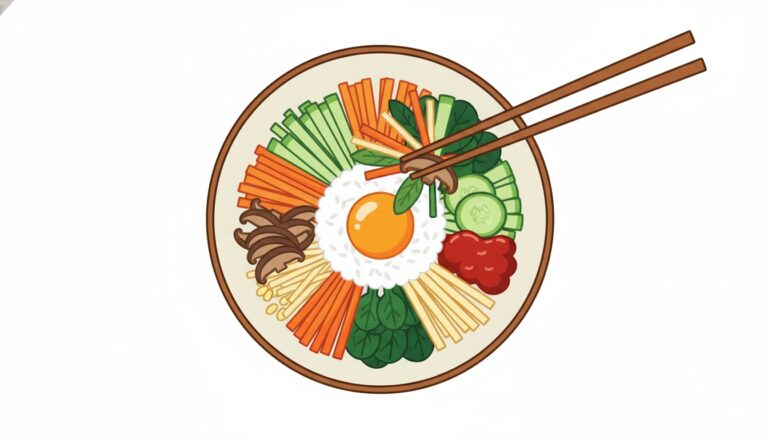
Don’t Eat Bibimbap Like a Salad! The Art of Mixing “Gol-go-ru”
Introduction
Hello, this is Daily Hangul!
Have you ever ordered Bibimbap in Korea and started eating the toppings one by one, carefully picking up the spinach, then the bean sprouts, and finally the rice? If you have, you might have felt the intense gaze of a Korean friend (or the restaurant owner) rushing over to stop you.
“No, no! You have to mix it!”
To many Westerners, a bowl with arranged toppings looks like a salad or a poke bowl meant to be eaten layer by layer. But in Korea, the soul of Bibimbap lies in the harmony created when everything is mashed together.
Today, based on a synthetic example of common mistakes observed among beginner learners, we will learn how to guide someone (or understand instructions) on mixing Bibimbap properly. We’ll cover not just the verb “to mix,” but the adverbs that make you sound like a local foodie.
Summary at a Glance
- Today’s Expressions: Essential verbs and adverbs for mixing food.
- Safe Zone: Casual dining, lunch with friends/colleagues.
- Level (B1): Essential because knowing how to eat is just as important as knowing what to order in Korean culture.
Table of Contents
- Today’s Key Expressions Deep Dive
- Textbook vs. Real Korean
- Unique Analysis: The “Delicious Sound” of Mixing
- Real-Life Role Play
- Shadowing Challenge
- FAQ
- Wrap-up & Quiz
Today’s Key Expressions Deep Dive
1. 골고루 비비세요 (Mix it thoroughly)
- Hangul: 골고루 비비세요
- Romanization: Golgoru bibiseyo
- Meaning: Please mix it thoroughly/evenly.
Usage & Register:
* To whom: A friend (polite), a colleague, or giving advice to a visitor.
* Tone: Polite request (Haeyo-che / 해요체).
Tutor’s Secret Note:
Just saying “비비세요” (Mix it) is okay, but adding “골고루” (evenly) shows you care about the flavor. Koreans believe that if white rice is visible, it’s not mixed enough! The sauce (Gochujang) must coat every grain of rice.
Pronunciation Clinic:
* Gol-go-ru: Make sure the ‘L’ sound in ‘Gol’ flows into the ‘Go’. Don’t stop abruptly.
* Bi-bi-se-yo: The ‘B’ sounds are soft, not an explosive ‘P’ sound.
Examples:
1. 야채랑 밥을 골고루 비비세요. (Yachaerang babeul golgoru bibiseyo.)
* Mix the vegetables and rice thoroughly. (General)
2. 소스가 뭉치지 않게 골고루 비벼요. (Soseuga mungchiji anke golgoru bibyeoyo.)
* Mix it evenly so the sauce doesn’t clump. (Detail-oriented)
3. 대충 말고, 골고루! (Daechung malgo, golgoru!)
* Not roughly, (mix it) evenly! (Casual emphasis)
Alternatives:
* Casual: 싹싹 비벼 (Ssak-ssak bibyeo – Mix it completely)
* Formal: 잘 섞어서 드세요 (Jal seokkeoseo deuseyo – Mix well and eat)
Mini Quiz (Click to see answer)
Q. “Please mix the Bibimbap evenly.”
Answer: 비빔밥을 골고루 비비세요.
2. 참기름 좀 넣을까요? (Shall we put in some sesame oil?)
- Hangul: 참기름 좀 넣을까요?
- Romanization: Chamgireum jom neoulkkayo?
- Meaning: Should I add some sesame oil?
Usage & Register:
* To whom: Anyone you are eating with.
* Tone: Soft suggestion (Haeyo-che).
Tutor’s Secret Note:
This is the “Cheat Code” of Korean cuisine. If Bibimbap tastes a bit dry or bland, Sesame Oil (Chamgireum) fixes everything. Suggesting this makes you look like a pro.
Pronunciation Clinic:
* Neoul-kka-yo: This is a liaison rule (Yeoneum). The ‘H’ (ㅎ) in 넣 is silent, and the batchim moves over. It sounds like [너을까요 / Neo-eul-kka-yo].
Examples:
1. 고소하게 참기름 좀 넣을까요? (Gosohage chamgireum jom neoulkkayo?)
* Shall we add some sesame oil to make it savory?
2. 고추장 더 넣으세요. (Gochujang deo neouseyo.)
* Please put in more Gochujang (red chili paste).
3. 김가루도 같이 넣어요. (Gimgarudo gachi neoeoyo.)
* Put the seaweed flakes in together, too.
Alternatives:
* Casual: 참기름 칠까? (Chamgireum chilkka? – literally “hit/sprinkle” oil)
* Polite: 추가해 드릴까요? (Chugahae deurilkkayo? – Shall I add it for you?)
Mini Quiz
Q. Fill in the blank: “_______ more Gochujang.” (고추장 더 _______)
Answer: 넣으세요 (neouseyo)
3. 눌어붙게 기다려요 (Wait for it to scorch/crust)
- Hangul: 눌어붙게 기다려요
- Romanization: Nureobutge gidaryeoyo
- Meaning: Wait for it to stick (to make scorched rice).
Usage & Register:
* Context: ONLY for Dolsot Bibimbap (Hot Stone Pot). Do not use this for a regular cold bowl!
Tutor’s Secret Note:
The best part of Dolsot Bibimbap is the Nurungji (crispy rice crust) at the bottom. If you mix it immediately, you lose the crust. A true friend tells you to “Wait a moment” so the rice gets crispy.
Pronunciation Clinic:
* Nureobutge: [누러붇께 / Nu-reo-but-kke]. The double consonant ‘kk’ sound happens due to tensing rules.
Examples:
1. 바로 비비지 말고, 좀 눌어붙게 기다려요. (Baro bibiji malgo, jom nureobutge gidaryeoyo.)
* Don’t mix it right away, wait for it to scorch a bit.
2. 누룽지 좋아하면 나중에 비비세요. (Nurungji joahamyeon najunge bibiseyo.)
* If you like scorched rice, mix it later.
3. 바닥이 탈 수 있으니까 조심해요. (Badagi tal su isseunikka josimhaeyo.)
* The bottom might burn, so be careful.
Mini Quiz
Q. What is the Korean word for “Scorched Rice”?
Answer: 누룽지 (Nurungji)
Textbook vs. Real Korean
| Feature | Book Korean (Textbook) | Real Korean (Survival) |
|---|---|---|
| The Verb | 섞으십시오 (Seokkeusipsio) | 비벼요 / 쉐킷쉐킷 (Bibyeoyo / Shake it) |
| Adverb | 매우 잘 (Maeu jal – Very well) | 싹싹 (Ssak-ssak – Thoroughly/Scraping sound) |
| Asking for Sauce | 고추장을 더 주시겠습니까? | 이모, 여기 고추장 좀 더요! (Auntie, more Gochujang here!) |
Tip: “섞다” (Seokda) is a general word for mixing (like chemicals or cards). “비비다” (Bibida) implies rubbing or mixing thick ingredients with rice/noodles. Always use 비비다 for Bibimbap!
Unique Analysis: The “Sound” of Mixing
In Korea, “How” you say it is as important as “What” you say. We often use onomatopoeia to describe the intensity of mixing.
The Mixing Intensity Scale
| Level | Expression | Nuance | Context |
|---|---|---|---|
| Lv. 1 | 살살 (Sal-sal) | Gently/Lightly | When mixing fragile tofu or trying not to spill. |
| Lv. 3 | 골고루 (Gol-go-ru) | Evenly/Standard | The standard instruction. Professional & Polite. |
| Lv. 5 | 싹싹 (Ssak-ssak) | Completely/Vigorously | Indicates scraping the bottom of the bowl. Used when you want to mix perfectly or clean the plate. |
| Warning | 쩝쩝 (Jjeop-jjeop) | Smacking lips | DON’T make this sound while eating. It’s considered rude! |
Real-Life Scenario: Role Play
Setting: A traditional Bibimbap restaurant near Jeonju Hanok Village.
Characters:
* Min-su (Korean): Showing his foreign friend how to eat.
* Alex (Foreigner): About to eat the spinach separately.
(The food arrives in hot stone pots)
Alex: 와, 예쁘다! (Wow, it’s pretty!) [Picks up a piece of mushroom with chopsticks]
Min-su: 잠깐만! 알렉스, 그렇게 먹으면 안 돼요. 골고루 비벼야 더 맛있어요.
(Wait! Alex, you shouldn’t eat like that. It tastes better if you mix it thoroughly.)
(Jamskkanman! Alex, geureoke meogeumyeon an dwaeyo. Golgoru bibyeoya deo masisseoyo.)
Alex: 아, 정말요? 젓가락으로 비벼요?
(Ah, really? Do I mix with chopsticks?)
(A, jeongmalyo? Jeotgarageuro bibyeoyo?)
Min-su: 네, 밥알이 안 뭉개지게 젓가락으로 살살 비비세요. 그리고 숟가락으로 드세요.
(Yes, mix gently with chopsticks so the rice grains don’t get crushed. Then eat with a spoon.)
(Ne, babari an munggaejige jeotgarageuro salsal bibiseyo. Geurigo sutgarageuro deuseyo.)
Alex: 알겠어요. 참기름 냄새가 좋네요.
(Okay. The sesame oil smells good.)
(Algesseoyo. Chamgireum naemsaega jonneyo.)
Min-su: 돌솥이니까 밥이 눌어붙게 조금 천천히 비벼도 돼요.
(Since it’s a stone pot, you can mix a bit slowly to let the rice scorch.)
(Dolsotinikka babi nureobutge jogeum cheoncheonhi bibyeodo dwaeyo.)
Shadowing / Speaking Challenge
Let’s practice the sentence that saves your Bibimbap experience. Repeat this 3 times out loud.
“Please mix the sauce and rice thoroughly so they blend well.”
소스랑 밥이 잘 섞이게 골고루 비벼 드세요.
(Soserang babi jal seokkige golgoru bibyeo deuseyo.)
- [ ] Attempt 1 (Slowly check pronunciation)
- [ ] Attempt 2 (Focus on “Gol-go-ru”)
- [ ] Attempt 3 (Natural speed like a hungry Korean)
Pronunciation Point: Try to say “비벼 드세요” (Bibyeo deuseyo) smoothly. Connect the sounds: [Bibyeo-deuseyo].
FAQ (Frequently Asked Questions)
Q1: Can I use a spoon to mix?
* A: Yes! Many Koreans use a spoon (숟가락 – Sutgarak). However, “Bibimbap purists” argue that using chopsticks (젓가락 – Jeotgarak) keeps the rice grains fluffy and separated, whereas a spoon might mash them. Try chopsticks for a more sophisticated vibe!
Q2: What if it’s too spicy?
* A: Before you mix, you can scoop out some of the red paste (Gochujang). Use this phrase:
* “고추장 조금만 덜어낼게요.” (I’ll take out a little bit of Gochujang.)
* (Gochujang jogeumman deoreonaelgeyo.)
Wrap-up & Action Item
One Sentence Summary:
When eating Bibimbap, don’t separate the toppings—use chopsticks to mix everything “Golgoru” (evenly) for the perfect taste!
Today’s Mission:
Next time you have a rice bowl (even if it’s not Korean), try saying “골고루 비비자!” (Let’s mix it evenly!) before you eat. Or watch a “Mukbang” video of Bibimbap and listen for the mixing sounds!
Comments:
Do you prefer your Bibimbap spicy with lots of Gochujang, or mild with more Sesame Oil? Tell me in the comments!
Final Quiz
1. Which adverb means “thoroughly” or “evenly”?
A) 빨리 (Ppalli)
B) 골고루 (Golgoru)
C) 살살 (Salsal)
2. Which verb is most specifically used for “mixing” Bibimbap?
A) 먹다 (Meokda)
B) 비비다 (Bibida)
C) 마시다 (Masida)
3. Fill in the blank: To make the rice crispy in a stone pot, you must wait for it to ______.
(Hint: 눌어붙다)
Answers:
1. B (골고루)
2. B (비비다)
3. 눌어붙다 (Nureobutda) or 눌어붙게 (Nureobutge)
Frequently Asked Questions (FAQ)
Q: What does "골고루 비비세요 (Mix it thoroughly)" mean in Korean and how do you pronounce it?
A: In Korean, "골고루 비비세요 (Mix it thoroughly)" is pronounced [see lesson guide] and means: Please mix it thoroughly/evenly.
Q: What does "참기름 좀 넣을까요? (Shall we put in some sesame oil?)" mean in Korean and how do you pronounce it?
A: In Korean, "참기름 좀 넣을까요? (Shall we put in some sesame oil?)" is pronounced [see lesson guide] and means: Should I add some sesame oil?
Q: What does "눌어붙게 기다려요 (Wait for it to scorch/crust)" mean in Korean and how do you pronounce it?
A: In Korean, "눌어붙게 기다려요 (Wait for it to scorch/crust)" is pronounced [see lesson guide] and means: Wait for it to stick (to make scorched rice).







