

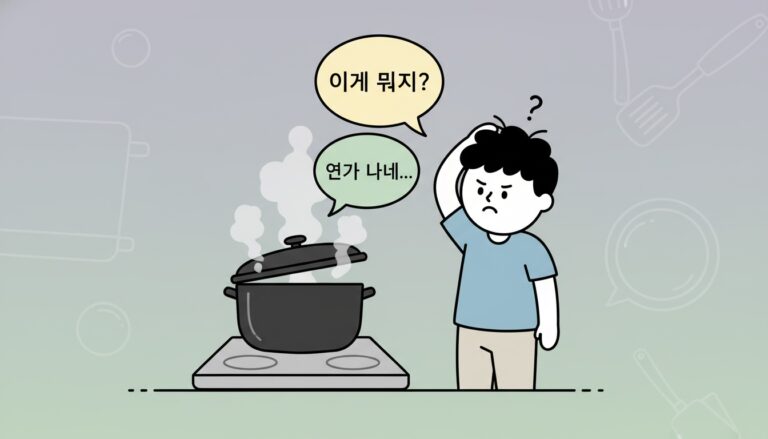
Help! I Burned the Kitchen! 😱 3 Korean Phrases for Cooking Disasters
Hello everyone, this is Daily Hangul! 😊
Have you ever tried to cook a fancy Korean meal to impress your friends, only to end up with a kitchen full of smoke? 🍳🔥
I still remember one of my students, Mark. He wanted to make Bulgogi for his Korean girlfriend’s birthday. He was so focused on chopping vegetables that he forgot the meat on the pan! When she arrived, instead of a romantic dinner, they had… well, charcoal.
Mark froze because he didn’t know how to explain what happened in Korean. He just pointed at the black pan and said, “Bulgogi… Black…”
Don’t be like Mark! Cooking fails happen to the best of us (even in K-Dramas!). Today, let’s learn how to handle these kitchen emergencies with wit and natural Korean expressions. Let’s dive in!
Today’s Core Expressions (Deep Dive)
1. 음식을 태웠어요 (Eumsigeul taewosseoyo)
Meaning: I burned the food.
- 음식 (Eumsik): Food
- 태웠어요 (Taewosseoyo): Burned (past tense)
[Tutor’s Secret Note 🤫]
If you just say “I cooked,” it’s boring. But if you say this with a sad face, Koreans will immediately sympathize with you! You can replace ‘음식’ with specific dishes.
* Ex: 고기를 태웠어요 (I burned the meat).
[Pronunciation Clinic 🗣️]
Be careful with 태 (Tae). It requires a strong burst of air (aspiration), like the ‘T’ in ‘Time’. Don’t say it softly like ‘Dae’, or people might get confused!
2. 완전 망했어요 (Wanjeon manghaesseoyo)
Meaning: I totally screwed up / It’s a total disaster.
- 완전 (Wanjeon): Totally / Completely
- 망했어요 (Manghaesseoyo): Ruined / Failed
[Tutor’s Secret Note 🤫]
This is super common slang! You’ll hear this in variety shows like Running Man all the time when a game goes wrong. It’s a funny, self-deprecating way to admit failure. It makes the atmosphere lighter instead of serious.
3. 탄 냄새 안 나요? (Tan naemsae an nayo?)
Meaning: Don’t you smell something burning?
[Tutor’s Secret Note 🤫]
Use this when you want to act innocent or when you genuinely smell danger! It’s the classic phrase used in K-Dramas right before the mom runs into the kitchen screaming.
Textbook vs. Real Korean (Context Comparison)
Here is how to sound like a local, not a robot.
📘 Book Korean (Too Stiff)
“요리에 실패했습니다.”
(Yorie silpae-haetseumnida)
Translation: I failed at cooking.
Why? This sounds like you are reporting a failed mission to a military general. Too serious!
📺 Real Korean (Natural)
“아… 다 태워 먹었어!”
(Ah… Da taewo meogeosseo!)
Translation: Ah… I burned it all up!
Why? Adding 먹다 (to eat) after 태우다 (to burn) doesn’t mean you actually ate the burnt food. It adds a nuance of “I did this action completely and to my own detriment.” This is top-tier native phrasing!
Real Life Scenario (Role Play)
📍 Situation: Jason is cooking Kimchi-jjigae for his Korean friend, Minji, at a shared guesthouse kitchen.
Minji: 킁킁… 어디서 탄 냄새 안 나요?
(Keung-keung… Eodiseo tan naemsae an nayo?)
(Sniff sniff… Don’t you smell something burning?)
Jason: 헉! 내 찌개! 완전 망했어요!
(Heok! Nae jjigae! Wanjeon manghaesseoyo!)
(Gasp! My stew! It’s totally ruined!)
Minji: 괜찮아요? 다 태웠어요?
(Gwaenchana-yo? Da taewosseoyo?)
(Are you okay? Did you burn it all?)
Jason: 네… 우리 그냥 배달 시킬까요?
(Ne… Uri geunyang baedal sikilkkayo?)
(Yes… Shall we just order delivery?)
[Daily Hangul’s Culture Tip 💡]
In Korea, when cooking fails, Delivery (Baedal) is the ultimate savior. Asking “Shall we order delivery?” is the most polite and sensible way to fix a ruined dinner situation. Nobody gets mad if chicken or Jjajangmyeon arrives instead of burnt stew!
FAQ – Frequently Asked Questions
Q1: Can I use “Hot” (뜨거워요) instead of “Burned” (태웠어요)?
No! This is a very common mistake.
* 뜨거워요 (Tteugeowoyo) means the temperature is high (Ouch, it’s hot!).
* 매워요 (Maewoyo) means the taste is spicy.
* 태웠어요 (Taewosseoyo) means it is physically burnt black.
Don’t say “The pizza is burned” if you just mean it’s hot!
Q2: Is “망했어요” (Manghaesseoyo) a bad word?
It’s not a swear word, but it is very casual. You can use it with friends or friendly tutors. However, do not use it in a formal business meeting with your boss (unless you want to get fired)! For formal situations, stick to “실수했습니다” (I made a mistake).
Summary & Today’s Mission
Cooking disasters are just opportunities to order fried chicken! 🍗 Don’t panic, just say “완전 망했어요” (It’s totally ruined) and laugh it off.
🚀 Today’s Mission:
Next time you watch a K-Drama or a Mukbang on YouTube, listen carefully! If the food looks bad or something goes wrong, try to catch if they say “망했다” or “태웠다”.
📝 Pop Quiz:
Which phrase should you use when you smell smoke in the kitchen?
A) 맛있어요 (Masisseoyo)
B) 탄 냄새가 나요 (Tan naemsae-ga nayo)
C) 배고파요 (Baegopayo)
(Scroll down for the answer!)
.
.
.
.
Answer: B) 탄 냄새가 나요!
Frequently Asked Questions (FAQ)
Q: What does "음식" mean in Korean and how do you pronounce it?
A: In Korean, "음식" is pronounced [Eumsik] and means: Food
Q: What does "태웠어요" mean in Korean and how do you pronounce it?
A: In Korean, "태웠어요" is pronounced [Taewosseoyo] and means: Burned (past tense)
Q: What does "태" mean in Korean and how do you pronounce it?
A: In Korean, "태" is pronounced [Tae] and means: . It requires a strong burst of air (aspiration), like the 'T' in 'Time'. Don't say it softly like 'Dae', or people might get confused!
Q: What does "완전" mean in Korean and how do you pronounce it?
A: In Korean, "완전" is pronounced [Wanjeon] and means: Totally / Completely







