

Introduction
Hello, everyone! Welcome back to Daily Hangul, your best friend for mastering Korean! 🌟
Have you ever watched a K-Drama where the protagonist confidently points out a mistake at a restaurant? It looks cool, right? But in real life, when we get the wrong order or find something strange in our food, we often hesitate because we don’t know what to say. 😅
Today, we are going to learn how to complain politely about unsatisfactory service or food in a restaurant. Don’t just eat the wrong food! Let’s learn to speak up like a local while keeping good manners. Ready to protect your consumer rights? Let’s go! 🚀
Key Expressions
Here are 4 essential phrases to handle restaurant mishaps smoothly.
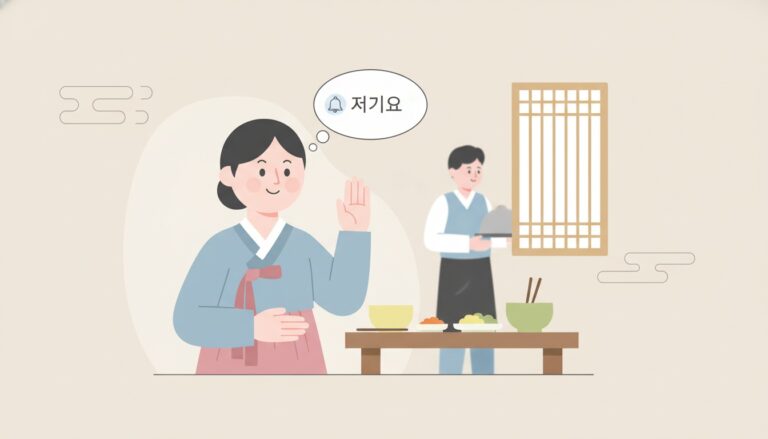
1. 여기요 / 저기요
- Pronunciation: [Yeogiyo] / [Jeogiyo]
- English Meaning: Excuse me (Over here)
- Detail: In many Western cultures, shouting for a waiter is rude. But in Korea, it is necessary! “여기요 (Yeogiyo)” literally means “Here,” calling attention to your table. You use this to summon the staff before making your complaint.
- 💡 Pronunciation Tip: Pronounce it with a rising intonation at the end to sound polite and friendly, not aggressive! 🎵
2. 이거 안 시켰는데요
- Pronunciation: [Igeo an sikyeonneundeyo]
- English Meaning: I didn’t order this.
- Detail: If the waiter brings you Kimchi-jjigae when you ordered Bibimbap, use this phrase! The ending “-는데요 (-neundeyo)” is magic; it softens the sentence, making it sound like “I didn’t order this… (so there must be a mistake),” rather than a blunt accusation.
- 💡 Pronunciation Tip: The double ‘ㅆ’ in 켰 (kyeot) sounds like a strong ‘t’ at the end. When followed by ‘는’, the sound changes slightly due to nasalization. Just remember to stress the “An” (not) clearly!
3. 머리카락이 나왔어요
- Pronunciation: [Meorikaragi nawasseoyo]
- English Meaning: There is a hair in the food.
- Detail: A classic hygiene complaint. “머리카락 (Meorikarak)” is hair, and “나왔어요 (nawasseoyo)” means “came out.” It’s a factual way to state the problem without getting angry.
- 💡 Pronunciation Tip: Linking sounds! 머리카락이 sounds like [Meo-ri-ka-ra-gi]. The ‘k’ sound moves to the next syllable.
4. 바꿔 주세요
- Pronunciation: [Bakkwo juseyo]
- English Meaning: Please change it / Please replace it.
- Detail: This is the solution you want. You can combine it with the previous phrases. For example, “There is a hair. Please change it.”
- 💡 Pronunciation Tip: 바꿔 (Bakkwo) has a ‘w’ sound. Make sure to round your lips! 👄
Real Conversation
Let’s see how this works in a real situation. You are at a busy BBQ restaurant in Seoul.
Guest (A): 저기요! 사장님?
[Jeogiyo! Sajangnim?]
(Excuse me! Boss/Manager?)
Staff (B): 네, 손님. 무엇을 도와드릴까요?
[Ne, sonnim. Mueoseul dowadeurilkkayo?]
(Yes, customer. How can I help you?)
Guest (A): 죄송한데, 이거 안 시켰는데요. 저희는 삼겹살 시켰어요.
[Joesonghande, igeo an sikyeonneundeyo. Jeohuineun samgyeopsal sikyeosseoyo.]
(I’m sorry, but we didn’t order this. We ordered Samgyeopsal.)
Staff (B): 아, 정말 죄송합니다. 금방 바꿔 드릴게요.
[A, jeongmal joesonghamnida. Geumbang bakkwo deurilgeyo.]
(Ah, I am really sorry. I will change it for you right away.)
Culture Tip 🇰🇷
“The Ding-Dong Bell”
Did you know? Many Korean restaurants have a Call Bell (호출 벨) on the table. You don’t always have to shout “Yeogiyo!” If you see a button, press it! It will make a “Ding-Dong” sound, and the server will come to you immediately. It’s not rude; it’s efficient! Also, when complaining, starting with “죄송한데…” (I’m sorry, but…) even though it’s not your fault, makes you sound extremely sophisticated and polite. It’s the Korean way of keeping harmony! 🕊️
Conclusion & Quiz
Great job! Now you don’t have to suffer in silence if your order is wrong. You can protect your dining happiness! 🥰
📝 Mini Quiz
- Fill in the blank: “Excuse me, I didn’t order this.” -> “저기요, 이거 ___ 시켰는데요.”
- True or False: In Korea, shouting “Yeogiyo!” to call a waiter is considered very rude.
Answers:
1. 안 (an)
2. False (It is normal and necessary if there is no bell!)
See you next time with more useful Korean! Annyeong! 👋
Frequently Asked Questions (FAQ)
Q: What does "여기요 / 저기요" mean in Korean and how do you pronounce it?
A: In Korean, "여기요 / 저기요" is pronounced [Yeogiyo] and means: Excuse me (Over here)
Q: What does "이거 안 시켰는데요" mean in Korean and how do you pronounce it?
A: In Korean, "이거 안 시켰는데요" is pronounced [Igeo an sikyeonneundeyo] and means: I didn't order this.
Q: What does "머리카락이 나왔어요" mean in Korean and how do you pronounce it?
A: In Korean, "머리카락이 나왔어요" is pronounced [Meorikaragi nawasseoyo] and means: There is a hair in the food.
Q: What does "바꿔 주세요" mean in Korean and how do you pronounce it?
A: In Korean, "바꿔 주세요" is pronounced [Bakkwo juseyo] and means: Please change it / Please replace it.







