

Hello everyone! This is Daily Hangul (DailyHangul.com), here to upgrade your Korean skills! 👋✨
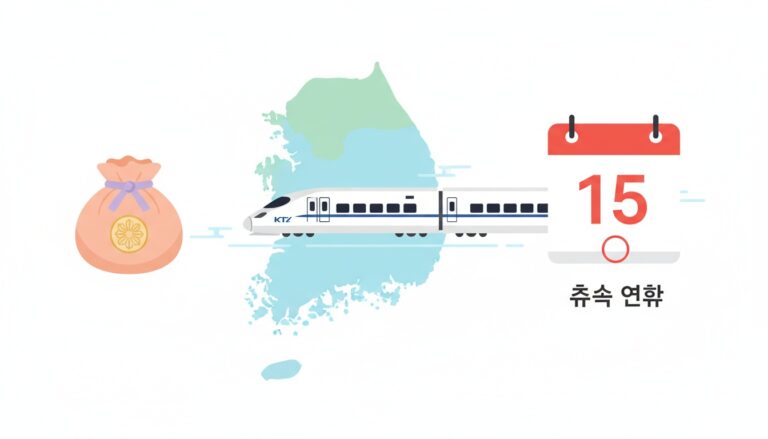
Are you ready for the holidays? In Korea, major holidays like Seollal (Lunar New Year) and Chuseok (Korean Thanksgiving) are huge events! If you watch K-Dramas like Reply 1988, you’ve probably seen families gathering, making tons of food, and wearing Hanbok. 🎎
But what if a Korean friend asks you about your plans? Or what if you want to ask them? Today, we will learn how to ask and answer questions about holiday plans. Let’s get started! 🚀
📚 Core Expressions
Here are 4 essential phrases to survive the holiday season in Korea!
1. 명절에 뭐 해요?
- Pronunciation: [Myeongjeol-e mwo haeyo?]
- Meaning: What are you doing during the holiday?
- Explanation:
- 명절 (Myeongjeol) means “traditional holiday.”
- 뭐 해요? (Mwo haeyo?) means “What are you doing?”
- Use this to start a conversation about plans!
- 💡 Pronunciation Tip:
When you say 명절에, the ‘L’ sound at the bottom of 절 (jeol) moves over to the next circle ‘ㅇ’. So it sounds more like [Myeong-jeo-re]. Smooth, right?
2. 고향에 내려가요.
- Pronunciation: [Gohyang-e naeryeogayo.]
- Meaning: I am going down to my hometown.
- Explanation:
- 고향 (Gohyang) is “hometown.”
- Koreans often say “going down (내려가요)” because many people live in Seoul (up north) and travel south to visit family.
- 💡 Pronunciation Tip:
Pronounce 고향 (Gohyang) clearly. Sometimes the ‘h’ is soft, but here it helps to emphasize it slightly to be understood clearly.
3. 집에서 푹 쉴 거예요.
- Pronunciation: [Jib-eseo puk swil geoyeyo.]
- Meaning: I’m going to get some good rest at home.
- Explanation:
- 푹 (Puk) is an adverb meaning “deeply” or “completely” (often used with resting or sleeping).
- 쉴 거예요 (Swil geoyeyo) is the future tense of “to rest.”
- Perfect for when you have no travel plans! 🏠
4. 즐거운 명절 보내세요!
- Pronunciation: [Jeulgeoun myeongjeol bonaeseyo!]
- Meaning: Have a happy holiday!
- Explanation:
- This is the standard greeting you can say to anyone—friends, coworkers, or teachers—before the holiday break begins.
- 💡 Pronunciation Tip:
즐거운 (Jeulgeoun) starts with a ‘J’ sound. Make sure not to say ‘Z’. It is a soft ‘J’ like in ‘Juice’.
🗣️ Real Dialogue
Let’s see how Min-su and Anna talk about their upcoming holiday plans.
Min-su: 안나 씨, 이번 명절에 뭐 해요?
(Anna, what are you doing this holiday?)
[Anna ssi, ibeon myeongjeol-e mwo haeyo?]
Anna: 저는 고향에 내려가요. 민수 씨는요?
(I am going down to my hometown. How about you, Min-su?)
[Jeoneun gohyang-e naeryeogayo. Minsu ssi-neun-yo?]
Min-su: 저는 그냥 집에서 푹 쉴 거예요. 넷플릭스 볼 거예요!
(I’m just going to rest well at home. I’m going to watch Netflix!)
[Jeoneun geunyang jib-eseo puk swil geoyeyo. Netpeullikseu bol geoyeyo!]
Anna: 와, 좋겠어요. 즐거운 명절 보내세요!
(Wow, that sounds good. Have a happy holiday!)
[Wa, jokesseoyo. Jeulgeoun myeongjeol bonaeseyo!]
🇰🇷 Culture Tip: The Great Migration (Minjok Daeyidong)
Did you know that getting a train ticket for Chuseok or Seollal is harder than buying tickets for a K-Pop concert? 🎫😱
We call this massive movement of people returning to their hometowns “Minjok Daeyidong” (The Great National Migration). Highways become huge parking lots, and KTX tickets sell out in seconds! If you hear a Korean friend say they are “going to their hometown,” wish them luck with the traffic! 🚗🚙
📝 Wrap-up & Quiz
Today we learned how to ask about holiday plans and wish someone a happy holiday. Don’t be shy to use these phrases this season!
Mini Quiz! (Fill in the blanks)
- “I am going to my hometown.”
= ________에 내려가요. (Hint: Place where you were born/family lives) -
“Have a happy holiday!”
= ________ 명절 보내세요! (Hint: Joyful/Happy) -
(O/X Quiz) “Puk (푹)” means to do something slightly or little.
(Answer: O / X)
Answers:
1. 고향 (Gohyang)
2. 즐거운 (Jeulgeoun)
3. X (It means deeply/completely!)
See you next time! 안녕! 👋
Frequently Asked Questions (FAQ)
Q: What does "명절에 뭐 해요?" mean in Korean and how do you pronounce it?
A: In Korean, "명절에 뭐 해요?" is pronounced [Myeongjeol-e mwo haeyo?] and means: What are you doing during the holiday?
Q: What does "고향에 내려가요." mean in Korean and how do you pronounce it?
A: In Korean, "고향에 내려가요." is pronounced [Gohyang-e naeryeogayo.] and means: I am going down to my hometown.
Q: What does "집에서 푹 쉴 거예요." mean in Korean and how do you pronounce it?
A: In Korean, "집에서 푹 쉴 거예요." is pronounced [Jib-eseo puk swil geoyeyo.] and means: I'm going to get some good rest at home.
Q: What does "즐거운 명절 보내세요!" mean in Korean and how do you pronounce it?
A: In Korean, "즐거운 명절 보내세요!" is pronounced [Jeulgeoun myeongjeol bonaeseyo!] and means: Have a happy holiday!







