

Introduction
Hello everyone! This is Daily Hangul, here to upgrade your Korean skills! 🌟
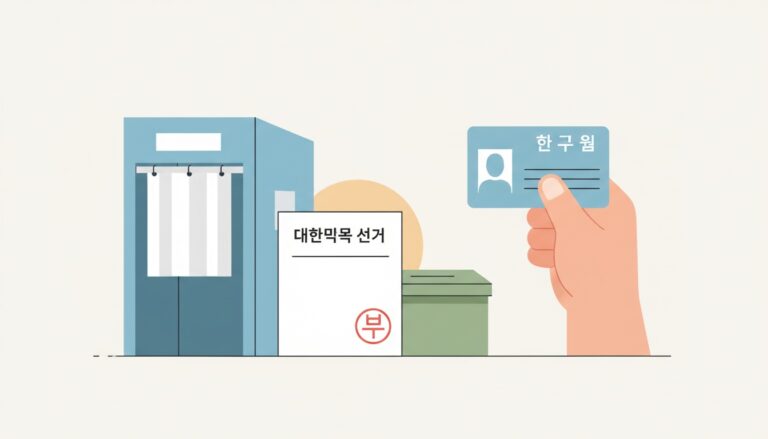
Have you ever watched political K-dramas like Queenmaker or Designated Survivor: 60 Days? You often see characters rushing to vote or talking about elections with passion! 🗳️
Today, we are going to learn how to talk about the Election Process and Voting in Korean. Even if you are a beginner, knowing these words will help you understand the news and dramas much better. Plus, democracy is all about participation, right? Let’s dive into the world of K-Democracy! Let’s go! (Gaja!) 🏃♂️💨
Core Expressions
Here are 3 essential expressions for election day!
1. 투표하다 (To vote)
- Pronunciation: [Tupyo-hada]
- Meaning: To vote
- Detail: This is the most basic and important verb. ‘Tu’ (투) implies throwing or casting, and ‘Pyo’ (표) means a ticket or ballot.
- 💡 Pronunciation Tip: The ‘Pyo’ sound has a ‘y’ sound in it. Try to say it quickly like “P-yo”.
2. 신분증 (ID Card)
- Pronunciation: [Sinbunjeung]
- Meaning: ID Card / Identification
- Detail: You cannot vote without this! In Korea, this usually refers to a Resident Registration Card, Driver’s License, or Passport. You will hear this word often at banks or airports too.
- 💡 Pronunciation Tip: The last syllable ‘Jeung’ (증) ends with a soft ‘ng’ sound, like the end of the English word “Sing“.
3. 도장을 찍다 (To stamp)
- Pronunciation: [Dojang-eul jjikda]
- Meaning: To stamp (the ballot)
- Detail: In many countries, you might write an ‘X’ or check a box. In Korea, we use a red stamp tool to mark our choice on the ballot paper!
- 💡 Pronunciation Tip: The ‘jj’ in ‘jjikda’ (찍다) is a Tensed Sound. You need to tense your throat and make a strong, sharp ‘J’ sound. It sounds much stronger than the English ‘J’.
Real Conversation
Let’s see how Min-su and Sarah talk about the upcoming election day!
Min-su: 내일 선거일이야. 투표할 거야?
(Naeil seong-geoil-iya. Tupyo-hal geoya?)
[Tomorrow is election day. Are you going to vote?]
Sarah: 응! 당연하지. 신분증 필요해?
(Eung! Dang-yeonhaji. Sinbunjeung piryohae?)
[Yeah! Of course. Do I need an ID card?]
Min-su: 응, 꼭 가져가. 가서 도장을 잘 찍어!
(Eung, kkok gajyeoga. Gaseo dojang-eul jal jjigeo!)
[Yes, make sure to bring it. Go and stamp it carefully!]
Culture Tip: The “Proof Shot” (인증샷)
Did you know that voting is also a trend on social media in Korea? 📸
After voting, many Koreans stamp the red voting mark (which looks like the character 卜) on the back of their hand and take a photo outside the polling station. This is called a “Voting Proof Shot” (Tupyo Injeung-shot).
People post these on Instagram to encourage their friends to vote too! If you see a red mark on your favorite K-pop idol’s hand, now you know what it means! 😎
Conclusion & Quiz
Great job today! You are now ready to discuss democracy in Korean. Next time you see an election scene in a drama, listen for “Tupyo” (Vote)! 🎧
📝 Mini Quiz
- What is the Korean verb for “To vote”?
- (True/False) In Korea, you usually use a pen to write your name on the ballot.
- Fill in the blank: To identify yourself, you must bring your _____ (Sinbunjeung).
Answer Key:
1. 투표하다 (Tupyo-hada)
2. False (We use a stamp/Dojang!)
3. 신분증 (ID Card)
Frequently Asked Questions (FAQ)
Q: What does "투표하다 (To vote)" mean in Korean and how do you pronounce it?
A: In Korean, "투표하다 (To vote)" is pronounced [Tupyo-hada] and means: To vote
Q: What does "신분증 (ID Card)" mean in Korean and how do you pronounce it?
A: In Korean, "신분증 (ID Card)" is pronounced [Sinbunjeung] and means: ID Card / Identification
Q: What does "도장을 찍다 (To stamp)" mean in Korean and how do you pronounce it?
A: In Korean, "도장을 찍다 (To stamp)" is pronounced [Dojang-eul jjikda] and means: To stamp (the ballot)







